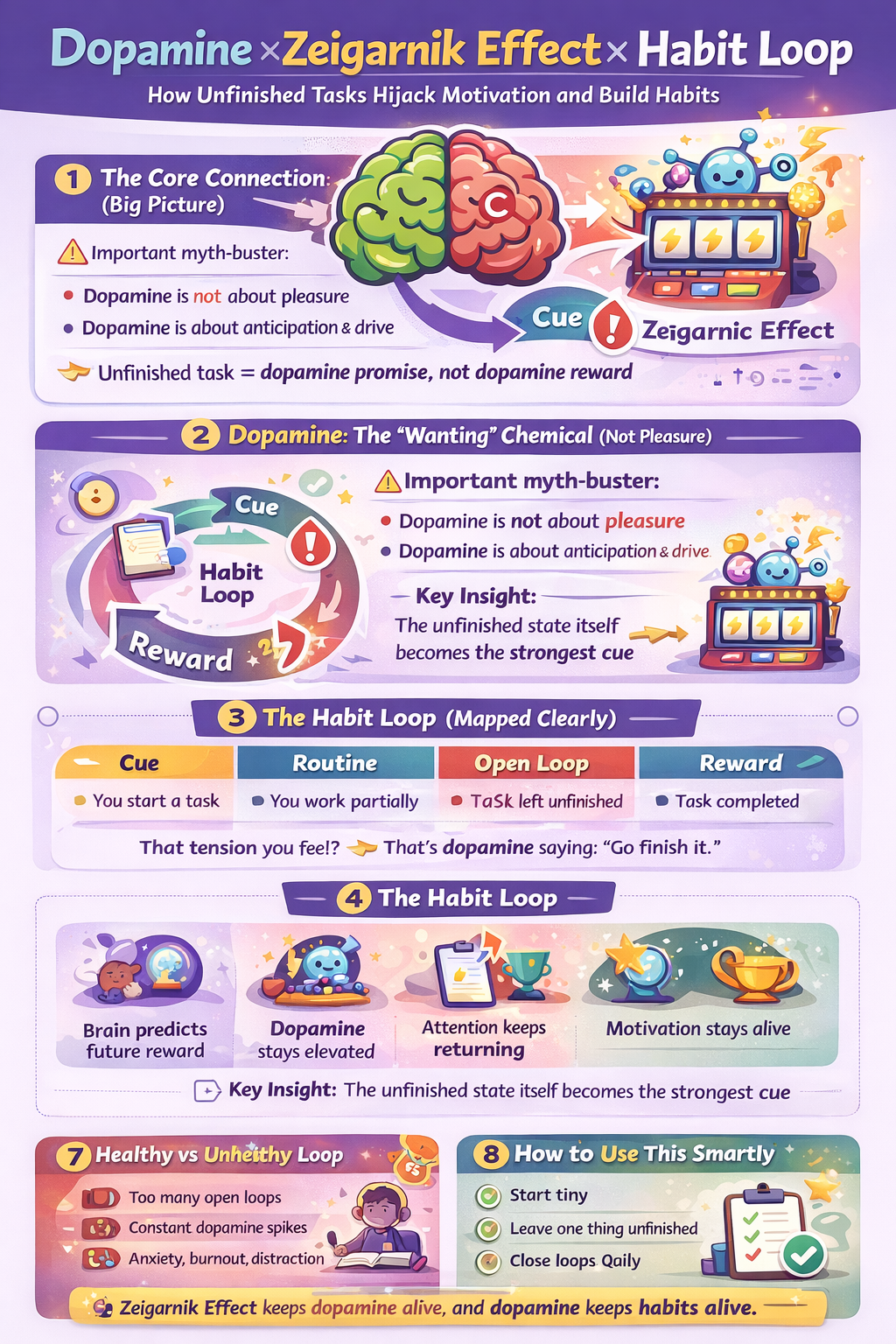
Think of the brain as a reward-prediction machine 🎰
Zeigarnik Effect → creates an open mental loop
Dopamine → fuels motivation to close that loop
Habit Formation → happens when this loop repeats regularly
👉 Unfinished task = dopamine promise, not dopamine reward
⚠️ Important myth-buster:
Dopamine is not about pleasure
Dopamine is about anticipation & drive
Task starts → 🧠 Dopamine rises
Task unfinished → ⚡ Dopamine stays active
Task completed → 😌 Dopamine drops (closure)
That tension you feel?
👉 That’s dopamine saying: “Go finish it.”
Cue → Routine → Reward
Now map Zeigarnik Effect into it 👇
| Habit Element | What Happens |
|---|---|
| 🟡 Cue | You start a task |
| 🔵 Routine | You work partially |
| 🔴 Open Loop | Task left unfinished |
| ⚡ Dopamine Spike | Brain expects completion |
| 🟢 Reward | Task completed → relief |
📌 Key Insight:
The unfinished state itself becomes the strongest cue
Brain predicts future reward
Dopamine stays elevated
Attention keeps returning
Motivation stays alive
This is why:
📱 You keep opening the same app
📚 You want to finish a half-read book
🎬 Cliffhangers hook you instantly
👉 Incomplete = irresistible
Small Start + Open Loop + Repeated Closure = Habit
Start reading for 5 minutes
Stop mid-topic (Zeigarnik)
Brain stays engaged (dopamine)
You return naturally
Repeat daily → 📈 Habit formed
Platforms exploit this loop perfectly:
Infinite scroll ❌ no closure
“Next episode auto-play”
Notifications left unread
Progress bars at 90%
🧠 Dopamine never fully drops
🔁 Habit becomes compulsive
Too many open loops
Constant dopamine spikes
Anxiety, burnout, distraction
Intentional open loop
Planned closure
Dopamine resets
Sustainable habits
Stop at curiosity points
Never finish at “easy closure”
Resume next day naturally
Start tiny
Leave one thing unfinished
Close loops daily
Tease next idea
Create episodic content
Use cliffhangers ethically
Zeigarnik Effect keeps dopamine alive, and dopamine keeps habits alive.
Unfinished tasks maintain dopamine-driven motivation, and when this loop repeats, it naturally forms habits.
Start Task
👉 Unfinished = anticipation
👉 Finished = reward
❌ Common Myth: Dopamine = pleasure
✅ Reality: Dopamine = motivation + anticipation
Before completion → “I need to finish this”
At completion → “Yes! I did it”
The Zeigarnik Effect fuels the first peak.
When you leave a task incomplete:
🧠 Brain marks it as important
🔔 Dopamine system stays activated
📌 Task stays in working memory
This creates:
⚡ Cognitive tension
⚡ Mental pull
⚡ Repeated recall
👉 Your brain is saying:
“Finish it to get the reward.”
| Habit Stage | Brain Action | Role of Zeigarnik |
|---|---|---|
| Cue | Task reminder | Open loop triggers recall |
| Craving | Dopamine anticipation | Zeigarnik amplifies craving |
| Response | Action | You resume task |
| Reward | Dopamine release | Completion gives relief |
🧠 Repeated loops = strong habit wiring
When you:
Start reading 📖
Write 2 lines ✍️
Code 5 minutes 💻
You create:
🔓 An open loop
🔔 Dopamine anticipation
Even after stopping, your brain keeps nudging you back.
👉 This is why motivation often comes AFTER starting, not before.
| Mechanism | Brain Effect | |||
|---|---|---|---|---|
| Cliffhanger | Dopamine spike without closure | |||
| “Part 2 soon” | Prolonged anticipation | |||
| Unfinished story | Zeigarnik loop stays open |
📱 Platforms weaponize this to build consumption habits.
Too many open loops =
🔥 Dopamine fatigue
😵 Overthinking
😰 Anxiety
🧠 Decision paralysis
🛑 Brain stays in anticipation mode, not reward mode.
Stop study sessions mid-topic
Resume easily next time
Start → pause → resume later
Close loops daily
Create intentional cliffhangers
But always deliver closure later
“Dopamine opens the loop, Zeigarnik keeps it open, and completion closes the habit.”
The Zeigarnik Effect keeps tasks active in working memory, while dopamine sustains motivation through anticipation and reward—together they drive habit formation.
 Continue With Google
  Health

