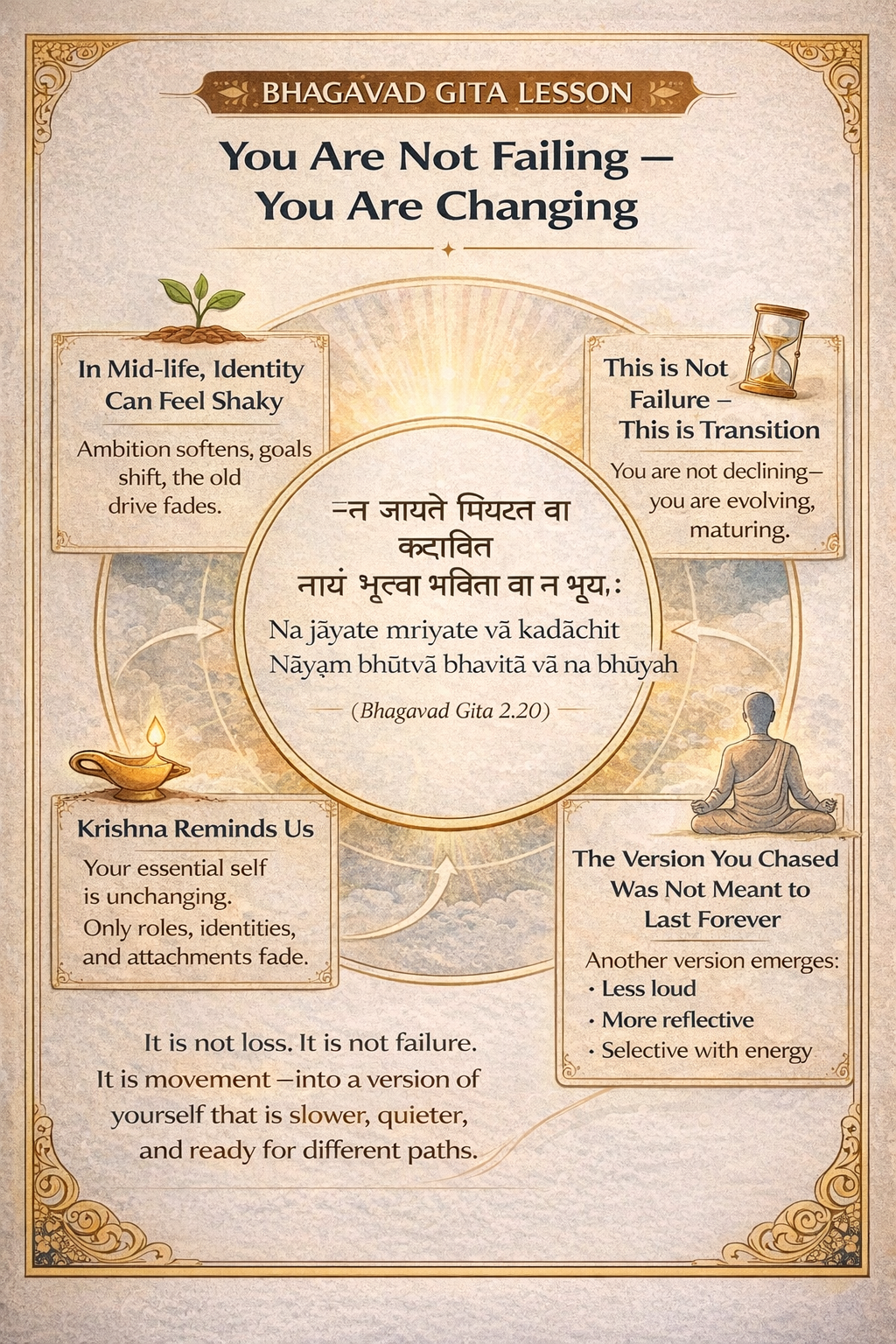
न जायते म्रियते वा कदाचित्
नायं भूत्वा भविता वा न भूयः ।
Transliteration:
Na jāyate mriyate vā kadāchit
Nāyaṁ bhūtvā bhavitā vā na bhūyaḥ
The self is never born, and it never dies.
It does not suddenly come into existence, nor does it disappear.
What changes is not who you are —
but the form, phase, and role you are currently living.
Mid-life often comes with a quiet, unsettling feeling:
“I don’t feel like the person I used to be.”
Ambition softens.
Certainty fades.
Old goals stop motivating you the same way.
This can feel like failure — but the Gita frames it differently.
It says: you are not declining, you are transitioning.
Krishna is not talking only about physical death here.
He is also pointing to psychological and identity shifts.
The version of you that chased, proved, and competed
was never meant to last forever.
Another version is emerging:
Less loud
More reflective
More selective about where energy goes
This is not loss.
This is movement.
You care less about titles, more about peace
You question paths that once felt obvious
You feel uncomfortable, but not lost
Discomfort is not always a sign to go back.
Sometimes it means you are between versions of yourself.
Change feels frightening only when we mistake it for failure.
The Gita reminds us:
What is essential does not disappear.
Only roles, identities, and attachments do.
You are not behind.
You are not broken.
You are becoming someone new — slowly, quietly, honestly.
And that process does not need justification.
 Continue With Google
  Quotes
 Yoga
Yoga