Introduction
Many people assume seasons happen because Earth moves closer to or farther from the Sun. This is incorrect. Seasons are primarily caused by Earth’s axial tilt.
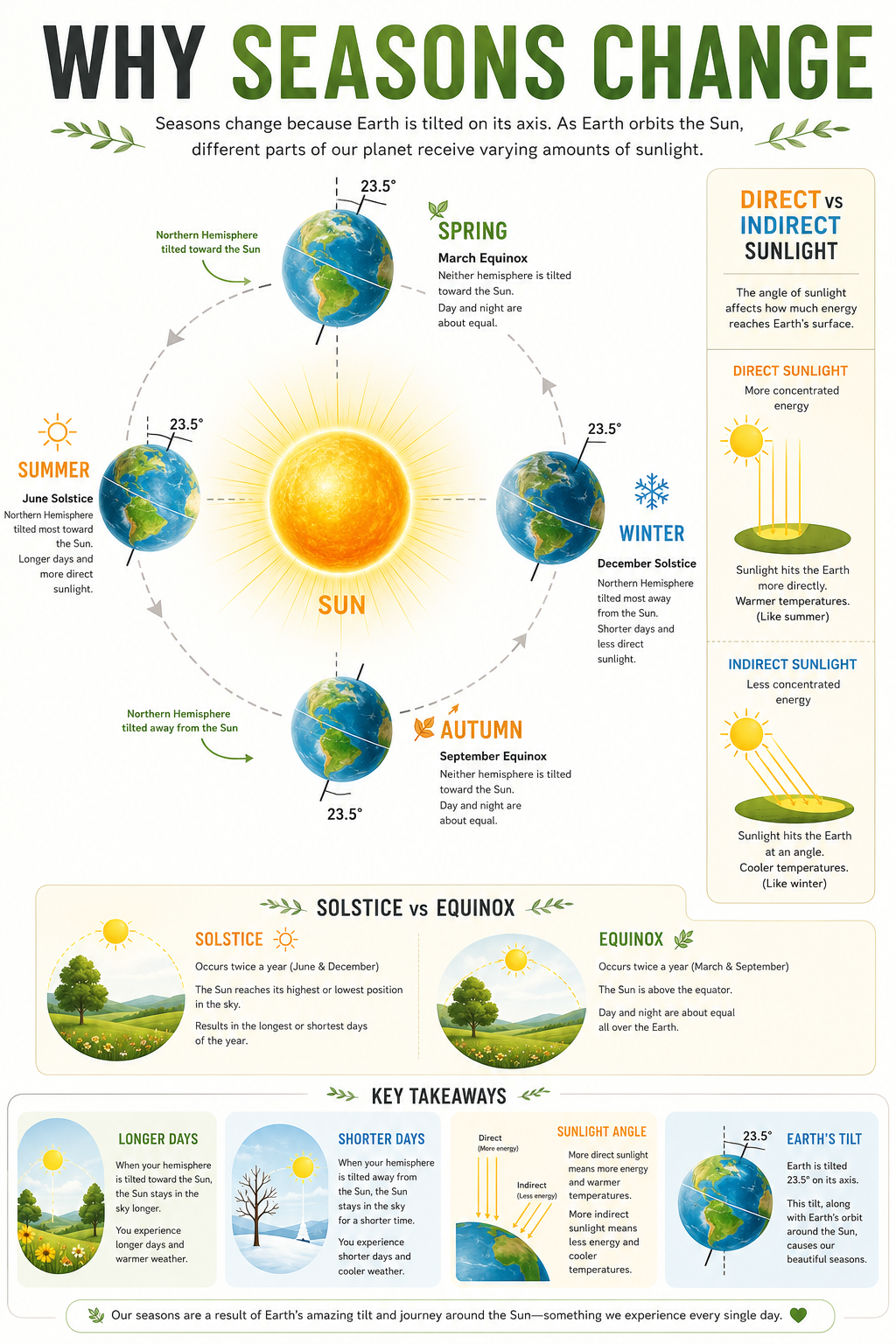
Earth is tilted at approximately 23.5 degrees as it orbits the Sun. This tilt changes how sunlight reaches different parts of the planet throughout the year.
1. Earth’s Tilt
Earth rotates on an imaginary axis.
That axis is tilted rather than perfectly straight.
As Earth moves around the Sun, this tilt remains relatively constant in direction.
Because of this, different hemispheres receive different amounts of sunlight during different times of the year.
2. Direct vs Indirect Sunlight
When a hemisphere is tilted toward the Sun:
- It receives more direct sunlight
- Days become longer
- Temperatures are generally warmer
This creates summer.
When a hemisphere is tilted away from the Sun:
- It receives less direct sunlight
- Days become shorter
- Temperatures are generally cooler
This creates winter.
3. Equinoxes
Equinoxes happen when neither hemisphere is tilted strongly toward or away from the Sun.
Day and night are nearly equal in length.
These mark:
- Spring Equinox
- Autumn Equinox
4. Solstices
Solstices happen when one hemisphere is tilted most directly toward or away from the Sun.
These mark:
- Summer Solstice (longest day)
- Winter Solstice (shortest day)
5. Opposite Seasons
When it is summer in the Northern Hemisphere, it is winter in the Southern Hemisphere.
This happens because both hemispheres receive sunlight differently at the same time.
Important Idea
Seasons are caused by Earth’s tilt changing sunlight distribution—not by Earth being significantly closer to the Sun.
It is a result of planetary geometry and the angle of sunlight.
 Continue With Google
  Science
 Education