Michael Porter
It helps businesses understand:
How Competitive Is An Industry?
          ↓
How Easy Is It To Make Profit?
Imagine you open a restaurant.
Before starting, you need to know:
How Many Competitors Exist?
Can New Restaurants Open Easily?
Can Customers Switch Easily?
Can Suppliers Increase Prices?
Are Alternative Food Options Available?
These factors determine whether your restaurant can earn good profits.
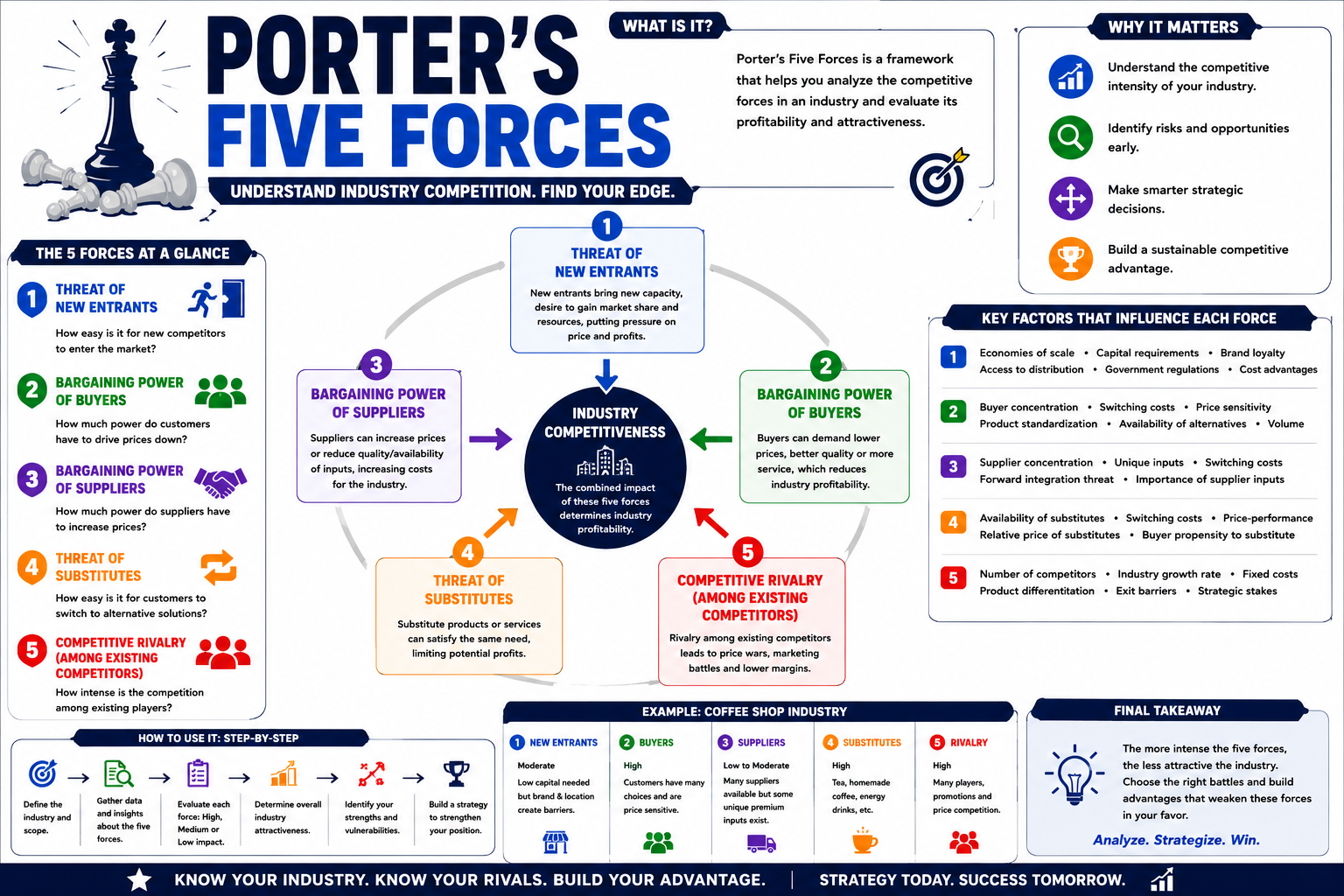
Porter's Five Forces helps answer:
"Why are some industries highly profitable while others struggle to make money?"
Example:
Luxury Software Industry
        ↓
Often High Profit
Airline Industry
        ↓
Often Low Profit
The difference comes from industry forces.
                 NEW ENTRANTS
                       ▲
                       │

SUPPLIERS ◄── INDUSTRY ──► BUYERS

                       │
                       ▼

                  SUBSTITUTES

                       ▲
                       │

             COMPETITIVE RIVALRY
Together these forces determine:
Industry Attractiveness
          ↓
Profit Potential
Competition among existing businesses.
How intense is the competition?
High Rivalry:
Restaurants
Airlines
E-commerce
Hotels
Low Rivalry:
Specialized Medical Equipment
Rare Industrial Technology
Many Competitors
        ↓
Price Wars
        ↓
Lower Profits
Few Competitors
        ↓
Less Price Pressure
        ↓
Higher Profits
Many Competitors
Slow Market Growth
Price Discounts
Heavy Advertising
Low Product Differentiation
More Competition
       ↓
Lower Prices
       ↓
Lower Margins
       ↓
Lower Profitability
Risk of new companies entering the market.
How easy is it for new competitors to enter?
Opening a small café:
Low Capital Needed
         ↓
Easy Entry
         ↓
Many New Competitors
Building aircraft:
Massive Capital Needed
         ↓
Hard Entry
         ↓
Few New Competitors
Factors that prevent new competitors.
Examples:
Large Investment Required
Strong Brand Loyalty
Government Regulations
Patents
Technology Requirements
Distribution Networks
Easy To Start
      ↓
Many New Competitors
      ↓
Lower Profit
Hard To Start
      ↓
Few New Competitors
      ↓
Higher Profit
The ability of customers to influence prices.
How much power do customers have?
Imagine:
100 Restaurants
Customers can easily switch.
Therefore:
Buyer Power High
Another example:
Only One Supplier
For Specialized Service
Buyer power becomes low.
Many Choices
      ↓
Customers Demand Discounts
      ↓
Lower Profits
Few Alternatives
      ↓
Customers Accept Pricing
      ↓
Higher Profits
Many Alternatives
Low Switching Cost
Price Sensitivity
Large Customers
Standardized Products
More Buyer Power
        ↓
More Negotiation
        ↓
Lower Prices
        ↓
Lower Profit
The ability of suppliers to increase prices or reduce flexibility.
How much power do suppliers have?
Coffee Shop
If:
100 Coffee Bean Suppliers
Supplier power is low.
If:
Only 1 Premium Supplier
Supplier power becomes high.
Few Suppliers
       ↓
Higher Prices
       ↓
Higher Costs
       ↓
Lower Profit
Many Suppliers
       ↓
Competitive Pricing
       ↓
Lower Costs
       ↓
Higher Profit
Limited Suppliers
Unique Products
High Switching Costs
Supplier Brand Strength
Supplier Power
      ↓
Higher Costs
      ↓
Reduced Margin
Risk that customers use another solution instead of yours.
Can customers solve the problem differently?
Movie Theater
Substitutes:
Streaming Services
Gaming
Social Media
Sports
Coffee Shop
Substitutes:
Tea
Energy Drinks
Homemade Coffee
Many Alternatives
      ↓
Customers Switch Easily
      ↓
Profit Pressure
Few Alternatives
      ↓
Customer Loyalty
      ↓
Better Profitability
Low Switching Cost
Cheaper Alternatives
Convenient Alternatives
Better Technology
More Alternatives
        ↓
Customer Switching
        ↓
Revenue Pressure
                  NEW ENTRANTS
                        ▲
                        │
         Can New Competitors Enter?
                        │

SUPPLIERS ◄──────── INDUSTRY ────────► BUYERS

 Can Suppliers      Competition      Can Customers
 Raise Prices?      Intensity        Demand Discounts?

                        │
                        ▼

                   SUBSTITUTES

           Alternative Solutions
Many Learning Platforms
Result:
High Rivalry
Technology Available
Result:
Moderate Entry Barrier
Students Have Many Choices
Result:
High Buyer Power
Many Content Creators
Result:
Low Supplier Power
Books
YouTube
Communities
Mentorship
Result:
High Substitute Threat
After evaluating all forces:
Low Rivalry
Low Buyer Power
Low Supplier Power
Low Substitute Threat
High Entry Barriers
Usually profitable.
High Rivalry
High Buyer Power
High Supplier Power
High Substitute Threat
Low Entry Barriers
Usually difficult to earn strong profits.
You can score each force.
| Force | Low | Medium | High |
|---|---|---|---|
| Rivalry | ✓ | ||
| New Entrants | ✓ | ||
| Buyer Power | ✓ | ||
| Supplier Power | ✓ | ||
| Substitutes | ✓ |
This provides a quick industry assessment.
Before:
Starting Business
Launching Product
Entering Market
Making Investment
Expanding Industry
Businesses analyze these forces.
Differentiate Product
Build Brand
Improve Customer Experience
Create Unique Value
Increase Switching Costs
Build Loyalty
Find Alternative Suppliers
Negotiate Long-Term Contracts
Diversify Supply Sources
Innovate Faster
Increase Value
Improve Convenience
Strengthen Brand
Build Network Effects
Improve Technology
Only Looking at Competitors
Porter's model is much broader.
Competition
Suppliers
Customers
Substitutes
Entrants
all matter.
Ignoring Substitute Products
Many businesses fail because of substitutes.
Treating Analysis as One-Time Activity
Markets change continuously.
Confusing Industry Growth with Profitability
Growing Industry
does not always mean:
Profitable Industry
Choose Industry
       ↓
Analyze Rivalry
       ↓
Analyze New Entrants
       ↓
Analyze Buyer Power
       ↓
Analyze Supplier Power
       ↓
Analyze Substitutes
       ↓
Evaluate Profit Potential
       ↓
Create Strategy
STEP 1
Identify Industry
         ↓
STEP 2
Analyze Existing Competitors
         ↓
STEP 3
Evaluate New Entry Risk
         ↓
STEP 4
Assess Customer Power
         ↓
STEP 5
Assess Supplier Power
         ↓
STEP 6
Identify Substitute Solutions
         ↓
STEP 7
Score Each Force
         ↓
STEP 8
Develop Strategy
Porter's Five Forces is not a tool for analyzing your company.
It is a tool for analyzing:
The Industry Around Your Company
The framework helps answer:
How Competitive Is This Industry?
How Easy Is It To Earn Profit?
What Risks Exist?
Where Should We Focus Strategically?
The essence of Porter's Five Forces is:
Competitive Rivalry
        +
Threat of New Entrants
        +
Buyer Power
        +
Supplier Power
        +
Threat of Substitutes
        ↓
Industry Profitability
The stronger these forces become, the harder it is to earn sustainable profits. The weaker these forces become, the more attractive and profitable the industry tends to be.
 Continue With Google
  Economics
 Business

