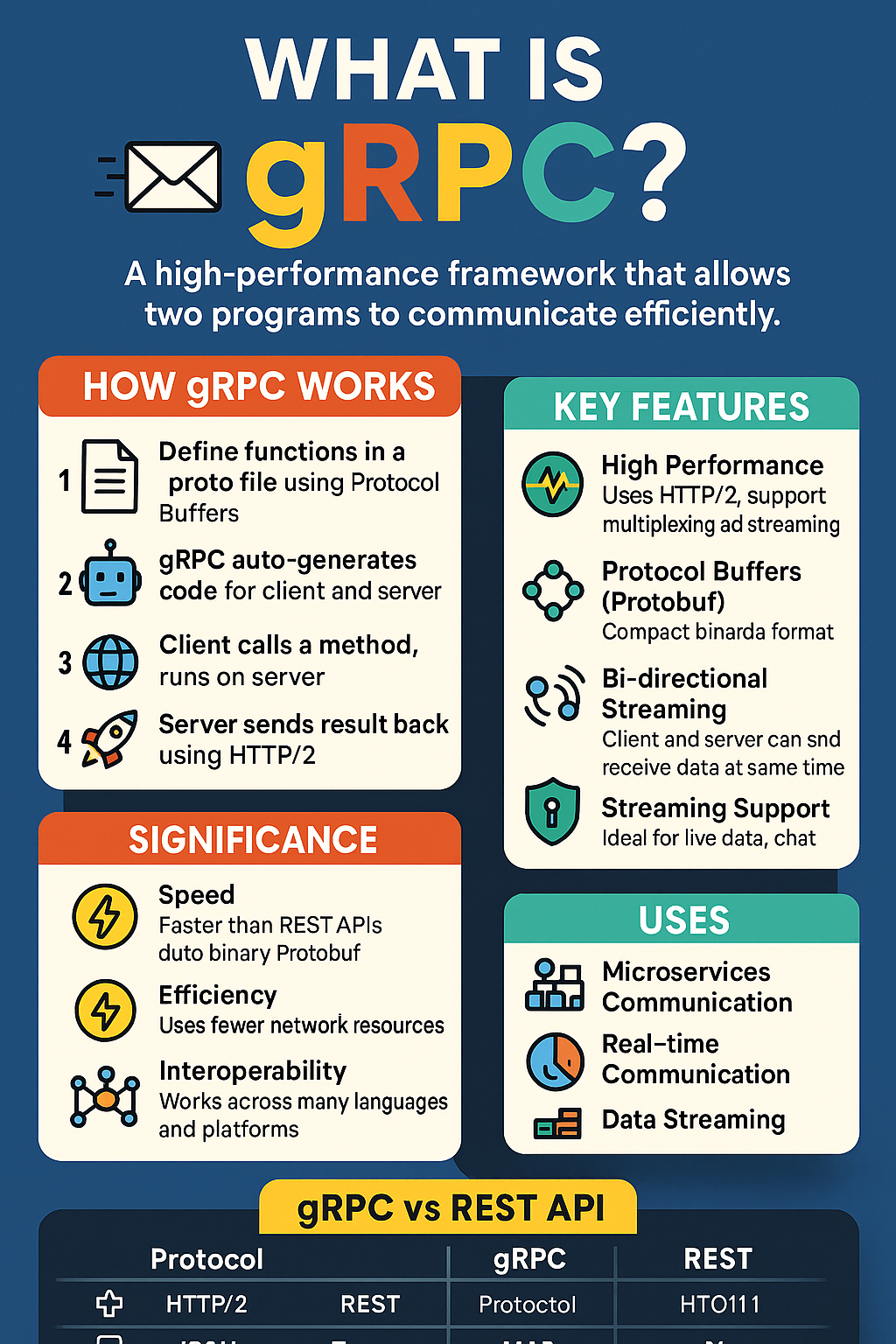
🧩 gRPC (Google Remote Procedure Call) is a high-performance framework that allows two programs (clients & servers) to communicate with each other efficiently — even if they’re written in different languages or running on different machines.
Think of it as:
📨 A super-fast courier that delivers messages between applications 🚀
👉 gRPC = Google Remote Procedure Call
It was developed by Google and is now an open-source project under the Cloud Native Computing Foundation (CNCF) — the same foundation behind Kubernetes 🧠.
When one program wants another program to do something, it can use Remote Procedure Calls (RPCs) — like saying:
“Hey server, run this function for me and send me the result!”
With gRPC, this communication is:
Fast ⚡
Secure 🔒
Language-independent 🌐
Efficient 🧠
| Step | What Happens | Emoji |
|---|---|---|
| 1️⃣ | You define your functions (methods) in a .proto file using Protocol Buffers |
📄 |
| 2️⃣ | gRPC auto-generates code for client and server in your favorite languages (Python, Java, Go, etc.) | 🤖 |
| 3️⃣ | The client calls a method like it’s local — but it actually runs on the server | 🌐 |
| 4️⃣ | The server sends the result back efficiently using HTTP/2 | 🚀 |
| Feature | Description | Emoji |
|---|---|---|
| 💨 High Performance | Uses HTTP/2, supports multiplexing and streaming | ⚡ |
| 🧠 Protocol Buffers (Protobuf) | Compact binary data format — smaller & faster than JSON | 📦 |
| 🔄 Bi-directional Streaming | Both client and server can send/receive data simultaneously | 🔁 |
| 🌐 Cross-language Support | Works with over 10+ programming languages | 🌍 |
| 🔒 Built-in Security | TLS encryption for secure data transfer | 🛡️ |
| 🧩 Code Generation | Auto-generates boilerplate for both client & server | 🤖 |
| Reason | Explanation | Example |
|---|---|---|
| 🚀 Speed | Faster than REST APIs (uses binary Protobuf instead of JSON) | Ideal for microservices |
| ⚙️ Efficiency | Uses fewer network resources, great for low-bandwidth systems | IoT or mobile apps |
| 🤝 Interoperability | Works across many languages and platforms | Python client ↔ Java server |
| 💬 Streaming Support | Great for live data, chat, or real-time analytics | Live dashboard updates |
| 🧩 Strong Contracts | .proto defines strict message formats, reducing errors |
Predictable communication |
| Use Case | Example | Emoji |
|---|---|---|
| 🌐 Microservices Communication | Connecting backend services inside apps | 🏗️ |
| 📡 Real-time Communication | Chat, gaming, stock updates | 💬 |
| 📊 Data Streaming | Analytics or telemetry systems | 📈 |
| 🤖 Machine Learning Models | Sending data to inference servers | 🧠 |
| ☁️ Cloud APIs | Used by Google Cloud, AWS, and many ML services | ☁️ |
| Feature | gRPC | REST |
|---|---|---|
| Protocol | HTTP/2 | HTTP/1.1 |
| Data Format | Protocol Buffers (binary) | JSON (text) |
| Speed | 🚀 Faster | 🐢 Slower |
| Streaming | ✅ Yes | ❌ No |
| Contract | Strict .proto |
Flexible |
| Ideal For | Microservices, real-time | Web APIs, simple CRUD |
In your earlier code:
asyncio.get_running_loop()
was required because gRPC (used by GoogleGenerativeAIEmbeddings) depends on asynchronous event loops to communicate efficiently.
✅ gRPC helps:
Handle multiple embedding requests at once
Reduce latency
Maintain a stable connection with Google servers
| Concept | Meaning | Emoji |
|---|---|---|
| gRPC | High-performance API framework | ⚙️ |
| Uses | Microservices, ML APIs, real-time apps | 💬 |
| Protocol | HTTP/2 + Protobuf | 🌐 |
| Strength | Fast, secure, cross-platform | 🔥 |
 Continue With Google
  Programming