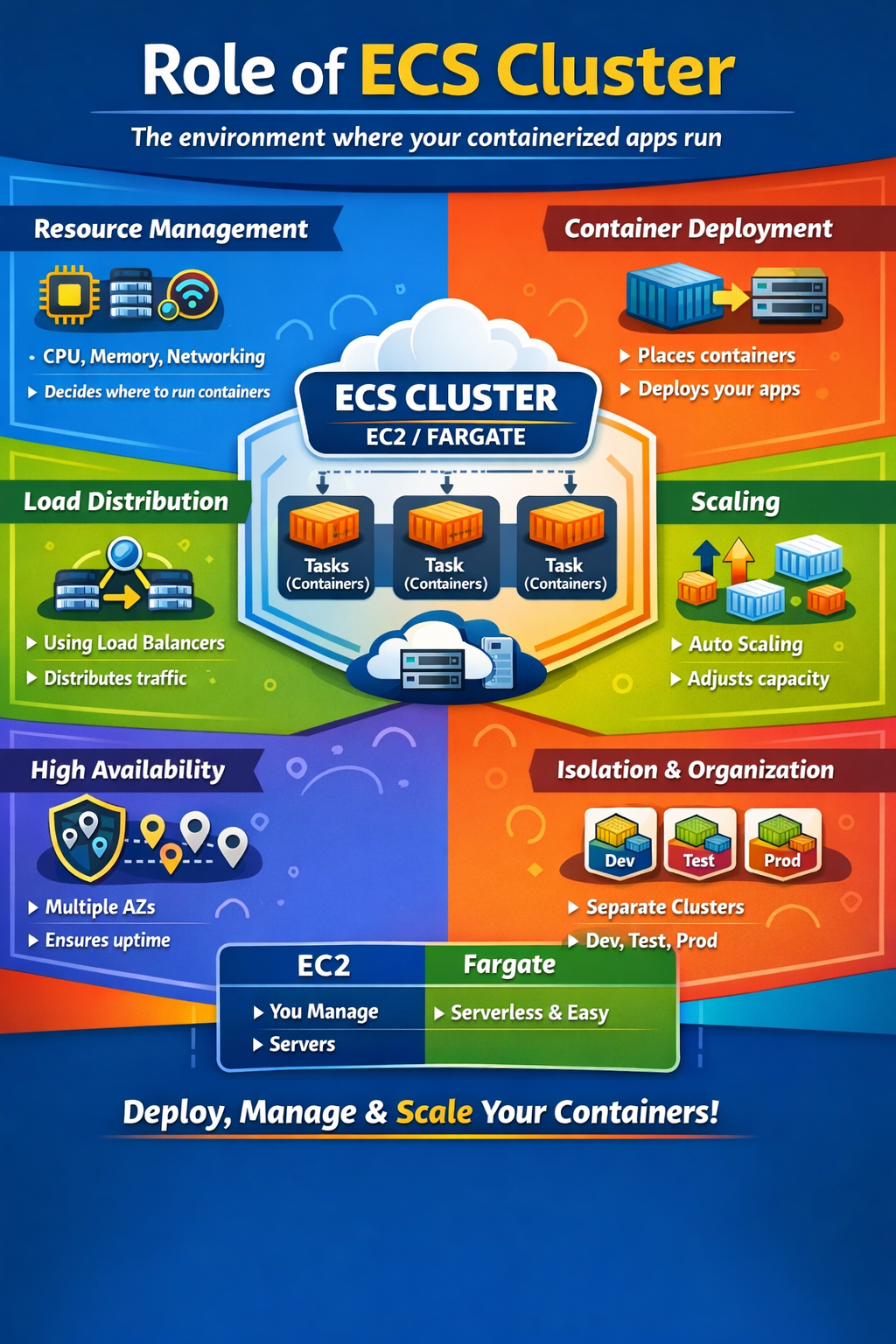
An ECS Cluster (Amazon Elastic Container Service Cluster) is the core logical grouping of compute resources where your containerized applications run.
An ECS Cluster is a collection of infrastructure (servers) that AWS uses to run your containers.
It can contain:
EC2 instances (your own virtual servers)
OR Fargate (serverless compute)
👉 Think of it like:
🏢 A data center (cluster) where your apps (containers) live and run
ECS Cluster manages:
CPU
Memory
Networking
👉 It decides where your container should run
When you deploy a service or task:
ECS Cluster places containers on available resources
Example:
You deploy your FastAPI app → ECS places it inside cluster → runs it
Works with:
Load Balancers (ALB/NLB)
👉 Distributes traffic across containers in the cluster
Supports:
Auto Scaling (increase/decrease containers)
Capacity scaling (add/remove EC2 instances)
Example:
More users → more containers automatically
Runs containers across:
Multiple Availability Zones
👉 Ensures your app doesn’t go down
You can create multiple clusters:
Dev cluster
Prod cluster
Testing cluster
👉 Keeps environments separate
ECS Cluster
   ├── EC2 Instances / Fargate
   │       ├── Task (Container)
   │       ├── Task (Container)
   │       └── Task (Container)
   │
   └── Services (manage tasks)
You are building:
👉 E-commerce AI Product Assistant
Flow:
You create:
Docker image (FastAPI + LangChain)
Push to:
ECR (container registry)
ECS Cluster:
Pulls image
Runs containers
Users hit:
Load Balancer → ECS Cluster → Your app
| Concept | Meaning |
|---|---|
| Cluster | Infrastructure pool |
| Task | Running container |
| Service | Keeps tasks running |
| Task Definition | Blueprint of container |
| Type | You Manage | Use Case |
|---|---|---|
| EC2 | Servers | More control |
| Fargate | Nothing | Easy, serverless |
ECS Cluster = The environment where your containerized apps are deployed, managed, scaled, and run
 Continue With Google
  Programming
 AI: Artificial intelligence