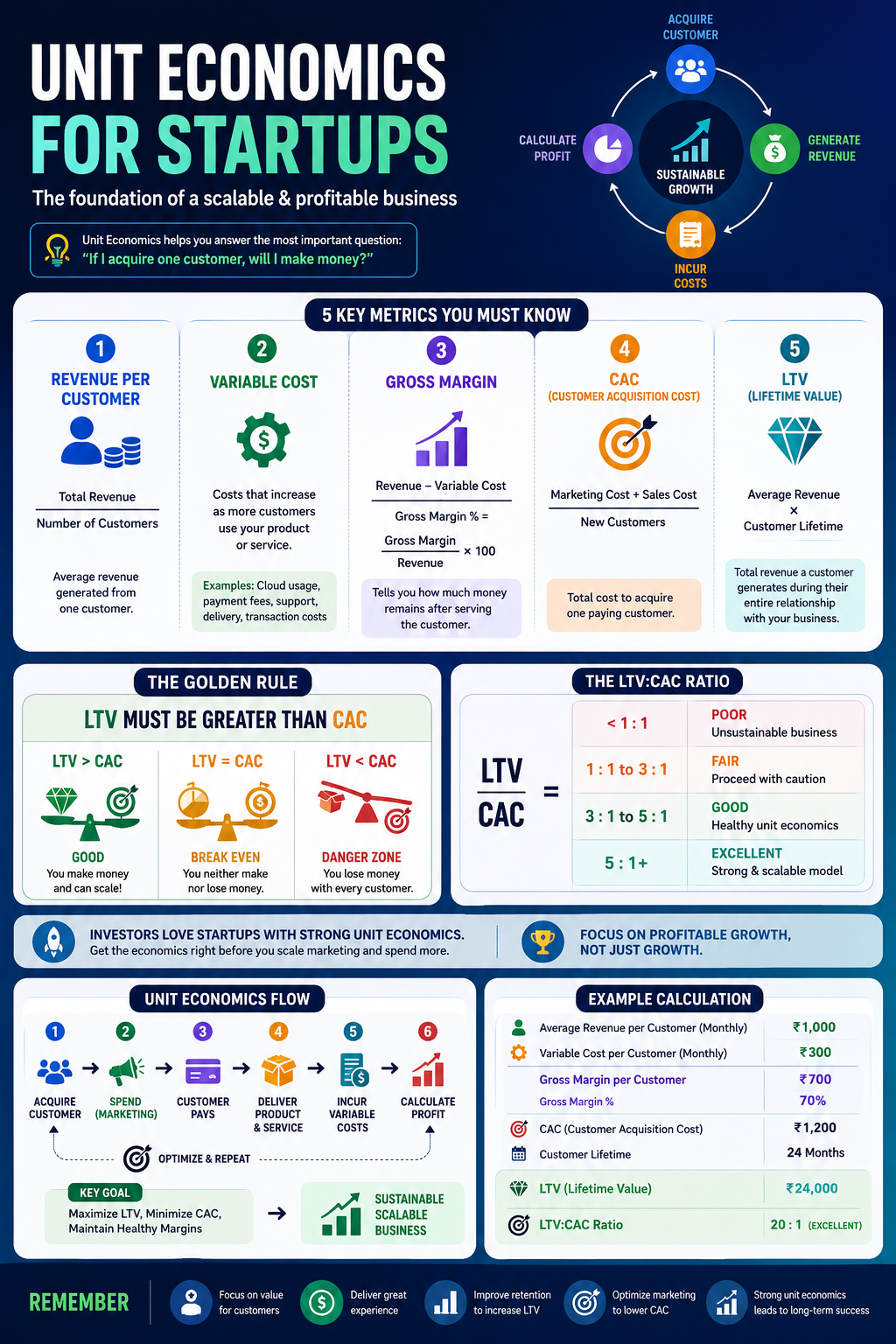
One of the biggest reasons startups fail is not because they lack customers.
They fail because:
The startup loses money every time it serves a customer.
This is where Unit Economics becomes important.
Unit Economics helps answer:
If I acquire one customer,
will I make money,
lose money,
or break even?
Before raising funding, scaling marketing, or hiring employees, founders must understand their unit economics.
Unit Economics measures:
Revenue Generated
        -
Cost to Serve Customer
        =
Profit Per Customer
Think of it as:
One Customer
      │
      ▼
How Much Money Comes In?
      │
      ▼
How Much Money Goes Out?
      │
      ▼
Net Result?
Imagine this situation:
100 Customers

Revenue = ₹1,000/customer

Cost = ₹500/customer
Profit:
₹500/customer
Good business.
100,000 Customers

Revenue = ₹1,000/customer

Cost = ₹1,500/customer
Loss:
-₹500/customer
Even with huge growth, the company loses money.
Good Unit Economics

Customer Revenue
       >
Customer Cost
Acquire Customer
       │
       ▼
Spend Money
(Marketing/Sales)
       │
       ▼
Customer Purchases
       │
       ▼
Generate Revenue
       │
       ▼
Deliver Product/Service
       │
       ▼
Incur Costs
       │
       ▼
Calculate Profit
Every startup founder should know:
1. Revenue Per Customer
2. Variable Cost
3. Gross Margin
4. CAC
5. LTV
Let's understand each one.
How much money does one customer generate?
Revenue Per Customer

=
Total Revenue
÷
Number of Customers
Revenue = ₹10,00,000

Customers = 1,000
Revenue per customer:
₹10,00,000 ÷ 1,000

= ₹1,000
Customers Buy
      │
      ▼
Revenue Generated
      │
      ▼
Divide by Customers
      │
      ▼
Revenue Per Customer
Costs that increase as customers increase.
Cloud Usage
Payment Processing Fees
Customer Support
Delivery Charges
Transaction Costs
Office Rent
Founder Salary
Legal Registration
These are fixed costs.
More Customers
      │
      ▼
More Usage
      │
      ▼
Higher Variable Cost
Revenue per customer:
₹1,000
Variable cost:
₹300
Profit before overhead:
₹700
This tells us how much money remains after serving the customer.
Gross Margin

=
Revenue
-
Variable Cost
Revenue = ₹1,000

Variable Cost = ₹300
Gross Margin:
₹700
Gross Margin %

=
Gross Margin
÷ Revenue
×100
₹700
÷
₹1,000
×100
= 70%
Revenue
   │
   ▼
Subtract Variable Costs
   │
   ▼
Gross Margin
Higher margin means:
More Cash
More Profit
More Ability to Scale
CAC means:
How much does it cost to acquire one customer?
CAC

=
Marketing Cost
+
Sales Cost

÷

New Customers
Marketing Spend:
₹1,00,000
New Customers:
100
CAC:
₹1,00,000

÷

100

=

₹1,000
Run Marketing Campaign
          │
          ▼
Spend Money
          │
          ▼
Acquire Customers
          │
          ▼
Calculate CAC
Imagine:
Customer Revenue = ₹500

CAC = ₹1,000
You lose money acquiring customers.
LTV means:
How much money will a customer generate over their entire relationship with the business?
LTV

=
Average Revenue
×
Customer Lifetime
Customer pays:
₹500/month
Average retention:
24 months
LTV:
₹500 × 24

=

₹12,000
Customer Joins
       │
       ▼
Pays Monthly
       │
       ▼
Stays for Months/Years
       │
       ▼
Total Revenue Generated
       │
       ▼
Lifetime Value
This is the most important concept in startup economics.
LTV > CAC
Meaning:
Customer Lifetime Value

must be greater than

Customer Acquisition Cost
CAC = ₹1,000

LTV = ₹10,000
Result:
Excellent Business
CAC = ₹5,000

LTV = ₹3,000
Result:
Losing Money
LTV
     │
     ▼
Compare
     │
     ▼
CAC
Decision:
If LTV > CAC
      │
      ▼
Healthy Business


If LTV = CAC
      │
      ▼
Break Even


If LTV < CAC
      │
      ▼
Danger Zone
Investors love this metric.
LTV
÷
CAC
LTV = ₹12,000

CAC = ₹3,000
Ratio:
4 : 1
Bad
Losing money.
Healthy
Good startup.
Excellent
Strong economics.
Another important metric.
How long until we recover the acquisition cost?
CAC:
₹1,200
Monthly profit:
₹200
Payback:
₹1,200
÷
₹200

=
6 Months
Acquire Customer
       │
       ▼
Spend CAC
       │
       ▼
Earn Monthly Profit
       │
       ▼
Recover Investment
       │
       ▼
Start Making Profit
STEP 1
Acquire Customer
       │
       ▼
STEP 2
Spend Marketing Budget
       │
       ▼
Calculate CAC
       │
       ▼
STEP 3
Customer Purchases Product
       │
       ▼
Generate Revenue
       │
       ▼
STEP 4
Subtract Variable Costs
       │
       ▼
Calculate Gross Margin
       │
       ▼
STEP 5
Measure Customer Lifetime
       │
       ▼
Calculate LTV
       │
       ▼
STEP 6
Compare LTV and CAC
       │
       ▼
LTV > CAC ?
       │
   ┌───┴───┐
   │       │
 YES      NO
   │       │
   ▼       ▼
Scale    Fix Economics
Growth   Before Scaling
Many founders think:
More Customers
=
Successful Startup
But the truth is:
Profitable Customer
=
Successful Startup
The ultimate goal is:
Acquire Customer
       │
       ▼
Generate Revenue
       │
       ▼
Maintain Healthy Margin
       │
       ▼
Achieve High LTV
       │
       ▼
Keep CAC Low
       │
       ▼
Create Sustainable Growth
Revenue Per Customer
        -
Variable Cost
        =
Gross Margin

LTV
        >
CAC

Good Unit Economics
        =
Scalable Startup
If you understand Revenue, Gross Margin, CAC, LTV, LTV:CAC Ratio, and Payback Period, you understand the core financial engine that investors use to evaluate whether a startup can become a sustainable and scalable business.
 Continue With Google
  Economics
 Business

