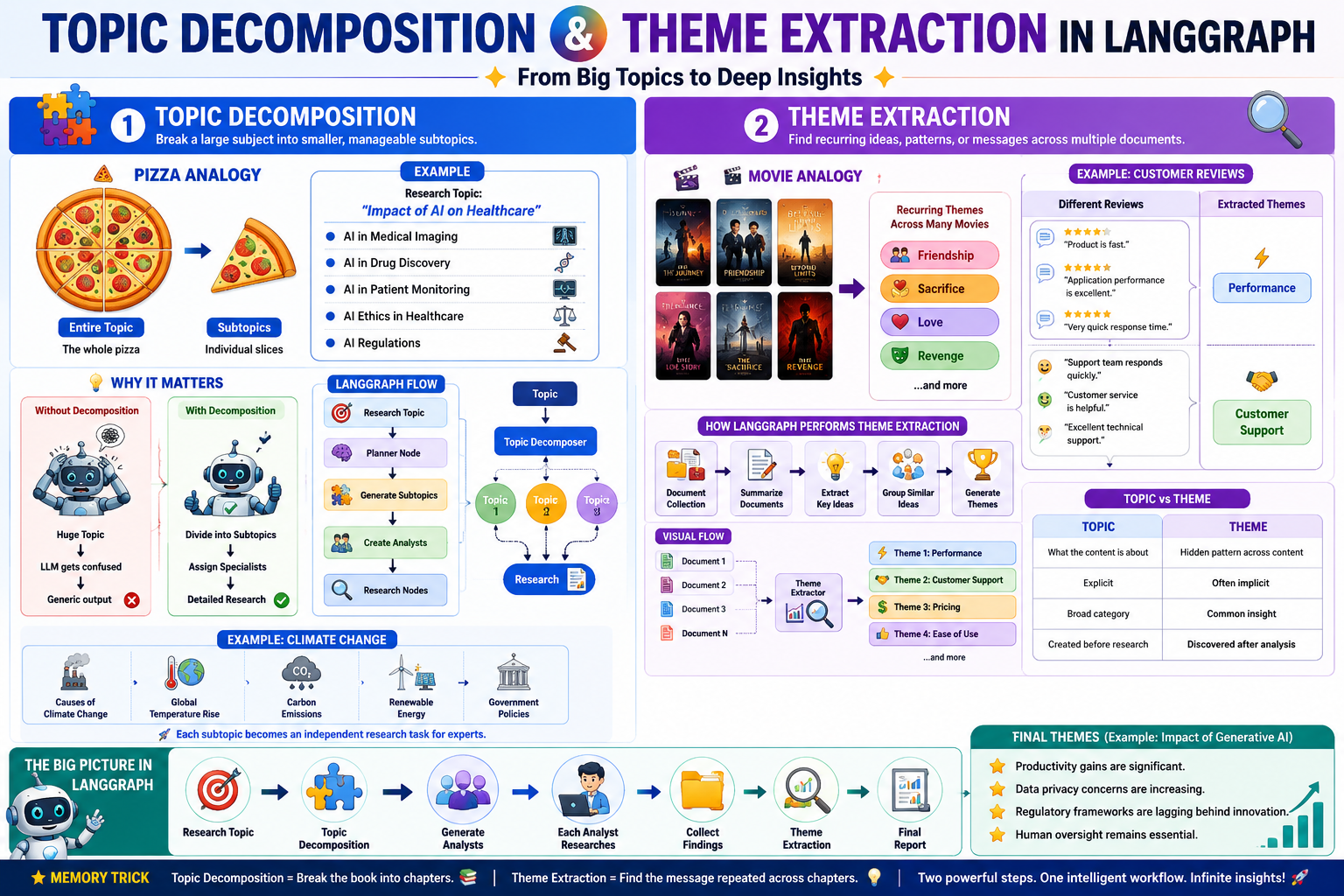
Before assigning work, LangGraph needs to answer two questions:
👉 Topic Decomposition
👉 Theme Extraction
Topic Decomposition means:
Breaking a large subject into smaller manageable subtopics.
Think of it like:
🍕 Pizza Analogy
You order a large pizza.
Instead of eating it whole, you divide it into slices.
The pizza = Entire research topic
The slices = Individual subtopics
Suppose the research topic is:
"Impact of AI on Healthcare"
Instead of analyzing everything together, LangGraph decomposes it into:
AI in Medical Imaging
AI in Drug Discovery
AI in Patient Monitoring
AI Ethics in Healthcare
AI Regulations
Now each analyst can focus on one slice.
Without decomposition:
Huge Topic
    ↓
LLM gets confused
    ↓
Generic output
With decomposition:
Huge Topic
    ↓
Divide into Subtopics
    ↓
Assign Specialists
    ↓
Detailed Research
In LangGraph, we often create:
Research Topic
      ↓
Planner Node
      ↓
Generate Subtopics
      ↓
Create Analysts
      ↓
Research Nodes
Visual Flow:
                    Topic
                      │
                      ▼
              Topic Decomposer
                /    |    \
               /     |     \
              ▼      ▼      ▼
         Topic1  Topic2  Topic3
              \     |     /
               \    |    /
                 Research
Input:
Climate Change
Topic Decomposition:
Causes of Climate Change
Global Temperature Rise
Carbon Emissions
Renewable Energy
Government Policies
Each becomes an independent research task.
Now let's move to the second concept.
Theme Extraction means:
Finding recurring ideas, patterns, or messages across multiple documents.
Think of it like:
🎬 Movie Analogy
You watch 100 movies.
Different stories.
Different actors.
Different locations.
But you notice:
Friendship
Sacrifice
Love
Revenge
These recurring ideas are themes.
Suppose we collected 100 customer reviews.
Review 1:
Product is fast.
Review 2:
Application performance is excellent.
Review 3:
Very quick response time.
Different words.
Same underlying theme:
⚡ Performance
Another example:
Support team responds quickly.
Customer service is helpful.
Excellent technical support.
Theme:
🤝 Customer Support
LangGraph typically does:
Document Collection
        ↓
Summarize Documents
        ↓
Extract Key Ideas
        ↓
Group Similar Ideas
        ↓
Generate Themes
Visual Flow:
Document 1 ─┐
Document 2 ─┼──► Theme Extractor
Document 3 ─┘

                 ▼

      Theme 1: Performance
      Theme 2: Customer Support
      Theme 3: Pricing
Many beginners confuse these.
| Topic | Theme |
|---|---|
| What the content is about | Hidden pattern across content |
| Explicit | Often implicit |
| Broad category | Common insight |
| Created before research | Discovered after analysis |
Research Topic:
Artificial Intelligence
Machine Learning
Computer Vision
NLP
Robotics
AI Ethics
These are topics.
After analyzing thousands of articles:
Automation replacing manual work
Growing privacy concerns
Need for regulation
Productivity improvement
Human-AI collaboration
These are themes.
Notice:
Topics are categories.
Themes are insights.
When you see:
Identify the most interesting themes
based upon the document and feedback.
It means:
❌ Not asking for subtopics.
✅ Asking for recurring patterns.
Example output:
Theme 1:
AI adoption is accelerating across industries.

Theme 2:
Organizations struggle with AI governance.

Theme 3:
Demand for AI-skilled professionals is rising.
Research Topic
      │
      ▼
Topic Decomposition
      │
      ▼
Generate Analysts
      │
      ▼
Each Analyst Researches
      │
      ▼
Collect Findings
      │
      ▼
Theme Extraction
      │
      ▼
Final Report
Topic:
Impact of Generative AI
AI in Education
AI in Healthcare
AI in Banking
AI Ethics
AI Regulations
Theme 1:
Productivity gains are significant.

Theme 2:
Data privacy concerns are increasing.

Theme 3:
Regulatory frameworks are lagging behind innovation.

Theme 4:
Human oversight remains essential.
"Break the book into chapters."
📚 ➜ 📖📖📖📖
"Find the message repeated across chapters."
📖📖📖📖 ➜ 💡 Common Insights
Topic Decomposition = Divide a large subject into smaller researchable parts.
Theme Extraction = Discover recurring insights and patterns from the collected research results.
This is exactly why advanced LangGraph multi-agent systems first perform Topic Decomposition (planning stage) and later perform Theme Extraction (synthesis stage) before generating the final report. 🚀
 Continue With Google
  Programming
 Data Science
 AI: Artificial intelligence