Introduction
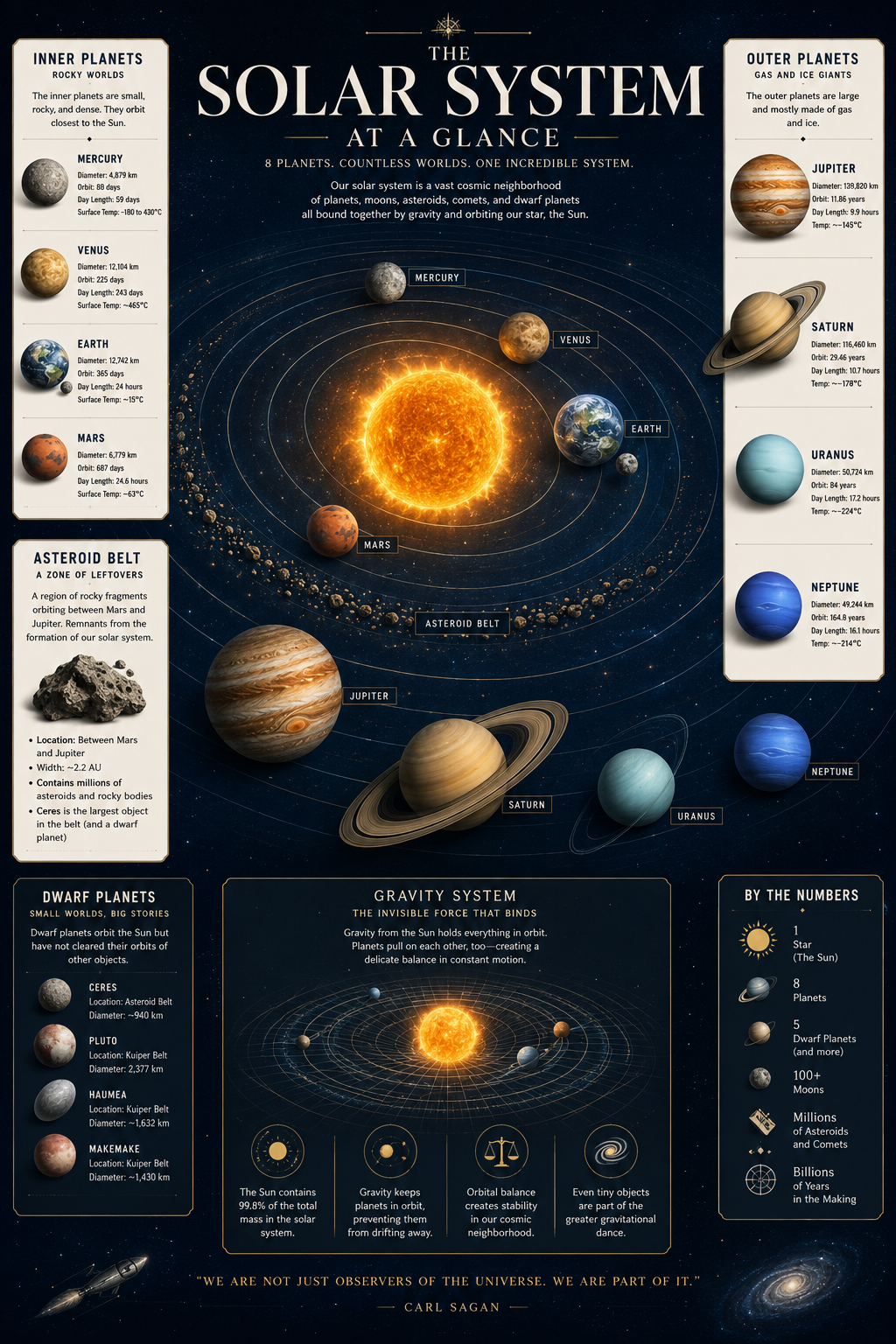
The solar system consists of the Sun and all celestial objects that orbit it due to gravity. This includes planets, moons, asteroids, comets and dwarf planets. The Sun contains more than 99 percent of the solar system’s total mass and acts as its gravitational center.
1. The Sun
The Sun is a star made primarily of hydrogen and helium.
Its functions:
- Provides heat
- Provides light
- Maintains gravitational stability
- Supports life on Earth
Without the Sun, planets would not remain in orbit.
2. Inner Planets
These planets are closer to the Sun and are rocky in composition.
Mercury
The smallest planet and closest to the Sun.
Venus
Known for extreme heat and thick atmosphere.
Earth
The only known planet that supports life.
Mars
Known as the red planet due to iron-rich surface dust.
3. Asteroid Belt
Located between Mars and Jupiter.
Contains millions of rocky objects orbiting the Sun.
It separates inner and outer planets.
4. Outer Planets
These are larger planets made mostly of gas and ice.
Jupiter
Largest planet in the solar system.
Saturn
Known for its ring system.
Uranus
Rotates on its side.
Neptune
Known for strong winds and extreme distance from the Sun.
5. Dwarf Planets
Objects like Pluto are classified as dwarf planets because they do not fully clear their orbital path.
6. Other Objects
The solar system also includes:
- Moons
- Comets
- Meteoroids
- Space dust
How It Works
Gravity keeps planets orbiting the Sun while moons orbit planets.
Everything moves in a structured gravitational system.
Important Idea
The solar system is not just a list of planets.
It is a dynamic gravitational system centered around one star.
 Continue With Google
  Science
 Education