Overthinking often feels like deep problem-solving.
But many times, it is not solving — it is looping.
A thought appears.
You analyze it.
Then question it.
Then imagine outcomes.
Then doubt your response.
Then start again.
That loop can feel productive while quietly draining energy.
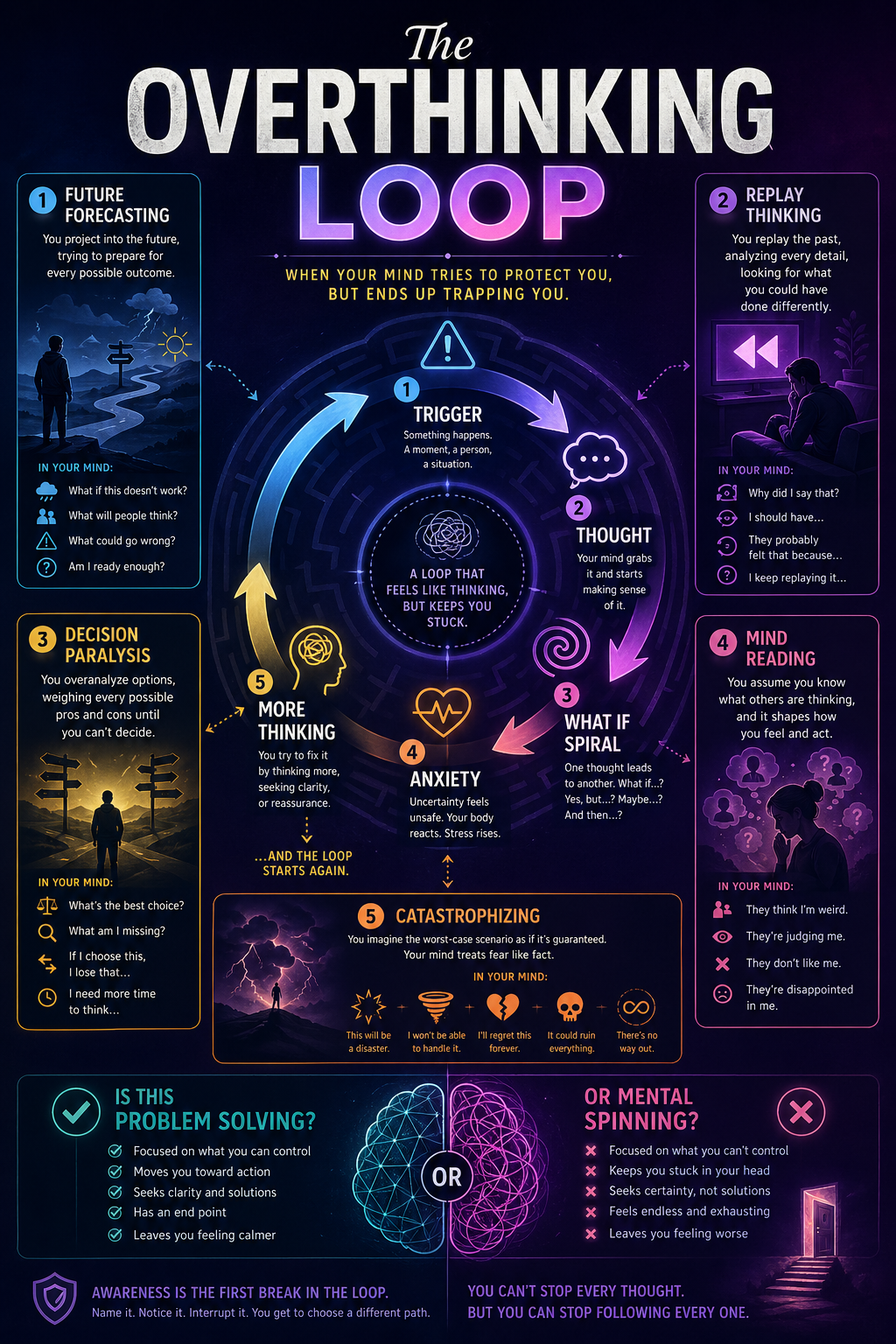
A simple way to understand overthinking is as a cycle:
Trigger → Thought → What-if Spiral → Anxiety → More Thinking → Back to Trigger
The mind treats repetition as protection.
“If I think enough, maybe I can prevent something bad.”
But excessive thinking rarely creates clarity.
It often creates noise.
Here are common forms of overthinking:
1. Future Forecasting
Imagining worst-case scenarios before they happen.
Example:
“What if this decision ruins everything?”
2. Replay Thinking
Re-running old conversations or mistakes.
Example:
“I should have said something else.”
3. Decision Paralysis
Overanalyzing options until no decision feels safe.
Example:
Spending weeks on a choice that needed one day.
4. Mind Reading
Assuming what others think about you.
Example:
“They probably judged me.”
5. Catastrophizing
Turning small uncertainty into large disaster.
Example:
One mistake feels like total failure.
What often helps is not adding better thoughts.
It is interrupting the loop.
Ask:
Is this problem-solving…
or repetitive mental spinning?
That question alone can break a cycle.
One thing to remember:
Not every thought deserves a meeting.
 Continue With Google
  Science