Most habits do not begin with discipline.
They begin with repetition.
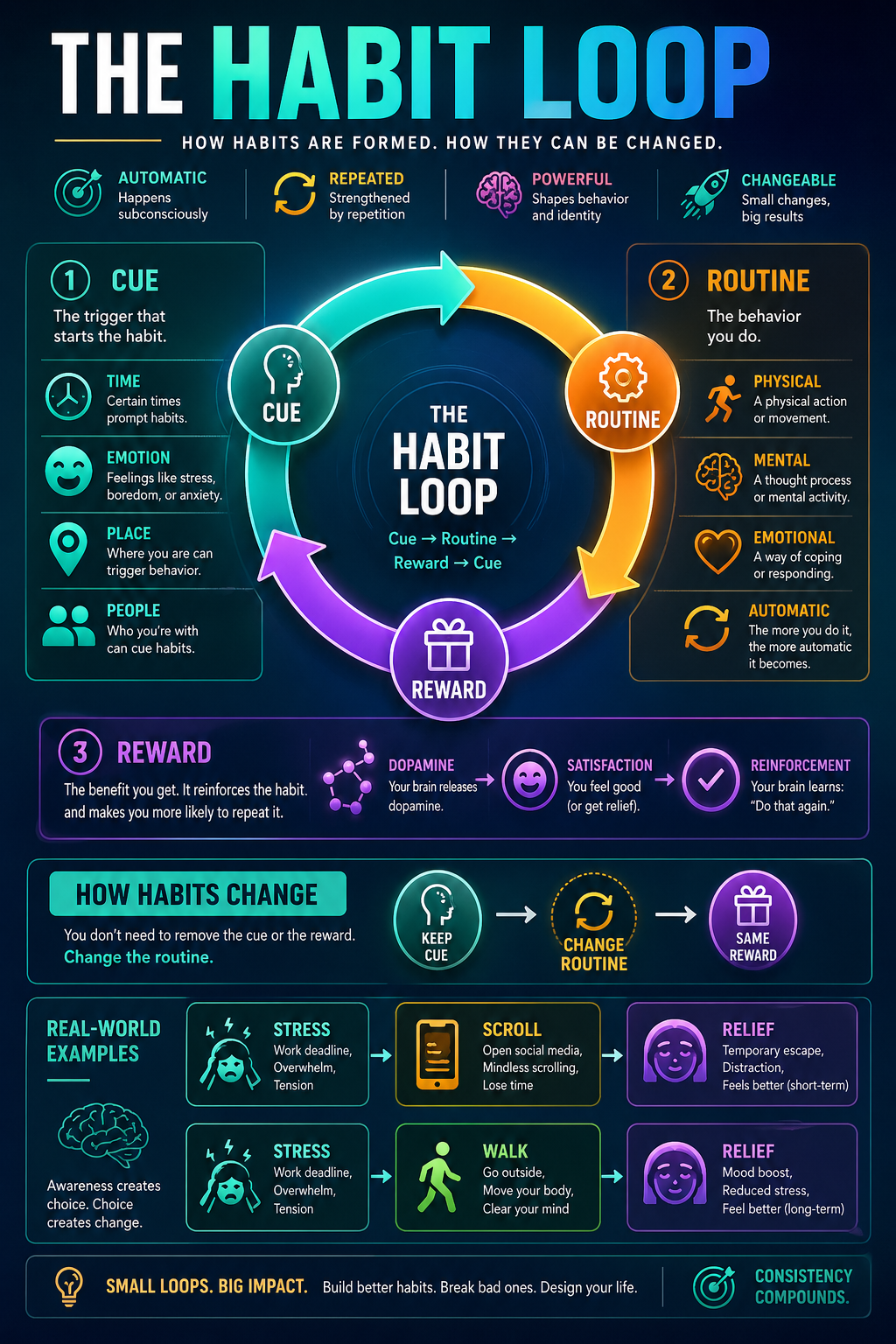
And most habits follow a loop.
Understanding that loop makes behavior easier to change.
A habit often runs in three parts:
Cue → Routine → Reward
1. Cue (The Trigger)
Every habit starts with a signal.
It could be:
- Time of day
- Emotion
- Place
- Person
- Situation
Examples:
Stress triggers scrolling.
Boredom triggers snacking.
Morning triggers coffee.
The cue starts the loop.
2. Routine (The Behavior)
This is the action itself.
The habit you see.
Examples:
Checking your phone
Eating sugar
Going for a walk
Opening a book
Good or bad —
this is the repeated pattern.
3. Reward (The Payoff)
Every habit survives because it gives something.
Maybe:
- Relief
- Pleasure
- Comfort
- Energy
- Achievement
Even unhealthy habits often meet a need.
That is why they repeat.
Why habits feel automatic
The brain likes efficiency.
Repeated loops become shortcuts.
Eventually,
less decision-making is required.
Behavior starts feeling natural.
How habits change
Most people try to remove habits through force.
Often it works better to:
Keep the cue
Change the routine
Preserve the reward
Example:
Stress (cue)
Walk instead of scroll (routine)
Still get relief (reward)
That changes the loop.
One important idea:
Small repeated actions shape identity quietly.
Habits are rarely built in dramatic moments.
They are built in ordinary ones.
One thought to keep:
You do not rise to your intentions.
You often fall to your systems.
 Continue With Google
  Science