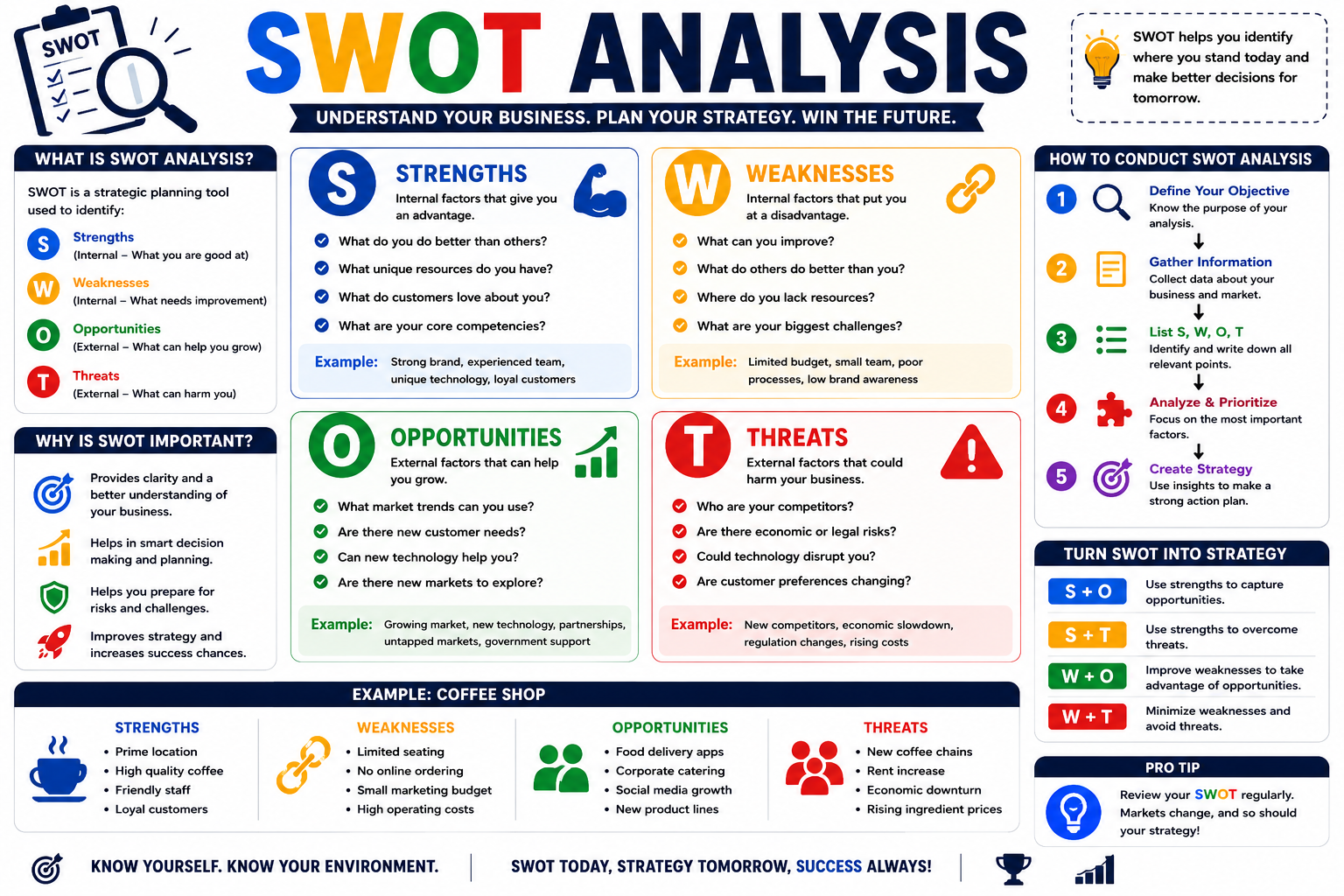
SWOT Analysis is a strategic planning tool used to understand:
S = Strengths
W = Weaknesses
O = Opportunities
T = Threats
It helps businesses answer:
"Where are we strong, where are we weak, what opportunities can we use, and what risks should we prepare for?"
Imagine you're preparing for a cricket tournament.
Before playing, you analyze:
Your Batting Skills
Your Bowling Skills
Available Opportunities
Opponent Threats
This helps you prepare better.
Businesses do exactly the same thing.
              SWOT ANALYSIS

      INTERNAL FACTORS
 ┌───────────────────────────┐
 │ Strengths   Weaknesses    │
 └───────────────────────────┘

      EXTERNAL FACTORS
 ┌───────────────────────────┐
 │ Opportunities  Threats    │
 └───────────────────────────┘
Things you can control.
Skills
Technology
Team
Brand
Product
Processes
Things outside your control.
Market Trends
Competition
Economy
Government Rules
Technology Changes
Customer Behavior
Strengths are things your business does well.
Think:
What advantages do we have?
Strong Brand
Excellent Team
Good Product
Large Customer Base
Unique Technology
Strong Cash Flow
Coffee Shop
Strengths:
Prime Location
High Quality Coffee
Loyal Customers
Experienced Staff
Strengths
     ↓
Competitive Advantage
     ↓
Better Performance
Ask:
What do customers love?
What are we best at?
Why do customers choose us?
What resources do we have?
Weaknesses are areas where the business struggles.
Think:
What is holding us back?
Limited Budget
Small Team
Poor Customer Support
Weak Marketing
Slow Website
Lack of Expertise
Coffee Shop
Weaknesses:
Limited Seating
No Online Delivery
Small Marketing Budget
Weakness
    ↓
Problem
    ↓
Reduced Growth
Ask:
Where do customers complain?
What are competitors doing better?
Which resources are missing?
What slows growth?
Opportunities are external situations that can help the business grow.
Think:
What favorable conditions exist?
Growing Market
New Technology
Untapped Customers
Industry Trends
Government Incentives
Partnerships
Coffee Shop
Opportunities:
Food Delivery Apps
Growing Office Population
Corporate Catering
Online Ordering
Market Opportunity
        ↓
Action
        ↓
Growth
Ask:
What trends are growing?
What customer needs are unmet?
Can new technology help us?
Are competitors ignoring something?
Threats are external risks that may harm the business.
Think:
What could hurt us?
New Competitors
Economic Recession
Changing Regulations
Rising Costs
Technology Disruption
Customer Preference Changes
Coffee Shop
Threats:
New Coffee Chains
Rent Increase
Food Inflation
Economic Slowdown
Threat
   ↓
Risk
   ↓
Business Impact
Ask:
Who are our competitors?
What market changes worry us?
Could regulations change?
Are customer preferences changing?
┌─────────────────────┬─────────────────────┐
│     STRENGTHS       │     WEAKNESSES      │
├─────────────────────┼─────────────────────┤
│ Strong Brand        │ Small Team          │
│ Good Product        │ Limited Budget      │
│ Loyal Customers     │ Weak Marketing      │
└─────────────────────┴─────────────────────┘

┌─────────────────────┬─────────────────────┐
│   OPPORTUNITIES     │      THREATS        │
├─────────────────────┼─────────────────────┤
│ Market Growth       │ Competition         │
│ New Technology      │ Regulations         │
│ New Customers       │ Economic Downturn   │
└─────────────────────┴─────────────────────┘
Identify Strengths
What are we good at?
↓
List strengths.
Identify Weaknesses
What needs improvement?
↓
List weaknesses.
Identify Opportunities
Where can we grow?
↓
List opportunities.
Identify Threats
What risks exist?
↓
List threats.
Analyze Business
        ↓
Identify Strengths
        ↓
Identify Weaknesses
        ↓
Identify Opportunities
        ↓
Identify Threats
        ↓
Create Strategy
        ↓
Take Action
Imagine an online fitness coaching company.
Experienced Coaches
Strong Testimonials
High Customer Satisfaction
Small Marketing Budget
Limited Brand Awareness
Growing Health Awareness
Increasing Online Learning
New Competitors
Advertising Costs Increasing
SWOT itself does not create growth.
The goal is:
SWOT
   ↓
Strategy
   ↓
Execution
Use strengths to capture opportunities.
Example
Strong Product
       +
Growing Market
       ↓
Expand Faster
Use strengths to defend against threats.
Example
Strong Brand
      +
New Competitors
      ↓
Maintain Market Position
Fix weaknesses to capture opportunities.
Example
Growing Market
      +
Weak Marketing
      ↓
Improve Marketing
Reduce risks.
Example
Limited Budget
      +
Economic Slowdown
      ↓
Control Expenses
Strengths
     ↓
Leverage

Weaknesses
     ↓
Improve

Opportunities
     ↓
Capture

Threats
     ↓
Mitigate
A startup can use SWOT like:
Product
Team
Market
Technology
Funding
Competition
Example
Strength:
AI Expertise

Weakness:
Small Team

Opportunity:
Growing AI Adoption

Threat:
Large Competitors
Being Too Generic
Bad:
Strength = Good Product
Better:
Strength = 95% Customer Satisfaction
Ignoring Weaknesses
Only Strengths
creates blind spots.
Confusing Opportunities and Strengths
Example:
Growing Market
is an Opportunity, not a Strength.
Creating SWOT but Taking No Action
Analysis
    ↓
No Strategy
    ↓
No Results
Identify Strengths
        ↓
Use Strengths
        ↓
Capture Opportunities
        ↓
Grow Business
        ↓
Strengthen Position
        ↓
Identify New Opportunities
        ↓
Repeat
Before launching:
New Product
New Market
New Service
New Business
Investment
Partnership
Run a SWOT analysis.
STEP 1
List Strengths
        ↓
STEP 2
List Weaknesses
        ↓
STEP 3
Identify Opportunities
        ↓
STEP 4
Identify Threats
        ↓
STEP 5
Match Strengths with Opportunities
        ↓
STEP 6
Fix Critical Weaknesses
        ↓
STEP 7
Prepare for Threats
        ↓
STEP 8
Create Action Plan
SWOT Analysis is one of the simplest yet most powerful strategic tools.
It helps answer:
What are we good at?
What are we bad at?
Where can we grow?
What could hurt us?
The essence of SWOT is:
Strengths
     ↓
Leverage

Weaknesses
     ↓
Improve

Opportunities
     ↓
Capture

Threats
     ↓
Manage
A well-done SWOT Analysis turns uncertainty into clarity and helps founders make smarter strategic decisions, allocate resources effectively, and build a stronger business for the future.
 Continue With Google
  Business

