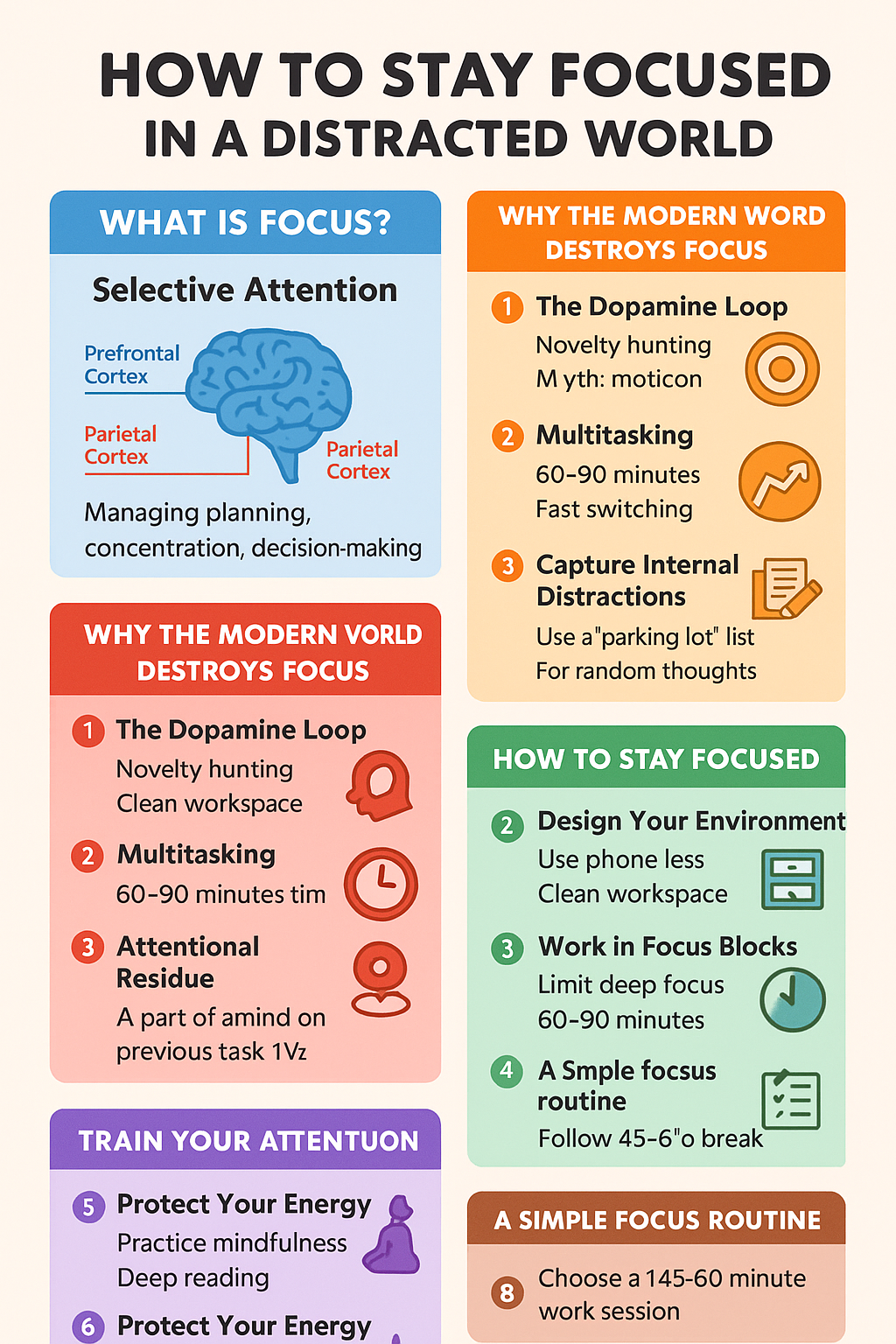
1️⃣ What Is Focus?
Focus = Selective Attention
Your brain is constantly bombarded with information (sounds, notifications, thoughts, worries).
Focus means your brain:
Selects one thing as important
Suppresses everything else
Key brain players:
🧠 Prefrontal Cortex (PFC) – “Boss” of your brain
Manages planning, concentration, decision-making
🧠 Parietal Cortex – helps direct attention to specific tasks or locations
🧠 Salience Network – decides what deserves attention (“Is this important?”)
Focus is not infinite. It’s a limited resource.
Every time you switch tasks, you pay a cost.
Every notification, message, like, or new video gives a tiny dopamine hit (reward signal).
Your brain learns:
“Checking phone = small reward.”
So it starts craving:
New messages
New content
New tabs
This turns your mind into a “novelty hunter”, always looking for the next hit instead of staying with one task.
You don’t actually multitask. You switch quickly between tasks.
Example:
You’re writing a report
A WhatsApp notification pops up
You check, reply, return to report
Each switch:
Breaks your chain of thought
Forces your brain to re-load context
Increases errors and time
This is called “context switching cost”.
Studies show it can take minutes to fully refocus after even a quick interruption.
When you move from Task A → Task B, a part of your mind is still thinking about A.
That leftover mental activity is called attentional residue.
So even when you sit to focus, your brain is half in:
Previous conversation
Social media scroll
Last unfinished task
Result: You feel busy but produce shallow work.
External distractions
Notifications, noise, people, messages, open tabs
Internal distractions
Worries, mental to-do list, boredom, emotions, overthinking
To stay focused, you must manage both.
Think of focus as a combination of:
SYSTEMS (environment) + HABITS (behaviour) + BRAIN CARE (energy).
Your phone is a portable distraction machine. Don’t rely on willpower; change its design.
Keep phone out of reach during deep work (in another room or bag).
Turn off non-essential notifications (social, promotion emails, random apps).
Keep only tools on your home screen: calendar, notes, task manager.
Move social media to a separate folder or remove from the phone and use only on desktop.
Make “checking phone” slightly inconvenient – your focus will improve instantly.
On laptop/PC:
Close unrelated tabs before starting important work.
Use full-screen mode for writing, coding, or reading.
Use website blockers (for example: blocking social sites during work hours).
Keep your desktop and downloads organized, to avoid friction and rabbit holes.
Physical space:
Clear your desk of clutter (only keep what you need for this task).
Use visual cues:
Notebook + pen = “I’m in thinking mode.”
Headphones = “I’m working; don’t disturb.”
Environment should whisper: “This place is for focus.”
Your brain can’t stay deeply focused for 8 hours straight.
Most people can do 60–90 minutes of deep focus, then need a break.
45–60 minutes Deep Focus
One task only
No phone, no social media, no “just checking mail”
5–10 minutes Break
Stand, stretch, walk, drink water
Don’t open social media; keep it light
Do 2–4 of these deep blocks a day, and your output will be higher than 10 hours of half-distracted work.
You can use:
The Pomodoro method: 25 min work + 5 min break (x4)
Or longer blocks if you can handle 45–90 minutes.
A distracted mind loves vagueness.
A focused mind loves clarity.
Before each focus block, ask:
“What exactly will I finish in this block?”
Examples:
“Write section 2 of the report.”
“Solve Q1–Q5 of this problem set.”
“Review and reply to 20 emails.”
Write it on paper or a sticky note and keep it in front of you.
This does two things:
Gives your brain a direction
Makes it easier to notice when you’ve drifted
Many times, we get distracted not by Instagram, but by our own thoughts:
“I also need to send that mail…”
“What about tomorrow’s meeting?”
“I should check that price…”
Solution: Externalize your mind.
Keep a simple “Parking Lot” list next to you:
Whenever a thought pops up (“oh, I must remember…”),
👉 write it quickly on the list
👉 tell your brain: “It’s safe. I’ll handle it later.”
This reassures your brain, so it doesn’t keep repeating the same thought.
You can strengthen focus over time. Two powerful exercises:
Sit comfortably
Focus on your breathing
Every time your mind wanders (and it will), gently bring it back
This is not failure; this is the training.
You are teaching your brain:
“When you drift, come back.”
Daily practice improves:
Attention span
Emotional control
Ability to stay with one thing without escaping
Pick a book (physical or an e-reader).
Set a timer for 15–20 minutes
No phone, no notifications
Just read one thing continuously
This trains your brain to tolerate slow, linear information, instead of constant dopamine bursts.
You can’t focus if your brain is tired, no matter how many productivity hacks you try.
Poor sleep = weaker PFC = weaker self-control & attention
Aim for consistent sleep + wake times
Heavy junk food → sluggish brain
Dehydration → fatigue + headaches
Even simple habits like:
Drinking water regularly
Eating lighter, balanced meals
will keep your focus sharper.
Short walks, stretching, or light exercise increase blood flow to the brain
Movement clears mental fog and improves mood
Focus is not just a mental skill, it’s a biological state.
You will not always be able to “force” yourself to resist distraction.
So make distractions weaker:
Remove addictive apps from your phone or log out after use.
Turn on “Do Not Disturb” during deep work.
Keep your charger in another room – if your phone battery is low, you won’t scroll mindlessly.
Decide specific times for social media (for example, 20–30 min in the evening), so it feels intentional, not constant.
When the default environment is focused, you don’t need superhuman discipline.
Here’s a ready-made mini-protocol:
Choose ONE important task for the next 45–60 minutes.
Prepare your space
Phone in another room
Only required tabs/apps open
Water nearby
Set a timer for 45–60 minutes.
Keep a “Parking Lot” note beside you for random thoughts.
Work until the timer ends. When your mind drifts, gently bring it back.
Take a 5–10 min break (move, breathe, but no social media).
Repeat 2–3 times.
Do this consistently for 2–3 weeks and you’ll literally feel your concentration getting stronger.
We live in a world designed to steal attention, so:
Don’t blame your willpower.
Design your systems and environment so that focus becomes easier, and distraction becomes harder.
 Continue With Google
  Art and Craft
 Yoga
Yoga

