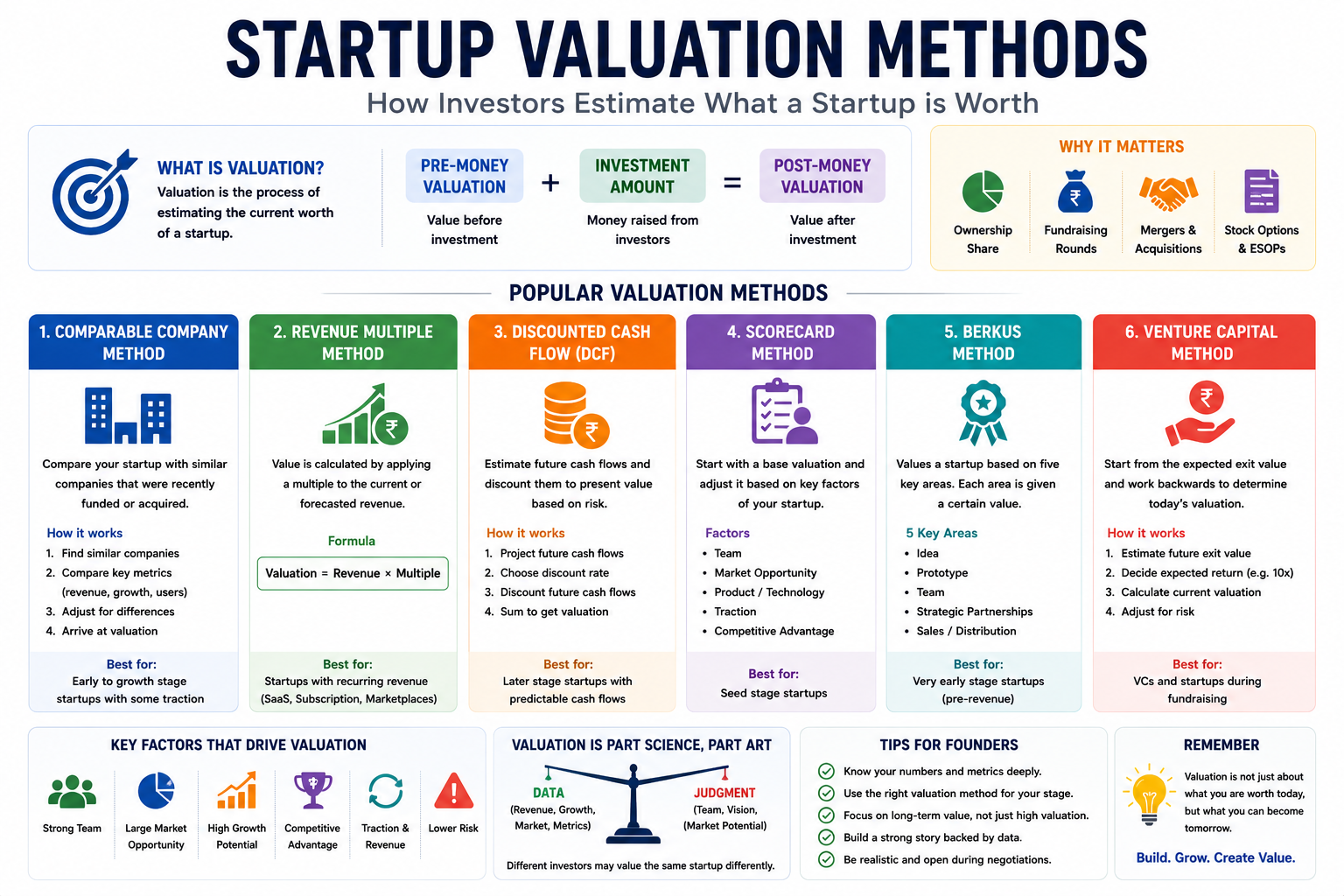
Startup Valuation is the process of estimating:
"How much is a startup worth today?"
Simply put:
Startup
    ↓
Estimate Value
    ↓
Valuation
Valuation affects:
Fundraising
Investor Ownership
Founder Ownership
Acquisitions
Stock Options
Suppose your startup is valued at:
₹10 Crore
An investor invests:
₹2 Crore
Now:
Investor Gets
Part Ownership
Valuation determines exactly how much ownership.
Imagine selling a house.
To determine price, buyers look at:
Location
Size
Condition
Demand
Similarly investors evaluate:
Team
Product
Market
Revenue
Growth
Risk
Established businesses have:
Revenue
Profit
Assets
Easy to value.
Startups often have:
No Profit
Little Revenue
Big Vision
Making valuation difficult.
TEAM
  +
MARKET
  +
PRODUCT
  +
TRACTION
  +
GROWTH
  +
RISK
  ↓
VALUATION
Before learning methods, understand this.
Value before investment.
Example:
Startup Worth
₹20 Crore
before funding.
Value after investment.
Example:
Pre-Money
₹20 Crore

+
Investment
₹5 Crore
↓
Post-Money
₹25 Crore
Visualization
Pre-Money
      +
Investment
      ↓
Post-Money
Most common method.
Compare with similar companies.
Example
Suppose similar startups are valued at:
₹50 Crore
₹60 Crore
₹55 Crore
Your startup may be valued similarly.
Flow
Find Similar Startup
         ↓
Compare Metrics
         ↓
Estimate Value
Revenue
Growth
Users
Industry
Market
Startup A:
Revenue = ₹5 Crore

Valuation = ₹50 Crore
Revenue Multiple:
10x Revenue
Your Startup:
Revenue = ₹4 Crore
Possible valuation:
₹40 Crore
Simple
Widely Used
Market Based
Finding Comparable Companies
Can Be Difficult
Popular for SaaS and technology startups.
Valuation
      =
Revenue × Multiple
Flow
Revenue
    ↓
Apply Industry Multiple
    ↓
Valuation
Startup Revenue:
₹10 Crore
Industry Multiple:
8x
Valuation:
10\times8=80
₹80 Crore
Fast-growing startups get:
Higher Multiples
Slow-growing startups get:
Lower Multiples
Used for more mature companies.
Estimate future cash flows.
Then calculate today's value.
Flow
Future Cash Flow
         ↓
Discount Future Risk
         ↓
Present Value
Example
Future Earnings:
Year 1 = ₹1 Crore
Year 2 = ₹2 Crore
Year 3 = ₹4 Crore
Convert to today's value.
Because:
₹100 Today
is worth more than:
₹100 Five Years Later
Financially Rigorous
Hard For Early Startups
because future projections are uncertain.
Very popular for Seed-stage startups.
Start with average market valuation.
Adjust based on startup quality.
Evaluate:
Team
Market
Product
Competition
Traction
Flow
Average Startup Valuation
            ↓
Score Factors
            ↓
Adjusted Valuation
Average Seed Valuation:
₹8 Crore
Strong Team:
+20%
Strong Market:
+15%
Final valuation increases.
Simple
Useful For Early Stage
Designed specifically for startups with little revenue.
Created by:
Dave Berkus
Idea
Prototype
Team
Partnerships
Sales Potential
Flow
Evaluate Factors
        ↓
Assign Value
        ↓
Total Valuation
Idea = ₹1 Crore

Prototype = ₹1 Crore

Team = ₹1 Crore

Partnerships = ₹1 Crore

Sales Potential = ₹1 Crore
Total:
₹5 Crore
Great For Pre-Revenue Startups
Widely used by VCs.
Start from future value.
Work backward.
Flow
Future Exit Value
          ↓
Desired Return
          ↓
Current Valuation
Investor expects:
10x Return
Expected future company value:
₹500 Crore
Current valuation:
₹50 Crore
What Can This Company
Be Worth Later?
not
What Is It Worth Today?
IDEA STAGE
      ↓
Berkus Method

SEED STAGE
      ↓
Scorecard Method

EARLY REVENUE
      ↓
Comparable Method

GROWING COMPANY
      ↓
Revenue Multiple

MATURE COMPANY
      ↓
DCF
Most investors don't rely on one formula.
They evaluate:
Market Size
Growth Rate
Team
Product
Traction
Competition
Revenue
Team
 ↓
Product
 ↓
Market
 ↓
Growth
 ↓
Risk
 ↓
Valuation
Because valuation is part science and part art.
Investor A:
Sees Huge Potential
Valuation:
₹50 Crore
Investor B:
Sees High Risk
Valuation:
₹25 Crore
Both can be reasonable.
Factors that increase valuation.
Large Opportunity
      ↓
Higher Valuation
Better Execution
      ↓
Higher Valuation
Fast Growth
      ↓
Higher Valuation
Brand
Network Effects
Technology
Data
↓
Higher Valuation
Example
Startup valuation:
₹20 Crore
Investor invests:
₹5 Crore
Ownership:
5 ÷ 25
=
20%
Flow
Higher Valuation
      ↓
Less Ownership Given Away
Thinking Valuation = Cash
Wrong.
Valuation:
Estimated Worth
not
Money In Bank
Focusing Only On High Valuation
Higher valuation can make future fundraising harder.
Ignoring Dilution
Funding
    ↓
Ownership Changes
Using Unrealistic Projections
Investors notice quickly.
| Method | Best For | Difficulty |
|---|---|---|
| Comparable Company | Revenue Startups | Easy |
| Revenue Multiple | SaaS/Tech | Easy |
| Scorecard | Seed Stage | Easy |
| Berkus | Pre-Revenue | Easy |
| VC Method | Fundraising | Medium |
| DCF | Mature Startups | Hard |
Analyze Market
        ↓
Evaluate Team
        ↓
Evaluate Product
        ↓
Analyze Revenue
        ↓
Analyze Growth
        ↓
Choose Valuation Method
        ↓
Estimate Company Worth
STEP 1
Identify Startup Stage
         ↓
STEP 2
Analyze Revenue & Growth
         ↓
STEP 3
Evaluate Market Opportunity
         ↓
STEP 4
Evaluate Team Strength
         ↓
STEP 5
Choose Valuation Method
         ↓
STEP 6
Calculate Valuation
         ↓
STEP 7
Negotiate With Investors
Startup valuation is not about:
What Founder Thinks
It is about:
What Investors Believe
The Startup Can Become
The essence of startup valuation is:
Team
  +
Market
  +
Product
  +
Growth
  +
Revenue
  +
Future Potential
  ↓
Valuation
Different methods are used at different stages, but all of them try to answer one question:
What is this startup worth today,
based on what it could become tomorrow?
That is the core of startup valuation.
 Continue With Google
  Business

