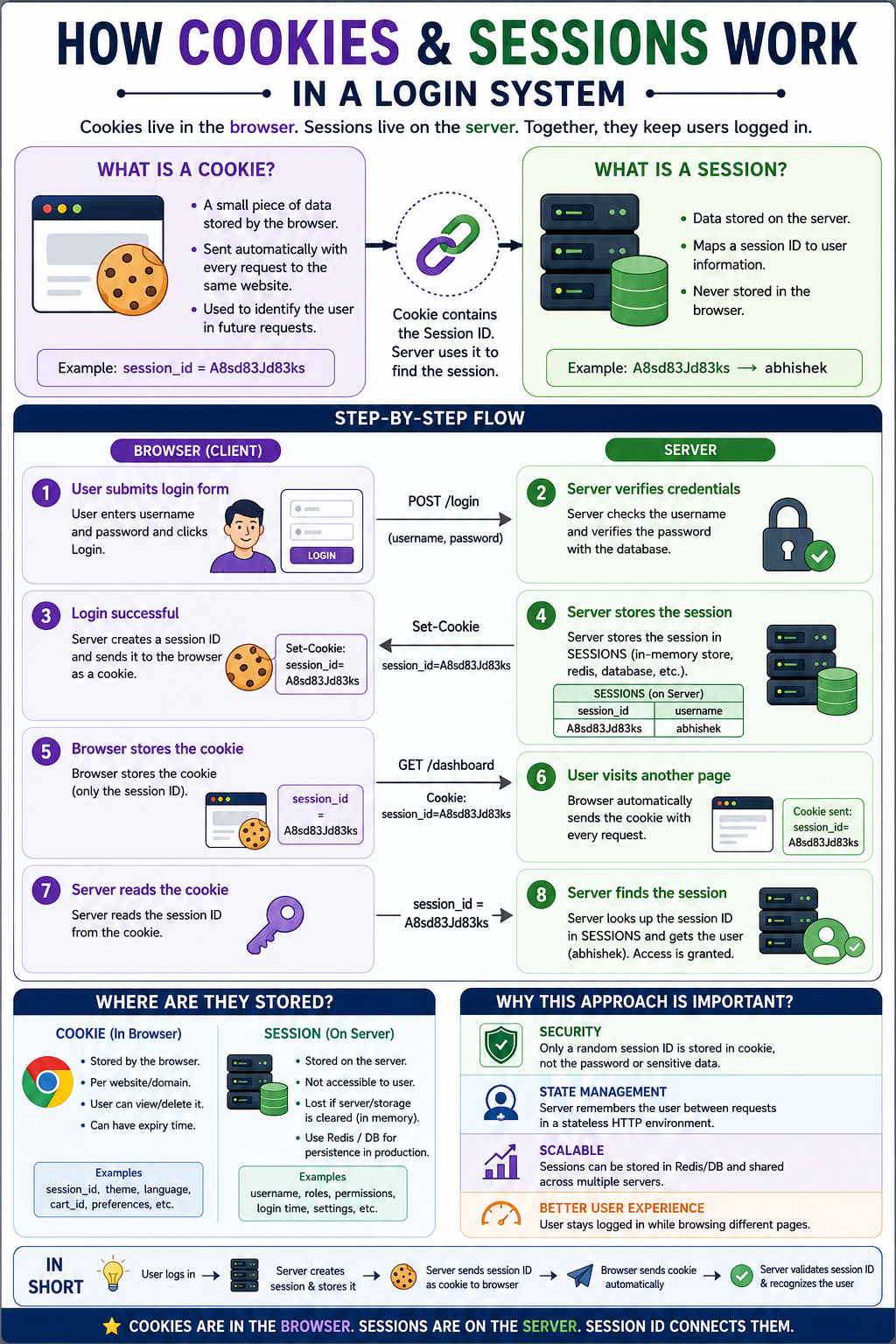
The server stores the session, and the browser stores the cookie.
Think of them as two separate storage locations.
             SERVER                          BROWSER

      Stores Session                  Stores Cookie

      SESSIONS = {                    Cookie
          "A8sd83Jd83ks"              session_id=A8sd83Jd83ks
              :
          "abhishek"
      }
Username: abhishek
Password: mypassword
↓
Browser sends them to the server.
verify_password(password, user.hashed_password)
If correct...
session_id = "A8sd83Jd83ks"
Then stores it:
SESSIONS["A8sd83Jd83ks"] = "abhishek"
Now the server remembers:
A8sd83Jd83ks → abhishek
response.set_cookie(
    key="session_id",
    value="A8sd83Jd83ks"
)
Notice carefully:
The server does not send the entire SESSIONS dictionary.
It sends only one small cookie:
session_id = A8sd83Jd83ks
Now Chrome stores:
Cookie

session_id = A8sd83Jd83ks
The browser has no idea that this belongs to Abhishek.
It simply stores the value.
Suppose the user opens
/dashboard
The browser automatically sends:
Cookie:

session_id = A8sd83Jd83ks
The server reads:
request.cookies.get("session_id")
which returns
A8sd83Jd83ks
Then it checks:
SESSIONS["A8sd83Jd83ks"]
Result:
abhishek
Now the server knows:
"This request is from Abhishek."
Imagine a cloakroom at a theater.
You give your coat to the attendant.
The attendant stores it and gives you a token.
Attendant (Server)

Token 57  →  Abhishek's Coat
You carry only:
Token 57
You do not carry the coat.
Later you return and hand over:
Token 57
The attendant looks up:
57 → Abhishek's Coat
and returns your coat.
In this analogy:
Session = the coat stored by the attendant (server)
Cookie = the token you carry (browser)
Session ID = the token number connecting the two
This is exactly how most session-based login systems work.
 Continue With Google
  Programming