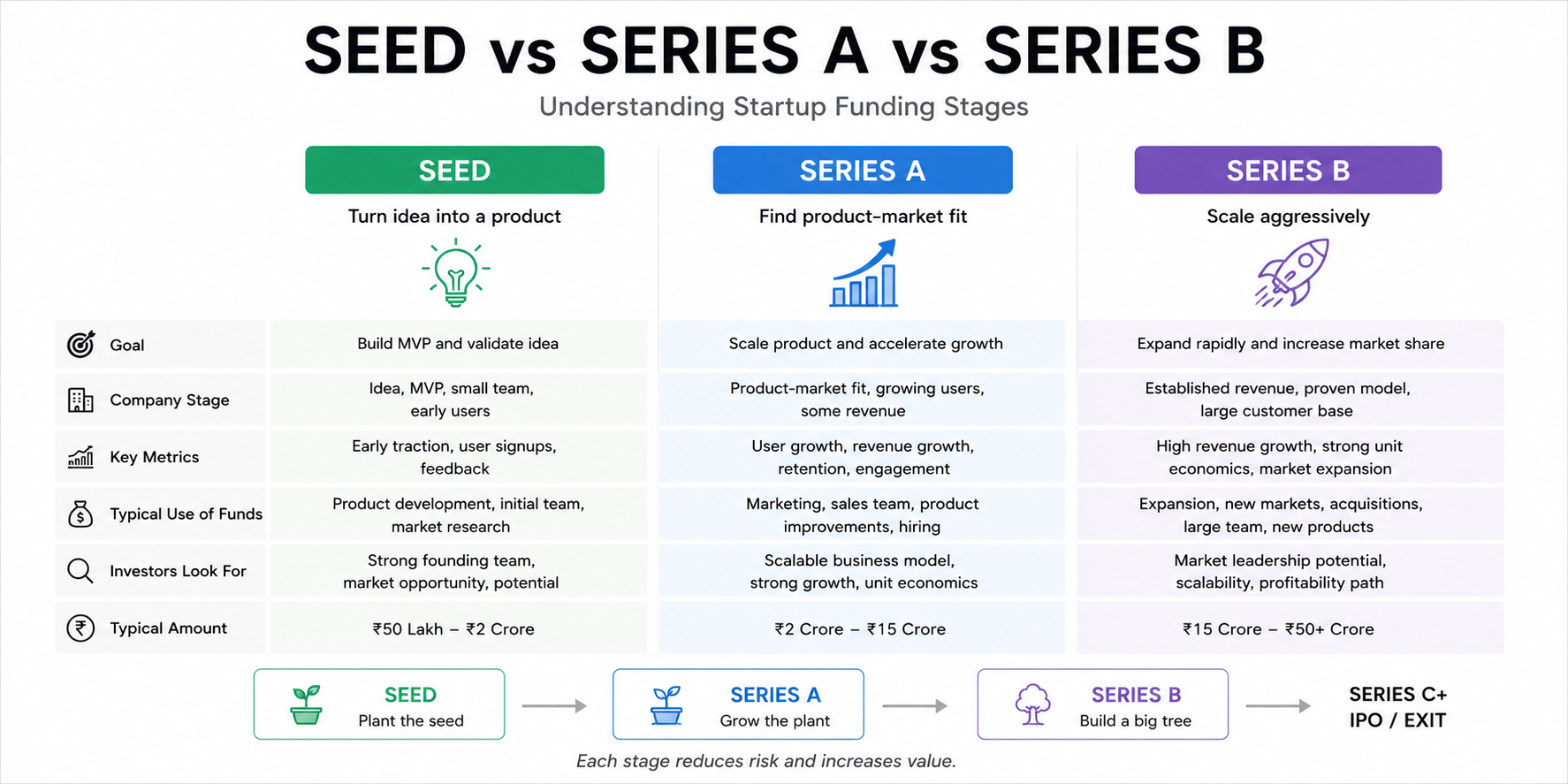
A startup does not usually raise ₹100 Crore on Day 1.
Instead, funding happens gradually.
Why?
Because investors want proof that the startup is growing.
Startup journey:
Idea
 ↓
Build Product
 ↓
Get Customers
 ↓
Grow Revenue
 ↓
Scale Business
Each stage requires different amounts of money.
BOOTSTRAP
    ↓
ANGEL
    ↓
SEED
    ↓
SERIES A
    ↓
SERIES B
    ↓
SERIES C+
    ↓
IPO / ACQUISITION
Think of it as climbing floors of a building.
Imagine constructing a shopping mall.
Land Purchased
Blueprint Created
Need money to start.
Foundation Built
Structure Visible
Need money to expand.
Mall Operating
Customers Coming
Need money to scale aggressively.
Seed funding is the first major startup funding round.
Purpose:
Turn Idea
     ↓
Into Business
Seed money helps startups:
Build MVP
Hire Initial Team
Validate Market
Acquire Early Customers
Typically has:
Idea
MVP
Small Team
Few Customers
Little Revenue
Startup Idea
      ↓
Build MVP
      ↓
Test Market
      ↓
Early Customers
Suppose founders want to build:
AI Learning Platform
Need money for:
Developers
Cloud Infrastructure
Marketing
Operations
They raise:
₹1 Crore
from Seed Investors.
Mostly:
Founding Team
Vision
Market Opportunity
Product Potential
At this stage:
Future Potential
      >
Current Revenue
Very High.
Visualization:
High Risk
    ↓
High Potential Reward
Usually:
MVP Ready
Some Users
Some Traction
Early Validation
Series A comes after Seed.
Goal:
Find Product-Market Fit
Meaning:
Customers Want Product
consistently.
Prove Business Model
Flow:
Seed Stage
      ↓
Users Love Product
      ↓
Series A
      ↓
Scale Customer Growth
Usually has:
Growing Customer Base
Revenue
Product-Market Fit
Repeatable Sales
The startup now has:
50,000 Users
500 Paying Customers
Growing Revenue
Investors think:
This Business Works
Now they invest more.
Expand Team
Improve Product
Increase Marketing
Build Sales Team
Seed investors ask:
Can this work?
Series A investors ask:
Can this scale?
Validated Product
        ↓
More Customers
        ↓
More Revenue
        ↓
Series A Investment
Typical signals:
Strong User Growth
Revenue Growth
Retention
Customer Satisfaction
Series B comes after successful Series A.
Goal:
Scale Aggressively
The company already knows:
Product Works
Customers Want It
Revenue Exists
Now the challenge is:
Grow Fast
Expansion
Product-Market Fit
        ↓
Growing Revenue
        ↓
Series B
        ↓
Rapid Expansion
Usually has:
Strong Revenue
Large Customer Base
Strong Team
Proven Business Model
Enter New Markets
Hire Hundreds Of Employees
Build New Products
Global Expansion
Acquisitions
Company grows from:
50,000 Users
to
5 Million Users
This requires significant investment.
Seed Investors:
Will it work?
Series A Investors:
Can it scale?
Series B Investors:
Can it dominate?
| Factor | Seed | Series A | Series B |
|---|---|---|---|
| Main Goal | Build Product | Scale Product | Scale Company |
| Revenue | Little/None | Growing | Significant |
| Customers | Early Users | Growing Users | Large User Base |
| Risk | Very High | High | Moderate |
| Team Size | Small | Growing | Large |
| Investor Focus | Potential | Product-Market Fit | Expansion |
| Typical Question | Can it work? | Can it scale? | Can it dominate? |
SEED
 ↓
Build Product

SERIES A
 ↓
Build Business

SERIES B
 ↓
Build Market Leadership
Idea
 ↓
Product
Product
 ↓
Business
Business
 ↓
Market Leader
SEED
High Risk
High Uncertainty

      ↓

SERIES A
Moderate Risk

      ↓

SERIES B
Lower Risk
Higher Predictability
Imagine founders own:
100%
After Seed:
Founders = 85%
Investors = 15%
After Series A:
Founders = 70%
Investors = 30%
After Series B:
Founders = 55%
Investors = 45%
Visualization:
More Funding
      ↓
More Growth
      ↓
More Dilution
Vision
Team
Potential
Users
Retention
Growth
Revenue
Scale
Market Share
Profitability Path
Expansion
Founder Idea
      ↓
Bootstrap
      ↓
Angel Funding
      ↓
Seed Round
      ↓
Build Product
      ↓
Series A
      ↓
Scale Product
      ↓
Series B
      ↓
Scale Company
      ↓
Series C+
      ↓
Global Expansion
      ↓
IPO / Acquisition
Idea
MVP
Seed Funding
Customer Growth
Revenue Growth
Series A
National Expansion
Large Team
Series B
Global Expansion
IPO Preparation
More Funding = Success
Wrong.
Funding is fuel.
Not the destination.
Series B Is Better Than Seed
Different stages solve different problems.
Investors Fund Ideas Only
Most investors fund:
Team
Market
Execution
Growth
Remember:
SEED
 ↓
Build Product

SERIES A
 ↓
Build Growth Engine

SERIES B
 ↓
Build Market Leader
SEED
Build Something People Want
            ↓
SERIES A
Prove People Want It
            ↓
SERIES B
Scale It Everywhere
The three stages can be summarized as:
SEED
"Can we build it?"
        ↓

SERIES A
"Can we scale it?"
        ↓

SERIES B
"Can we dominate the market?"
The essence of startup funding is:
Capital
    ↓
Validation
    ↓
Growth
    ↓
Scale
    ↓
Market Leadership
Each funding round represents a different chapter in a startup's journey—from proving an idea, to proving a business, to becoming a major player in the market.
 Continue With Google
  Business

