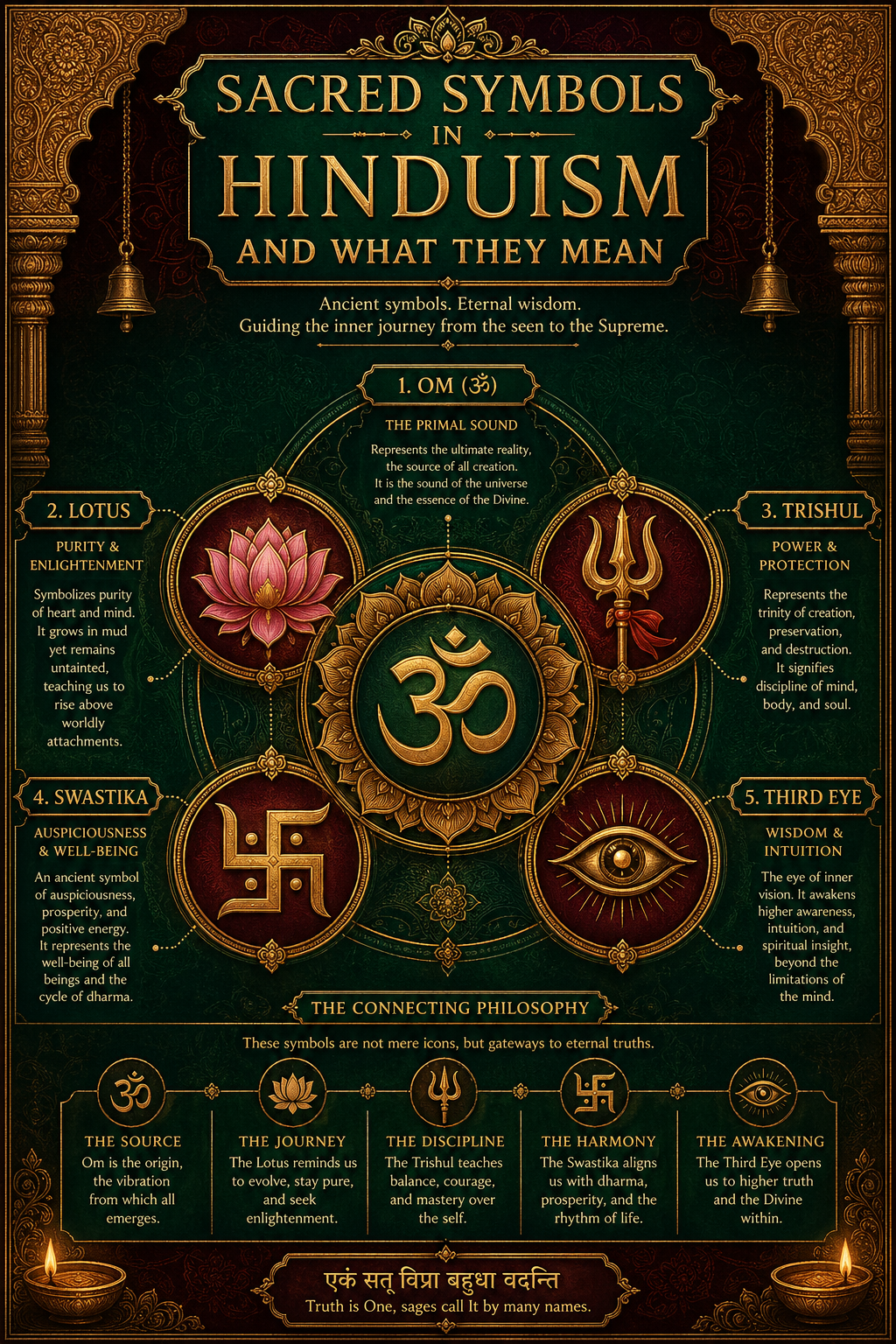
Many symbols in Hindu tradition are not decoration.
They carry ideas.
Some represent protection.
Some represent consciousness.
Some represent cosmic principles.
Understanding the symbols often reveals the philosophy behind them.
Here are five powerful ones:
1. Om (ॐ)
Often called the primordial sound.
Represents:
Creation,
consciousness,
the underlying vibration of existence.
It is not just a symbol.
It is considered a sound-form of reality.
---
2. Lotus
A flower rooted in mud yet blooming untouched.
Represents:
Purity,
awakening,
spiritual growth.
A reminder:
Growth can emerge from difficulty.
---
3. Trishul (Trident)
Associated with Shiva.
Represents many triads, including:
Creation, preservation, destruction
Past, present, future
Body, mind, spirit
A symbol of power and balance.
---
4. Swastika (Ancient Auspicious Symbol)
In Hindu tradition, an ancient sacred symbol of wellbeing.
Represents:
Auspiciousness,
prosperity,
cosmic order.
Traditionally used in rituals and sacred spaces.
---
5. Third Eye
Often shown on Shiva.
Represents:
Insight beyond ordinary sight,
wisdom,
inner perception.
Seeing beyond appearances.
---
Why symbols matter
Symbols compress meaning.
One image can hold a philosophy.
That is why sacred traditions often teach visually.
One thought to keep:
Sometimes a symbol is not meant to be looked at.
It is meant to be contemplated.
 Continue With Google
  Sanskrit and Vedas