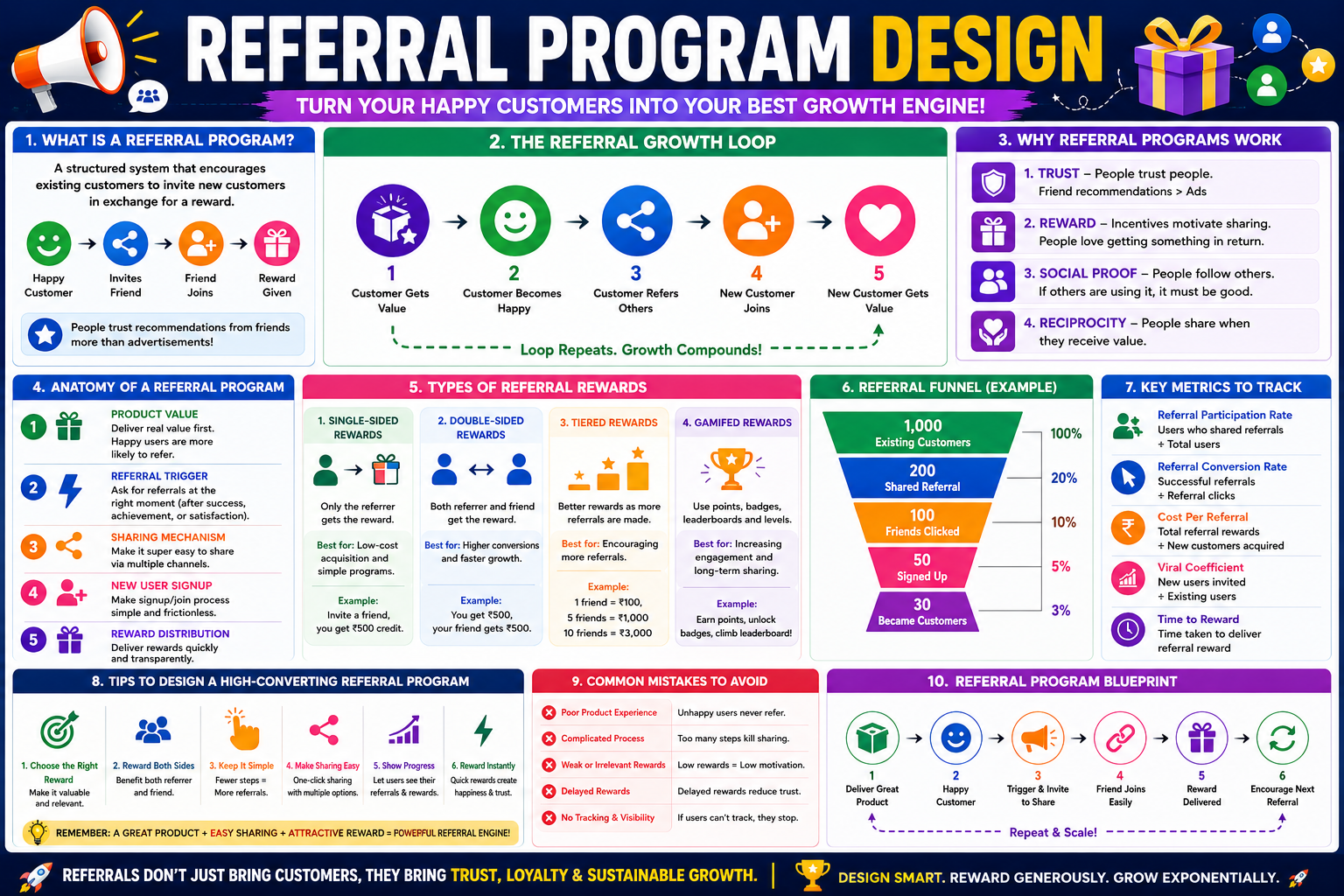
A Referral Program is a structured system that encourages existing customers to invite new customers in exchange for a reward.
Simply put:
Happy Customer
       ↓
Invites Friend
       ↓
Friend Joins
       ↓
Reward Given
Instead of spending money on advertisements, businesses leverage satisfied customers to bring in new users.
People trust recommendations from friends more than advertisements.
Think about your own behavior.
When a friend says:
"This product helped me."
You are much more likely to try it.
Compared to:
Random Advertisement
Trust is significantly higher.
Business
    ↓
Ads
    ↓
Customer
Every new customer costs marketing money.
Customer
    ↓
Invites Friend
    ↓
New Customer
    ↓
Invites Friend
Growth becomes more efficient.
A successful referral system works like a loop.
Customer Gets Value
          ↓
Customer Becomes Happy
          ↓
Customer Refers Others
          ↓
New Customer Joins
          ↓
New Customer Gets Value
          ↓
Refers Others
          ↓
Loop Repeats
This creates compounding growth.
A referral program should help achieve:
Acquire New Customers
          ↓
Reduce Marketing Cost
          ↓
Increase Trust
          ↓
Accelerate Growth
Referral programs work because of four psychological triggers.
People trust people.
Friend Recommendation
         ↓
Higher Trust
         ↓
Higher Conversion
People enjoy receiving incentives.
Invite Friend
      ↓
Earn Reward
Motivates sharing.
People follow others.
Many People Use Product
            ↓
Must Be Valuable
When users receive value:
Receive Benefit
       ↓
Feel Motivated To Share
Every referral program contains five components.
Product Value
      ↓
Referral Trigger
      ↓
Sharing Mechanism
      ↓
New User Signup
      ↓
Reward Distribution
Let's understand each.
Referral programs cannot fix a bad product.
Bad experience:
User
 ↓
Unhappy
 ↓
Never Refers
Good experience:
User
 ↓
Satisfied
 ↓
Wants To Share
The product must solve a real problem first.
Referral Trigger = Moment when user is most likely to share.
Examples:
After Purchase
After Success
After Positive Review
After Goal Achievement
Flow:
User Achieves Success
          ↓
Feels Excited
          ↓
Referral Request Appears
Timing matters.
The easier it is, the more referrals occur.
Bad Design:
Copy Link
Write Email
Send Manually
Too much effort.
Good Design:
Click Button
      ↓
Share Instantly
Low friction.
Email
WhatsApp
SMS
Facebook
LinkedIn
Telegram
Copy Link
Provide multiple options.
The invited person should experience minimal friction.
Bad Flow:
Referral Link
      ↓
10 Forms
      ↓
Leaves
Good Flow:
Referral Link
      ↓
Simple Signup
      ↓
Value Delivered
Reward must be clear and immediate.
Successful Referral
         ↓
Reward Issued
No confusion.
Only the referrer receives a reward.
Customer Invites Friend
          ↓
Friend Joins
          ↓
Customer Gets Reward
Example:
₹500 Credit
Advantages:
Simple
Low Cost
Easy To Manage
Both users benefit.
Customer Invites Friend
          ↓
Friend Joins
          ↓
Both Receive Reward
Example:
You Get ₹500
Friend Gets ₹500
Advantages:
Higher Conversion
More Attractive
Faster Growth
This is the most common referral design.
More referrals = Bigger rewards.
1 Referral → Reward A
5 Referrals → Reward B
10 Referrals → Reward C
Flow
More Referrals
        ↓
Bigger Incentive
        ↓
More Sharing
Uses competition and achievements.
Examples:
Points
Badges
Leaderboards
Levels
Flow
Refer Friends
      ↓
Earn Points
      ↓
Unlock Rewards
Low-value reward:
Invite Friend
Get ₹5
Little motivation.
Better:
Invite Friend
Get ₹500 Credit
Higher participation.
Best practice:
Referrer Wins
Friend Wins
Creates mutual benefit.
Ideal flow:
Click
 ↓
Share
 ↓
Friend Joins
 ↓
Reward
Nothing more.
People enjoy seeing results.
Example:
Referrals Completed: 3
Next Reward: 2 More Referrals
A referral program is a funnel.
1000 Customers
       ↓
200 Share Referral
       ↓
100 Friends Click
       ↓
50 Sign Up
       ↓
30 Become Customers
Each stage should be optimized.
Measures sharing activity.
Formula:
Users Who Shared
÷
Total Users
Example:
100 Users Shared
1000 Total Users
Referral\ Participation\ Rate=\frac{100}{1000}\times100
Result:
10%
Measures signup effectiveness.
Formula:
Successful Referrals
÷
Referral Clicks
Example:
50 Signups
200 Clicks
Referral\ Conversion\ Rate=\frac{50}{200}\times100
Result:
25%
Measures referral efficiency.
Total Referral Rewards
÷
New Customers Acquired
Lower is better.
1 Referral → ₹100
5 Referrals → ₹1000
10 Referrals → ₹3000
Encourages continuous sharing.
Refer Friend
      ↓
Friend Purchases
      ↓
1 Month Free
Popular for SaaS businesses.
Invite Member
      ↓
Earn Reputation
      ↓
Unlock Benefits
Works well in communities.
Weak Product
Poor Product
      ↓
No Referrals
Complicated Process
Too Many Steps
       ↓
No Sharing
Small Rewards
Low Incentive
      ↓
Low Motivation
Delayed Rewards
Referral Successful
       ↓
Reward After 60 Days
Users lose interest.
Poor Tracking
Referral Happens
       ↓
Not Recorded
       ↓
No Reward
Trust is lost.
Deliver Great Product
          ↓
Identify Happy Users
          ↓
Trigger Referral Request
          ↓
Offer Attractive Reward
          ↓
Enable Easy Sharing
          ↓
Friend Joins
          ↓
Deliver Fast Value
          ↓
Issue Reward
          ↓
Encourage Next Referral
          ↓
Repeat
STEP 1
Create Real Customer Value
         ↓
STEP 2
Choose Referral Reward
         ↓
STEP 3
Make Sharing Effortless
         ↓
STEP 4
Reduce Signup Friction
         ↓
STEP 5
Track Every Referral
         ↓
STEP 6
Reward Quickly
         ↓
STEP 7
Measure Performance
         ↓
STEP 8
Optimize Continuously
A referral program is not simply:
Invite Friend
Get Reward
A successful referral system is a carefully designed growth engine:
Great Product
      ↓
Happy Customer
      ↓
Easy Sharing
      ↓
New Customer
      ↓
Fast Value
      ↓
Reward
      ↓
More Referrals
      ↓
Sustainable Growth
The best referral programs create a situation where:
✅ Existing customers benefit
✅ New customers benefit
✅ The business acquires customers at lower cost
✅ Growth compounds over time
That is the essence of Referral Program Design.
 Continue With Google
  Business

