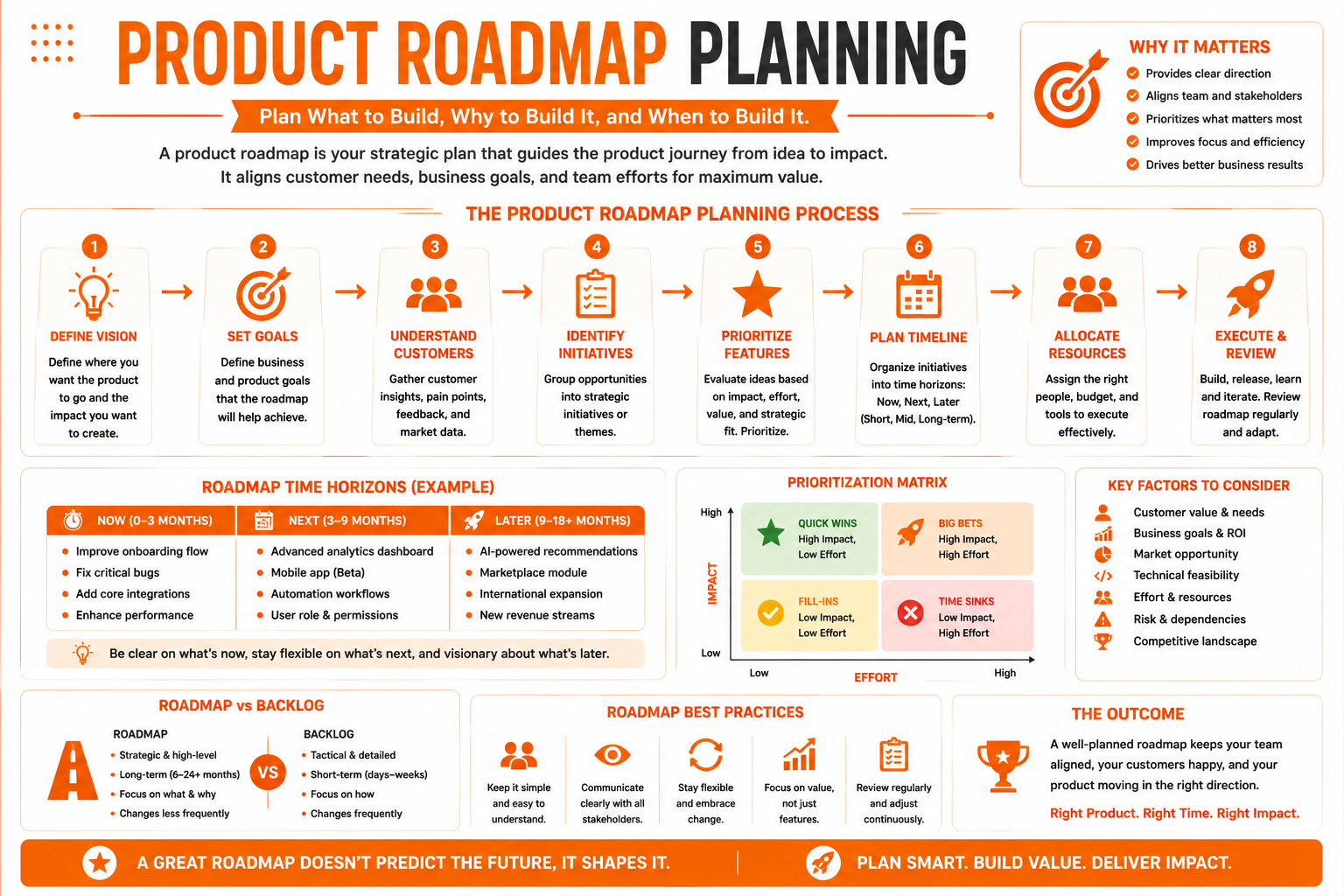
A Product Roadmap is a strategic plan that shows:
What a product team plans to build, why they are building it, and when it will be delivered.
Simply put:
Vision
   ↓
Goals
   ↓
Features
   ↓
Execution
A roadmap acts like a GPS for product development.
Imagine planning a road trip.
You don't simply get into a car and start driving.
You decide:
Destination
      ↓
Route
      ↓
Stops
      ↓
Timeline
Similarly, product teams decide:
Vision
     ↓
Features
     ↓
Priorities
     ↓
Timeline
Without a roadmap:
Random Ideas
      ↓
Random Development
      ↓
Confusion
With a roadmap:
Clear Goals
      ↓
Prioritized Work
      ↓
Focused Execution
What should we build?

Why should we build it?

When should we build it?

What comes next?

How does it support business goals?
VISION
   ↓
GOALS
   ↓
INITIATIVES
   ↓
FEATURES
   ↓
RELEASES
Many beginners confuse these.
Strategic.
Next 6-24 Months
Focus:
Where We Are Going
Tactical.
Tasks
Bugs
User Stories
Focus:
What We Build Next
| Product Roadmap | Product Backlog |
|---|---|
| Strategic | Tactical |
| Long-Term | Short-Term |
| Goals & Initiatives | Tasks & Stories |
| Executive View | Team View |
Everything starts with vision.
Vision answers:
What future are we creating?
Flow
Vision
   ↓
Direction
   ↓
Roadmap
Bad Example
Build Features
Good Example
Become the easiest platform
for online learning
Future State
      ↓
Strategic Direction
      ↓
Roadmap Decisions
A roadmap must support business objectives.
Examples:
Increase Revenue

Improve Retention

Acquire Customers

Expand Market

Improve Profitability
Goal Alignment Flow
Business Goal
        ↓
Product Goal
        ↓
Features
Business Goal:
Increase Customer Retention
Product Goal:
Improve User Engagement
Potential Features:
Notifications
Rewards
Personalization
Products exist to solve problems.
Gather:
Customer Feedback
Support Tickets
Reviews
Interviews
Usage Data
Customer Insight Flow
Customer Problem
        ↓
Opportunity
        ↓
Product Initiative
Customers complain:
Difficult Navigation
Opportunity:
Improve User Experience
Initiatives are large strategic themes.
Examples:
Mobile Experience

Security

Automation

AI Features

Customer Engagement
Roadmap Structure
Vision
   ↓
Initiatives
   ↓
Features
Initiative:
Improve Mobile Experience
Features:
New App Design

Offline Mode

Faster Loading
You cannot build everything.
This is where roadmap planning becomes important.
Feature Prioritization Flow
Ideas
   ↓
Evaluate
   ↓
Prioritize
   ↓
Build
Questions to Ask
Customer Impact?

Business Impact?

Development Effort?

Strategic Importance?
HIGH IMPACT
      +
LOW EFFORT
      ↓
Build First
LOW IMPACT
      +
HIGH EFFORT
      ↓
Build Later
Roadmaps are usually divided into periods.
Example
NOW
 ↓
NEXT
 ↓
LATER
Current Quarter
Highly certain.
Upcoming Quarter
Moderately certain.
Future Ideas
Flexible.
NOW
 ↓
Immediate Priorities

NEXT
 ↓
Upcoming Initiatives

LATER
 ↓
Long-Term Vision
Every roadmap requires resources.
Resources Include
Developers
Designers
Product Managers
Budget
Infrastructure
Resource Planning Flow
Roadmap
    ↓
Resource Needs
    ↓
Execution Plan
Initiative:
Launch Mobile App
Needs:
Developers
Designers
QA Team
Now convert roadmap into releases.
Flow
Roadmap
    ↓
Features
    ↓
Sprints
    ↓
Release
Example
Quarter 1:
User Profiles
Quarter 2:
Messaging Feature
Quarter 3:
Recommendation Engine
Focus:
Business Outcomes
Example
Increase Retention
Increase Revenue
Improve Satisfaction
Focus:
Specific Features
Example
Chat Feature
Analytics Dashboard
Mobile App
Focus:
Strategic Themes
Example
Growth
Security
Automation
Focus:
Infrastructure
Architecture
Scalability
Vision
  ↓
Business Goals
  ↓
Customer Research
  ↓
Initiatives
  ↓
Feature Prioritization
  ↓
Resource Planning
  ↓
Roadmap Creation
  ↓
Execution
A roadmap is not fixed forever.
Review:
Monthly

Quarterly

Annually
Review Flow
Roadmap
    ↓
Execution
    ↓
Results
    ↓
Adjust
VISION
Become Market Leader
         ↓

GOAL
Increase Customer Retention
         ↓

INITIATIVE
Improve Engagement
         ↓

FEATURES
Rewards
Notifications
Personalization
         ↓

RELEASE
Q2 Launch
Answers:
WHAT
WHY
Answers:
HOW
WHEN
WHO
Comparison
| Roadmap | Project Plan |
|---|---|
| Strategic | Operational |
| Long-Term | Detailed |
| Flexible | Structured |
| Goal-Focused | Task-Focused |
Building Everything Customers Request
Bad Flow
Request
 ↓
Build
 ↓
Request
 ↓
Build
No strategy.
Feature Overload
Too Many Features
      ↓
Complex Product
Ignoring Business Goals
Feature:
Cool
but
No Business Value
Roadmap Never Updated
Markets change.
Customers change.
Roadmaps must evolve.
Confusing Roadmap with Deadline List
Roadmaps are strategic guides.
Not promises.
□ Clear Vision

□ Business Goals Defined

□ Customer Research Conducted

□ Features Prioritized

□ Resource Allocation Planned

□ Release Strategy Defined

□ Metrics Identified

□ Regular Review Process
Product Vision
        ↓
Business Goals
        ↓
Customer Insights
        ↓
Strategic Initiatives
        ↓
Feature Prioritization
        ↓
Roadmap Creation
        ↓
Development
        ↓
Release
        ↓
Measurement
        ↓
Roadmap Update
STEP 1
Define Product Vision
          ↓
STEP 2
Set Business Goals
          ↓
STEP 3
Research Customers
          ↓
STEP 4
Identify Initiatives
          ↓
STEP 5
Prioritize Features
          ↓
STEP 6
Plan Timeline
          ↓
STEP 7
Allocate Resources
          ↓
STEP 8
Launch Features
          ↓
STEP 9
Measure Results
          ↓
STEP 10
Update Roadmap
A Product Roadmap is not:
A Feature List
It is:
A Strategic Plan
that connects:
Vision
   ↓
Goals
   ↓
Customer Needs
   ↓
Features
   ↓
Business Outcomes
The essence of Product Roadmap Planning is:
UNDERSTAND
      ↓
PRIORITIZE
      ↓
PLAN
      ↓
EXECUTE
      ↓
MEASURE
      ↓
ADAPT
The best product teams don't build the most features.
They build the right features, at the right time, for the right reasons—and a well-designed roadmap is what makes that possible.
 Continue With Google
  Business

