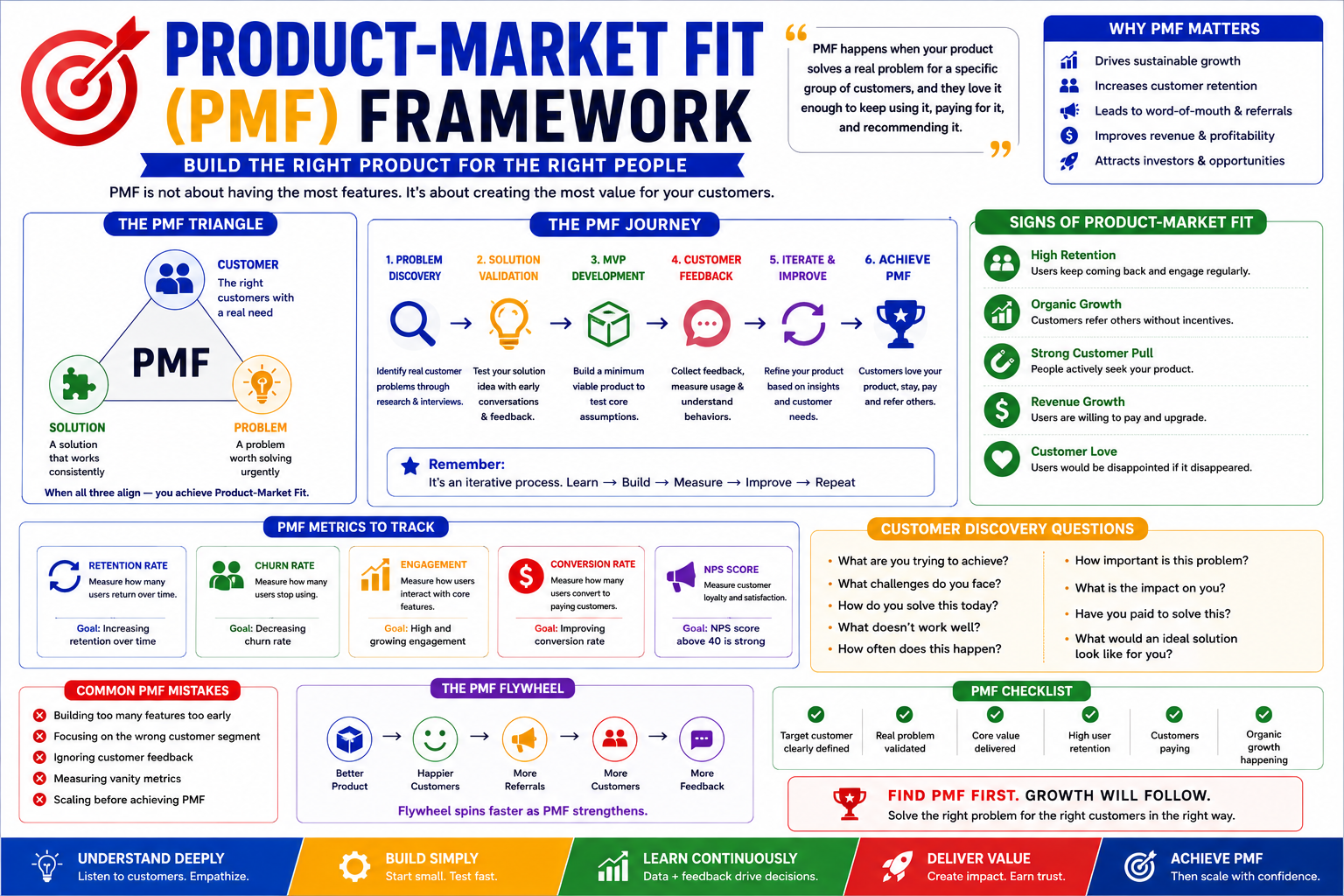
Product-Market Fit (PMF) happens when:
Your product solves a real problem for a specific group of customers, and they love it enough to keep using it, paying for it, and recommending it.
Simply put:
RIGHT PRODUCT
       +
RIGHT CUSTOMERS
       +
RIGHT PROBLEM
       =
PRODUCT-MARKET FIT
Imagine opening a food shop.
Scenario 1
Sell Ice Cream
        ↓
In Snowy Mountains
        ↓
Low Demand
No Product-Market Fit.
Scenario 2
Sell Ice Cream
        ↓
At Busy Beach
        ↓
High Demand
Strong Product-Market Fit.
The product is the same.
The market is different.
Many startups fail because they focus on:
Building Product
instead of:
Solving Customer Problems
Without PMF
Product
   ↓
No Customers
   ↓
No Growth
With PMF
Product
   ↓
Happy Customers
   ↓
Growth
   ↓
Referrals
Customer Problem
        ↓
Solution
        ↓
Product
        ↓
Customer Value
        ↓
Retention
        ↓
Product-Market Fit
Product-Market Fit sits at the intersection of:
CUSTOMER
     +
PROBLEM
     +
SOLUTION
Visualization
Customer Needs
        +
Product Capabilities
        +
Market Demand
        ↓
Product-Market Fit
Think of PMF as a pyramid.
PRODUCT FEATURES
        ↑
VALUE PROPOSITION
        ↑
CUSTOMER NEEDS
        ↑
TARGET CUSTOMER
Before building anything, ask:
Who is this for?
Bad Answer:
Everyone
Good Answer:
Freelancers

Students

Small Businesses

Parents

Teachers
Customer Identification Flow
Market
   ↓
Customer Segment
   ↓
Target Customer
Instead of:
Fitness App
For Everyone
Use:
Fitness App
For Busy Professionals
Customers don't buy products.
They buy solutions.
Question:
What problem hurts enough
that people want it solved?
Customer Need Flow
Pain Point
      ↓
Need
      ↓
Opportunity
Examples
Long Waiting Times

Poor Organization

High Costs

Lack Of Automation
This is:
Why customers should choose you
Formula
Problem
    ↓
Solution
    ↓
Benefit
Example
Problem
Expense Tracking Is Difficult

Solution
Simple Expense Tracker

Benefit
Save Time And Money
Customer Pain
        ↓
Solution
        ↓
Customer Benefit
Only after understanding customers should features be built.
Bad Process
Features
     ↓
Find Customers
Good Process
Customers
      ↓
Needs
      ↓
Features
Customer
   ↓
Problem
   ↓
Solution
   ↓
Features
   ↓
Feedback
Most startups follow:
Idea
 ↓
MVP
 ↓
Early Users
 ↓
Feedback
 ↓
Improvement
 ↓
PMF
Before PMF comes:
Problem-Solution Fit
Question:
Does our solution solve
a real problem?
Flow
Problem
   ↓
Solution
   ↓
Validation
Build:
Minimum Viable Product
Goal:
Learn Quickly
Flow
MVP
 ↓
Users
 ↓
Feedback
Now customers begin:
Using Product
Returning
Paying
Referring Others
Visualization
Product
     ↓
Customer Love
     ↓
Retention
     ↓
Growth
Many founders ask:
How can I tell?
Customers keep returning.
Bad
100 Users
 ↓
10 Remain
Good
100 Users
 ↓
80 Remain
Retention Flow
Users
  ↓
Return
  ↓
Retention
Customers tell others.
Flow
Happy Customer
       ↓
Referral
       ↓
New Customer
Customers actively seek your product.
Examples
Waiting Lists

Customer Requests

Word Of Mouth

Referrals
Customers pay willingly.
Flow
Value Delivered
       ↓
Customer Pays
A famous PMF question:
Popularized by:
Sean Ellis
Ask:
How would you feel
if this product disappeared?
Responses
Not Disappointed
PMF likely weak.
Very Disappointed
PMF likely strong.
Do Users Stay?
Do Users Leave?
Are Users Happy?
Do Users Recommend?
Do Users Pay?
Retention
    +
Referrals
    +
Revenue
    +
Satisfaction
    ↓
PMF Strength
Build Product
       ↓
Get Users
       ↓
Collect Feedback
       ↓
Improve Product
       ↓
Increase Value
       ↓
Get More Users
Better Product
        ↓
Happier Customers
        ↓
More Referrals
        ↓
More Customers
        ↓
More Feedback
        ↓
Better Product
Building Too Many Features
Features
 ↓
Features
 ↓
Features
instead of solving problems.
Ignoring Customer Feedback
Build
 ↓
Ignore Users
Targeting Everyone
Everyone
means
No One
Scaling Too Early
Bad Flow
Build MVP
 ↓
Spend Huge Marketing Budget
before PMF.
Good Flow
Find PMF
      ↓
Scale Growth
Confusing Downloads with PMF
Downloads ≠ Product-Market Fit.
PMF requires:
Usage
Retention
Love
PMF comes before growth.
Wrong Order
Marketing
      ↓
Growth
      ↓
PMF
Correct Order
PMF
 ↓
Growth
 ↓
Scale
Do Customers Need It?
         ↓
YES
         ↓
Do They Use It?
         ↓
YES
         ↓
Do They Return?
         ↓
YES
         ↓
Do They Pay?
         ↓
YES
         ↓
Product-Market Fit
□ Target Customer Identified

□ Real Problem Defined

□ Strong Value Proposition

□ MVP Built

□ Users Acquired

□ Customer Feedback Collected

□ High Retention

□ Referrals Increasing

□ Revenue Growing

□ Customers Love Product
Customer Research
         ↓
Problem Discovery
         ↓
Solution Design
         ↓
MVP
         ↓
Customer Feedback
         ↓
Product Improvements
         ↓
Retention Growth
         ↓
Product-Market Fit
         ↓
Scaling
STEP 1
Identify Target Customer
            ↓
STEP 2
Understand Pain Points
            ↓
STEP 3
Create Value Proposition
            ↓
STEP 4
Build MVP
            ↓
STEP 5
Launch To Early Users
            ↓
STEP 6
Collect Feedback
            ↓
STEP 7
Improve Product
            ↓
STEP 8
Measure Retention
            ↓
STEP 9
Validate PMF
            ↓
STEP 10
Scale Growth
Product-Market Fit is not:
Building A Product
It is:
Building A Product
People Truly Want
The essence of Product-Market Fit is:
CUSTOMER
     ↓
PROBLEM
     ↓
SOLUTION
     ↓
VALUE
     ↓
RETENTION
     ↓
GROWTH
A startup doesn't achieve success because it has the most features.
It succeeds when customers repeatedly use the product, receive clear value from it, and would genuinely miss it if it disappeared.
That moment is called Product-Market Fit. 🚀
 Continue With Google
  Business

