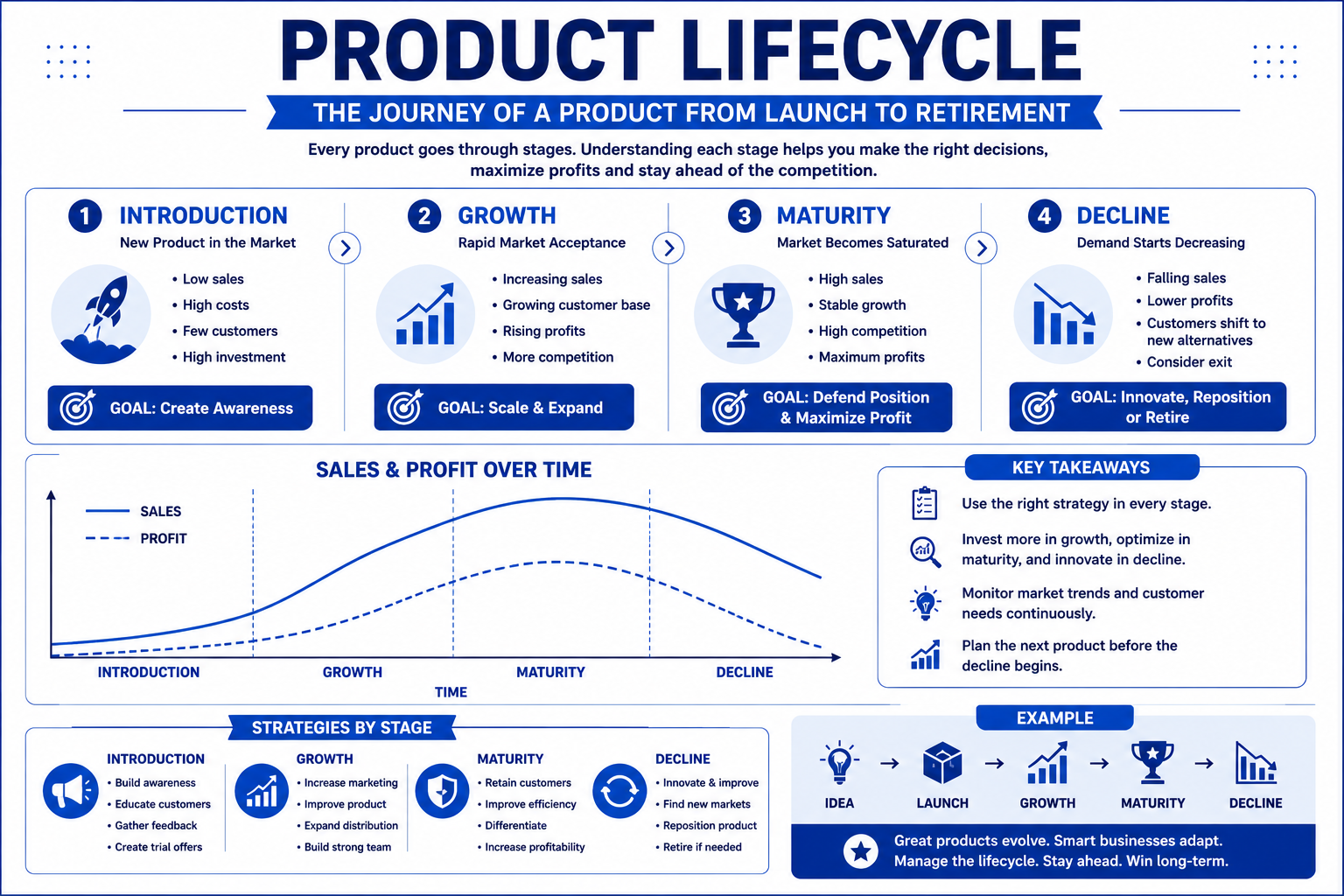
The Product Lifecycle (PLC) is the journey a product goes through from the time it is introduced into the market until it is eventually discontinued.
Simply put:
Product Idea
      ↓
Launch
      ↓
Growth
      ↓
Maturity
      ↓
Decline
Every product follows a lifecycle.
Think of a human life.
Birth
 ↓
Childhood
 ↓
Youth
 ↓
Adulthood
 ↓
Old Age
Similarly, products go through:
Introduction
 ↓
Growth
 ↓
Maturity
 ↓
Decline
Understanding the lifecycle helps businesses:
Plan Marketing
Manage Investments
Forecast Revenue
Improve Products
Prepare Future Products
Without understanding PLC:
Launch Product
      ↓
React To Problems
With PLC:
Launch Product
      ↓
Predict Changes
      ↓
Plan Ahead
INTRODUCTION
      ↓
GROWTH
      ↓
MATURITY
      ↓
DECLINE
Sales

 ↑
 |
 |            MATURITY
 |          /---------
 |         /
 |       /
 |     /
 |   /
 | /
 |/
INTRODUCTION → GROWTH → DECLINE

--------------------------------→ Time
This is when a product enters the market.
New Product
Few Customers
Low Revenue
High Costs
Create Awareness
Product Launch
       ↓
Customer Awareness
       ↓
Early Adoption
Marketing Campaigns
Product Demonstrations
Customer Education
Brand Building
Low Sales
High Marketing Cost
Customer Skepticism
A company launches a revolutionary wearable health device.
Most people have never heard of it.
Company must:
Educate Market
before selling.
Awareness
User Signups
Product Trials
Customer Feedback
New Product
      ↓
Awareness
      ↓
First Customers
The market starts accepting the product.
Increasing Customers
Rapid Revenue Growth
Growing Market Demand
Scale Growth
Customer Adoption
        ↓
Word Of Mouth
        ↓
Rapid Growth
More Customers
More Revenue
More Market Visibility
Expand Marketing
Improve Product
Increase Distribution
Build Team
Competition Appears
Operational Scaling
Customer Support
More Customers
       ↓
More Revenue
       ↓
More Growth
This is often the most exciting phase.
Growth Engine:
Happy Customers
        ↓
Referrals
        ↓
New Customers
The product becomes well established.
Stable Revenue
Large Customer Base
Intense Competition
Defend Market Position
Market Saturation
         ↓
Slower Growth
         ↓
Competition Increases
Customer Retention
Efficiency
Cost Optimization
Differentiation
Price Pressure
Competition
Slower Growth
Large Customer Base
         ↓
Maintain Position
         ↓
Maximize Profitability
Instead of:
Acquire New Customers Only
Focus on:
Retain Existing Customers
Demand starts decreasing.
Sales Decline
Customer Loss
Reduced Demand
Decide:
Revive
or
Retire
Reduced Demand
         ↓
Lower Sales
         ↓
Strategic Decision
Reasons:
New Technology
Changing Preferences
Market Shifts
Competition
DVD Players
declined because streaming services became popular.
Modify Product
      ↓
Target New Market
Add Features
      ↓
Renew Interest
Retire Product
| Stage | Sales | Profit | Competition |
|---|---|---|---|
| Introduction | Low | Low/Negative | Low |
| Growth | Increasing | Rising | Growing |
| Maturity | High | High | High |
| Decline | Falling | Falling | Variable |
Profit usually behaves differently from sales.
Visualization
Introduction
    ↓
Little Profit

Growth
    ↓
Increasing Profit

Maturity
    ↓
Maximum Profit

Decline
    ↓
Falling Profit
Businesses should manage products differently at each stage.
Educate Customers
Create Awareness
Gather Feedback
Scale Marketing
Expand Distribution
Improve Product
Retain Customers
Optimize Costs
Differentiate
Revive
Replace
Retire
Introduction
      ↓
Is Demand Growing?
      ↓
Yes
      ↓
Growth
      ↓
Can Growth Continue?
      ↓
No
      ↓
Maturity
      ↓
Demand Declining?
      ↓
Yes
      ↓
Decline
Many beginners confuse them.
Tracks:
Product Journey
Tracks:
Company Journey
Example
A company may have:
Old Product In Decline
and simultaneously:
New Product In Growth
Smart companies manage multiple products.
Visualization
Product A
Maturity

Product B
Growth

Product C
Introduction
This reduces risk.
Companies often try to extend maturity.
Methods:
Product Improvements
New Features
New Markets
Rebranding
Partnerships
Extension Flow
Maturity
    ↓
Innovation
    ↓
Renewed Growth
Ignoring Introduction Stage
Launch
 ↓
No Marketing
Failing to Scale During Growth
Demand
 ↓
Cannot Deliver
Ignoring Competition During Maturity
Competitor Improves
        ↓
Customers Leave
Waiting Too Long During Decline
Falling Sales
       ↓
No Action
□ Create Awareness

□ Educate Customers

□ Collect Feedback
□ Scale Marketing

□ Improve Operations

□ Expand Distribution
□ Retain Customers

□ Increase Efficiency

□ Strengthen Brand
□ Evaluate Demand

□ Innovate

□ Reposition

□ Retire If Necessary
Product Idea
      ↓
Development
      ↓
Introduction
      ↓
Growth
      ↓
Maturity
      ↓
Decline
      ↓
Replacement
or
Retirement
STEP 1
Build Product
         ↓
STEP 2
Launch Product
         ↓
STEP 3
Create Awareness
         ↓
STEP 4
Acquire Customers
         ↓
STEP 5
Scale Growth
         ↓
STEP 6
Defend Market Position
         ↓
STEP 7
Monitor Demand
         ↓
STEP 8
Innovate or Retire
No product grows forever.
Every product follows a lifecycle:
Introduction
      ↓
Growth
      ↓
Maturity
      ↓
Decline
The key to success is understanding:
What Stage
Your Product
Is Currently In
and applying the right strategy.
The essence of Product Lifecycle Management is:
Launch
   ↓
Grow
   ↓
Optimize
   ↓
Adapt
   ↓
Renew
or
Retire
The businesses that succeed long-term are not the ones that avoid product decline.
They are the ones that recognize lifecycle changes early and adapt before competitors do.
 Continue With Google
  Business

