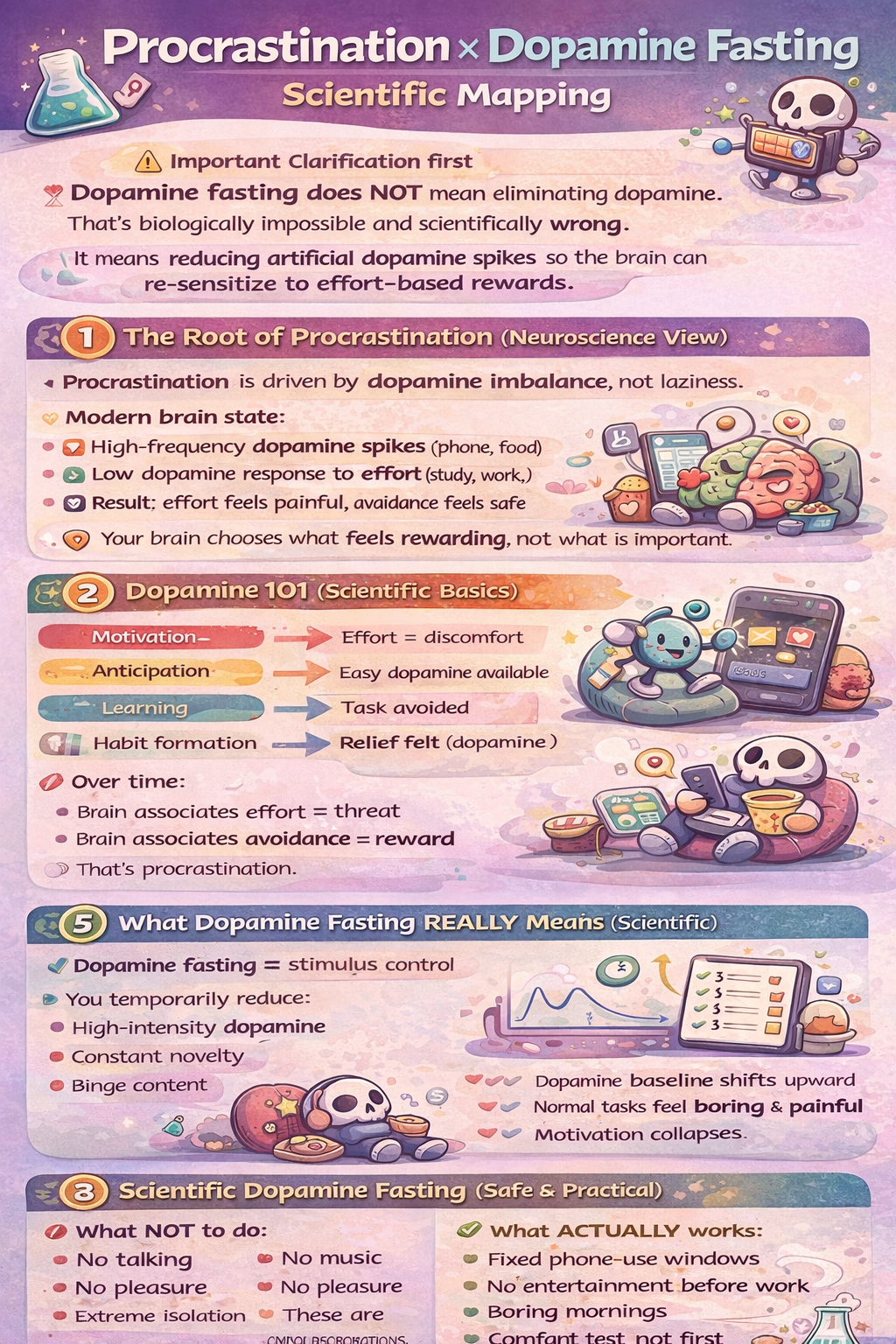
⚠️ Important clarification first
Dopamine fasting does NOT mean eliminating dopamine.
That’s biologically impossible and scientifically wrong.
It means reducing artificial dopamine spikes so the brain can re-sensitize to effort-based rewards.
Procrastination is driven by dopamine imbalance, not laziness.
🔼 High-frequency dopamine spikes (phone, food, notifications)
🔽 Low dopamine response to effort (study, work, thinking)
🧠 Result: effort feels painful, avoidance feels safe
📌 Your brain chooses what feels rewarding, not what is important.
| Dopamine Role | What It Actually Does |
|---|---|
| Motivation | Pushes you to act |
| Anticipation | Signals future reward |
| Learning | Reinforces behaviors |
| Habit formation | Repeats rewarded actions |
❗ Dopamine is about “wanting”, not “liking”.
Task appears
↓
Effort = discomfort
↓
Easy dopamine available (phone, food)
↓
Task avoided
↓
Relief felt (dopamine)
↓
Avoidance reinforced
🧠 Over time:
Brain associates effort = threat
Brain associates avoidance = reward
That’s procrastination.
📱 Infinite scroll
🔔 Notifications
🍔 Junk food
🎮 Games
🎬 Binge content
These create:
Fast spikes
No effort
No satisfaction
Quick crash
📉 Result:
Dopamine baseline shifts upward
Normal tasks feel boring & painful
Motivation collapses
Dopamine fasting = stimulus control
You temporarily reduce:
High-intensity dopamine
Constant novelty
Instant gratification
You keep:
Movement
Work
Reading
Thinking
Conversation
📌 The goal is dopamine re-sensitization, not deprivation.
Boredom increases
Restlessness appears
Urge to escape rises
🧠 This is dopamine recalibration, not damage.
Effort feels less painful
Focus improves
Starting becomes easier
Small wins feel rewarding again
🧠 Dopamine receptors regain sensitivity.
Motivation stabilizes
Habits stick naturally
Procrastination weakens
| Dopamine Fasting Action | Brain Effect | Procrastination Impact |
|---|---|---|
| Reduce scrolling | Lower dopamine noise | Tasks feel less boring |
| Allow boredom | Natural motivation rises | Easier to start |
| Delay comfort | Effort becomes tolerable | Less avoidance |
| Finish small tasks | Dopamine from progress | Habits form |
No talking
No music
No pleasure
Extreme isolation
These are misinterpretations.
Fixed phone-use windows
No entertainment before work
Boring mornings
Effort-first rule
Comfort last, not first
📌 Sequence matters more than restriction.
Reward must follow effort — not precede it.
Modern life breaks this rule.
Dopamine fasting restores it.
Procrastination is a dopamine prediction error; dopamine fasting corrects the prediction.
By reducing artificial dopamine spikes, dopamine fasting restores the brain’s sensitivity to effort-based rewards, reducing procrastination and improving habit formation.
 Continue With Google
  Health