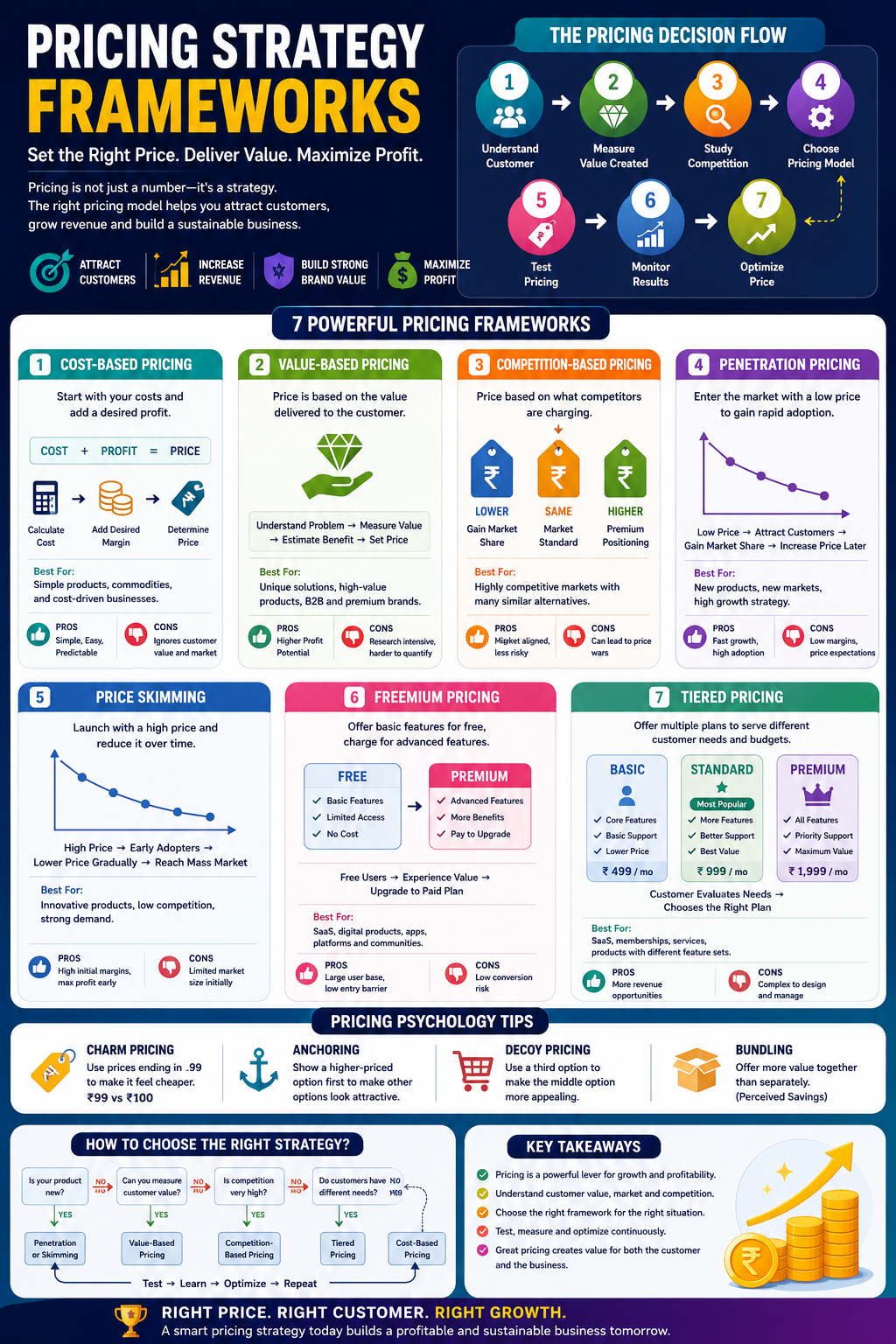
Many new entrepreneurs believe pricing is simple:
Cost + Profit = Selling Price
But successful companies use pricing as a strategic weapon.
A good pricing strategy can:
Increase Revenue
Increase Profit
Improve Brand Positioning
Attract More Customers
Beat Competitors
A bad pricing strategy can destroy even a great product.
Pricing Strategy is the method used to decide:
How Much Should We Charge?
The goal is not:
Highest Price
The goal is:
Maximum Sustainable Profit
while delivering value to customers.
Every pricing decision starts with four questions:
1. What value do we provide?
2. Who is our customer?
3. What are competitors charging?
4. What price maximizes profit?
Build Product
      │
      ▼
Understand Customer
      │
      ▼
Measure Value Created
      │
      ▼
Study Competition
      │
      ▼
Choose Pricing Model
      │
      ▼
Test Pricing
      │
      ▼
Monitor Results
      │
      ▼
Optimize Price
Imagine:
Customer Count = 1,000
Price Option A:
₹100
Revenue:
₹100,000
Price Option B:
₹120
Revenue:
₹120,000
A small pricing change can dramatically affect profit.
1. Cost-Based Pricing
2. Value-Based Pricing
3. Competition-Based Pricing
4. Penetration Pricing
5. Price Skimming
6. Freemium Pricing
7. Tiered Pricing
This starts with:
How much does it cost us?
Cost
   +
Desired Profit
   =
Selling Price
Cost:
₹500
Desired Profit:
₹200
Price:
₹700
Calculate Cost
        │
        ▼
Add Desired Margin
        │
        ▼
Determine Price
Easy
Simple
Predictable
Ignores Customer Value
Ignores Competition
May Underprice
May Overprice
Instead of asking:
What does it cost us?
Ask:
What value does the customer receive?
Customer gains:
₹1,00,000 of benefit
You charge:
₹10,000
Customer still receives huge value.
Understand Customer Problem
             │
             ▼
Measure Business Value
             │
             ▼
Estimate Customer Benefit
             │
             ▼
Set Price Based on Value
Luxury buyers often pay for:
Status
Convenience
Experience
Brand Trust
Not just product cost.
Cost-Based Pricing

"What did it cost us?"


Value-Based Pricing

"What is it worth to the customer?"
Used in highly competitive markets.
What are competitors charging?
Gain Customers Faster
Market Standard
Premium Positioning
Analyze Competitors
          │
          ▼
Compare Features
          │
          ▼
Determine Position
          │
          ▼
Set Price
LOW PRICE
      │
      ▼
Budget Brand


MEDIUM PRICE
      │
      ▼
Mainstream Brand


HIGH PRICE
      │
      ▼
Premium Brand
Used when entering a market.
Goal:
Acquire Customers Quickly
Launch with low prices.
Enter Market
      │
      ▼
Offer Lower Price
      │
      ▼
Attract Customers
      │
      ▼
Gain Market Share
      │
      ▼
Increase Price Later
Fast Growth
High Adoption
Strong Awareness
Low Profit
Customer Expectation of Low Prices
Price Wars
Opposite of penetration pricing.
Start with a high price.
Reduce later.
Launch Product
       │
       ▼
High Initial Price
       │
       ▼
Early Adopters Buy
       │
       ▼
Lower Price Gradually
       │
       ▼
Reach Larger Market
Innovation Exists
Competition is Low
Demand is Strong
Launch
  │
  ▼
₹10,000

Month 6
  │
  ▼
₹8,000

Month 12
  │
  ▼
₹6,000
Very popular in software and digital products.
Basic Features = Free

Advanced Features = Paid
User Signs Up
       │
       ▼
Uses Free Plan
       │
       ▼
Needs More Features
       │
       ▼
Upgrades
       │
       ▼
Revenue Generated
Lower Entry Barrier
Large User Base
Easy Product Adoption
10,000 Free Users
          │
          ▼
1,000 Active Users
          │
          ▼
100 Paid Users
          │
          ▼
Revenue
One of the most common frameworks.
Different customer groups have different needs.
Basic
Standard
Premium
Enterprise
Customer Evaluates Needs
             │
             ▼
Choose Appropriate Tier
             │
             ▼
Pay Matching Price
Some customers want:
Lowest Price
Others want:
Maximum Features
Tiering captures both.
Many businesses use pricing psychology.
Instead of:
₹100
Use:
₹99
Customers perceive it as cheaper.
Show:
Premium Plan
₹10,000

Standard Plan
₹5,000
The standard plan feels inexpensive.
Example:
Basic = ₹500

Standard = ₹1,000

Premium = ₹1,100
Many customers choose Premium because the price difference is small.
START
  │
  ▼
Is Product New?
  │
  ├─ Yes
  │     │
  │     ▼
  │ Penetration or Skimming
  │
  └─ No
        │
        ▼
Can Customer Value Be Measured?
        │
        ├─ Yes
        │      ▼
        │ Value-Based Pricing
        │
        └─ No
              │
              ▼
       Cost-Based Pricing
Highest Level
────────────────
Value-Based Pricing

Measures Customer Value


Middle Level
────────────────
Competition-Based Pricing

Measures Market Position


Lowest Level
────────────────
Cost-Based Pricing

Measures Internal Cost
Most beginners think:
What price should we charge?
Experienced founders ask:
Who is the customer?
What problem is being solved?
How much value is created?
What alternatives exist?
What price maximizes profit and adoption?
STEP 1
Understand Customer
       │
       ▼
STEP 2
Understand Problem
       │
       ▼
STEP 3
Measure Value Created
       │
       ▼
STEP 4
Analyze Competitors
       │
       ▼
STEP 5
Choose Pricing Framework
       │
       ├─ Cost-Based
       ├─ Value-Based
       ├─ Competition-Based
       ├─ Penetration
       ├─ Skimming
       ├─ Freemium
       └─ Tiered
       │
       ▼
STEP 6
Launch Pricing
       │
       ▼
STEP 7
Collect Customer Feedback
       │
       ▼
STEP 8
Measure Revenue & Profit
       │
       ▼
STEP 9
Optimize Pricing
       │
       ▼
Repeat Continuously
Cost-Based
=
Price from Cost

Value-Based
=
Price from Value

Competition-Based
=
Price from Market

Penetration
=
Low Price First

Skimming
=
High Price First

Freemium
=
Free Then Upgrade

Tiered
=
Multiple Plans for Different Customers
The most successful startups rarely rely on a single pricing strategy. They often combine Value-Based Pricing + Tiered Pricing + Freemium Models and continuously experiment until they find the pricing structure that maximizes customer value, revenue, and long-term profitability.
 Continue With Google
  Economics
 Business

