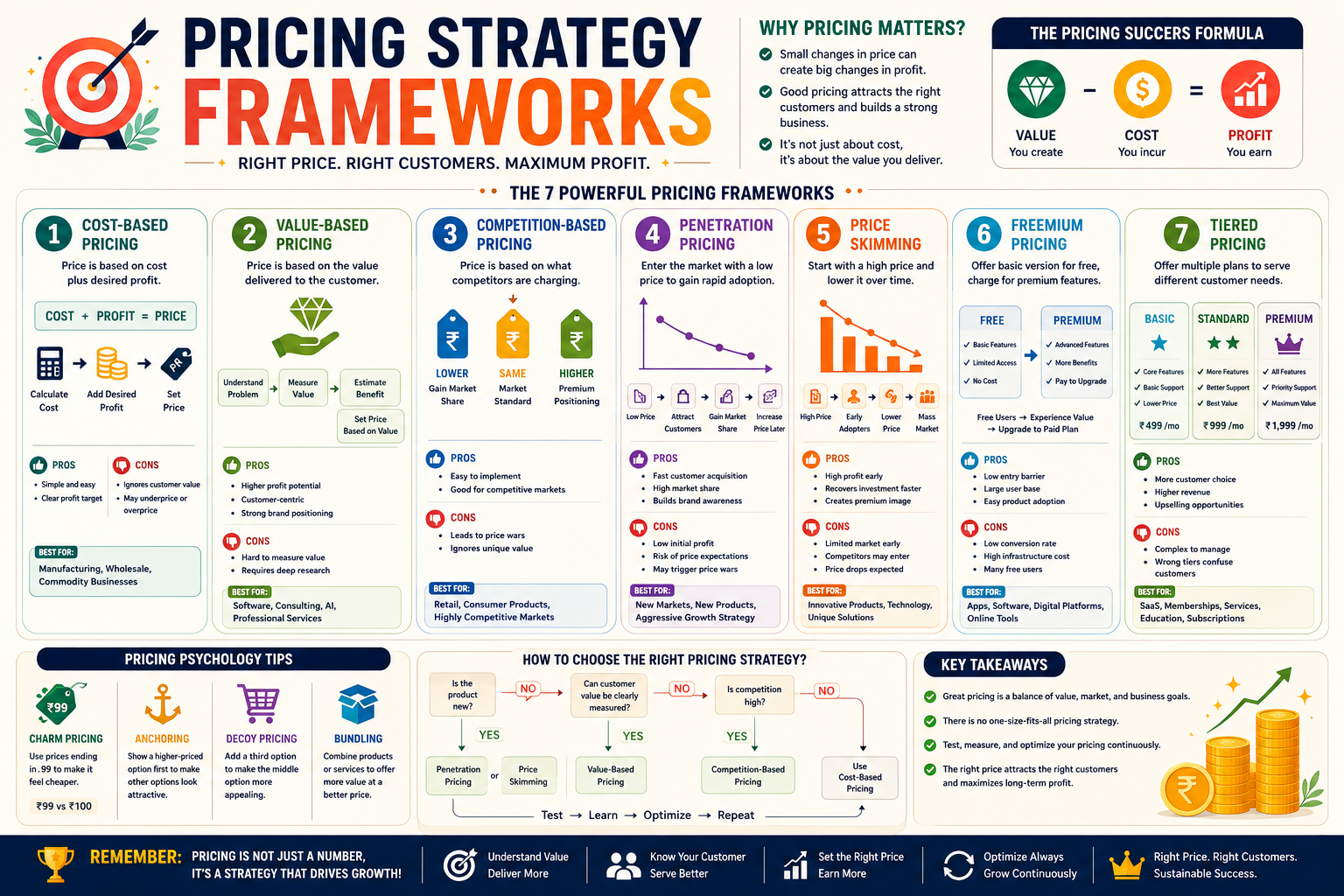
By the end of this guide, you will understand:
✅ What pricing strategy is
✅ Why pricing matters
✅ Major pricing frameworks
✅ When to use each framework
✅ Advantages and disadvantages
✅ Real-world business applications
✅ How successful companies think about pricing
Pricing Strategy is the systematic process of deciding:
How much should we charge
for our product or service?
Most beginners think:
Product Cost
     +
Profit
     =
Selling Price
But modern businesses think differently.
They ask:
What value do we create?

Who is our customer?

What are alternatives?

What price maximizes
profit and growth?
A product can be:
Excellent Product
        +
Poor Pricing
        =
Business Failure
Or
Average Product
        +
Excellent Pricing
        =
Successful Business
Imagine:
100 Customers
Price Option A:
₹500
Revenue:
₹50,000
Price Option B:
₹700
Revenue:
₹70,000
Only pricing changed.
Revenue increased by:
40%
without getting more customers.
Before choosing any price:
STEP 1
Understand Customer
       │
       ▼
STEP 2
Understand Problem
       │
       ▼
STEP 3
Measure Value Created
       │
       ▼
STEP 4
Analyze Competition
       │
       ▼
STEP 5
Select Pricing Strategy
       │
       ▼
STEP 6
Test Pricing
       │
       ▼
STEP 7
Optimize Pricing
1. Cost-Based Pricing

2. Value-Based Pricing

3. Competition-Based Pricing

4. Penetration Pricing

5. Price Skimming

6. Freemium Pricing

7. Tiered Pricing
The simplest pricing method.
Start with cost.
Add desired profit.
Set price.
Selling Price

=

Cost

+

Desired Profit
Manufacturing Cost = ₹600

Desired Profit = ₹200
Price:
₹800
Calculate Cost
       │
       ▼
Determine Desired Profit
       │
       ▼
Add Margin
       │
       ▼
Final Price
Easy

Simple

Predictable
Ignores Customer Value

Ignores Competition

Can Leave Money On Table
Manufacturing

Wholesale

Commodity Businesses
Instead of asking:
What does it cost us?
Ask:
What is it worth
to the customer?
Customer Problem
        │
        ▼
Business Solution
        │
        ▼
Customer Benefit
        │
        ▼
Value Created
        │
        ▼
Price Based On Value
Suppose a software helps a company save:
₹10,00,000 per year
Charging:
₹50,000
still feels reasonable.
Why?
Because value delivered is much larger.
Highest Profit Potential

Customer-Centric

Premium Positioning
Hard To Measure Value

Requires Research
Software

Consulting

AI Solutions

Professional Services
Price is based on market competitors.
Study Competitors
        │
        ▼
Compare Features
        │
        ▼
Determine Position
        │
        ▼
Set Price
Lower Price
Same Price
Higher Price
LOW PRICE
      │
      ▼
Budget Brand

MID PRICE
      │
      ▼
Mainstream Brand

HIGH PRICE
      │
      ▼
Premium Brand
Highly Competitive Markets

Retail

Consumer Products
Acquire customers quickly.
Launch with low prices.
Gain market share.
Increase prices later.
Launch Product
       │
       ▼
Offer Low Price
       │
       ▼
Attract Customers
       │
       ▼
Gain Market Share
       │
       ▼
Build Brand Awareness
       │
       ▼
Increase Price Gradually
Fast Growth

High Adoption

Customer Acquisition
Low Initial Profit

Price Expectations

Price Wars
New Markets

New Products

Aggressive Growth Strategy
Start expensive.
Lower later.
Launch Product
       │
       ▼
High Initial Price
       │
       ▼
Early Adopters Buy
       │
       ▼
Recover Investment
       │
       ▼
Reduce Price
       │
       ▼
Reach Larger Audience
Launch
₹10,000

Month 6
₹8,000

Month 12
₹6,000

Month 18
₹4,000
High Margin

Quick Cost Recovery

Premium Image
Limited Market Size

Competition Can Enter
Innovative Products

Technology Products

Unique Solutions
Basic version is free.
Advanced version is paid.
User Signs Up
       │
       ▼
Uses Free Version
       │
       ▼
Experiences Value
       │
       ▼
Needs More Features
       │
       ▼
Upgrades To Paid Plan
       │
       ▼
Revenue Generated
10,000 Free Users
          │
          ▼
2,000 Active Users
          │
          ▼
200 Paying Users
          │
          ▼
Revenue
Low Entry Barrier

Fast User Growth

Easy Product Adoption
Too Many Free Users

Low Conversion Rate

Infrastructure Costs
Apps

Software

Digital Platforms

Online Tools
Different customers need different levels of service.
BASIC

STANDARD

PREMIUM

ENTERPRISE
Customer Arrives
       │
       ▼
Evaluates Needs
       │
       ▼
Compares Plans
       │
       ▼
Chooses Tier
       │
       ▼
Pays Appropriate Price
Some customers want:
Lowest Cost
Others want:
Maximum Features
Tiering serves both.
Higher Revenue

More Customer Segments

Upselling Opportunities
Software

Memberships

Services

Education Platforms
These frameworks influence buying behavior.
Instead of:
₹100
Use:
₹99
Customers perceive it as cheaper.
Show:
Premium Plan
₹10,000

Standard Plan
₹5,000
The standard plan appears affordable.
Basic = ₹500

Standard = ₹1,000

Premium = ₹1,100
Many buyers select Premium.
Product A
      +
Product B
      +
Product C
      =
Bundle Price
Creates perceived savings.
START
  │
  ▼
Is Product New?
  │
  ├── YES
  │      │
  │      ▼
  │ Penetration Pricing
  │ OR
  │ Price Skimming
  │
  └── NO
          │
          ▼
Can Customer Value
Be Clearly Measured?
          │
          ├── YES
          │      ▼
          │ Value-Based Pricing
          │
          └── NO
                 │
                 ▼
        Is Competition High?
                 │
                 ├── YES
                 │      ▼
                 │ Competition-Based Pricing
                 │
                 └── NO
                        ▼
                  Cost-Based Pricing
LEVEL 4
────────────────────

Value-Based Pricing

Highest Profit Potential

────────────────────

LEVEL 3

Tiered Pricing

Customer Segmentation

────────────────────

LEVEL 2

Competition-Based Pricing

Market Positioning

────────────────────

LEVEL 1

Cost-Based Pricing

Basic Pricing Method
Beginners ask:
What price should we charge?
Experts ask:
Who is the customer?

What problem is being solved?

How valuable is the solution?

What alternatives exist?

What pricing structure
maximizes profit and adoption?
Pricing is not about
what your product costs.

Pricing is about
the value customers
believe they receive.
Cost-Based
=
Price From Cost

Value-Based
=
Price From Value

Competition-Based
=
Price From Market

Penetration
=
Low Price First

Skimming
=
High Price First

Freemium
=
Free Then Upgrade

Tiered
=
Different Plans
For Different Customers
A strong entrepreneur understands that pricing is one of the most powerful growth levers in business, because even a small improvement in pricing can often increase profit more than acquiring hundreds of additional customers.
 Continue With Google
  Economics
 Business

