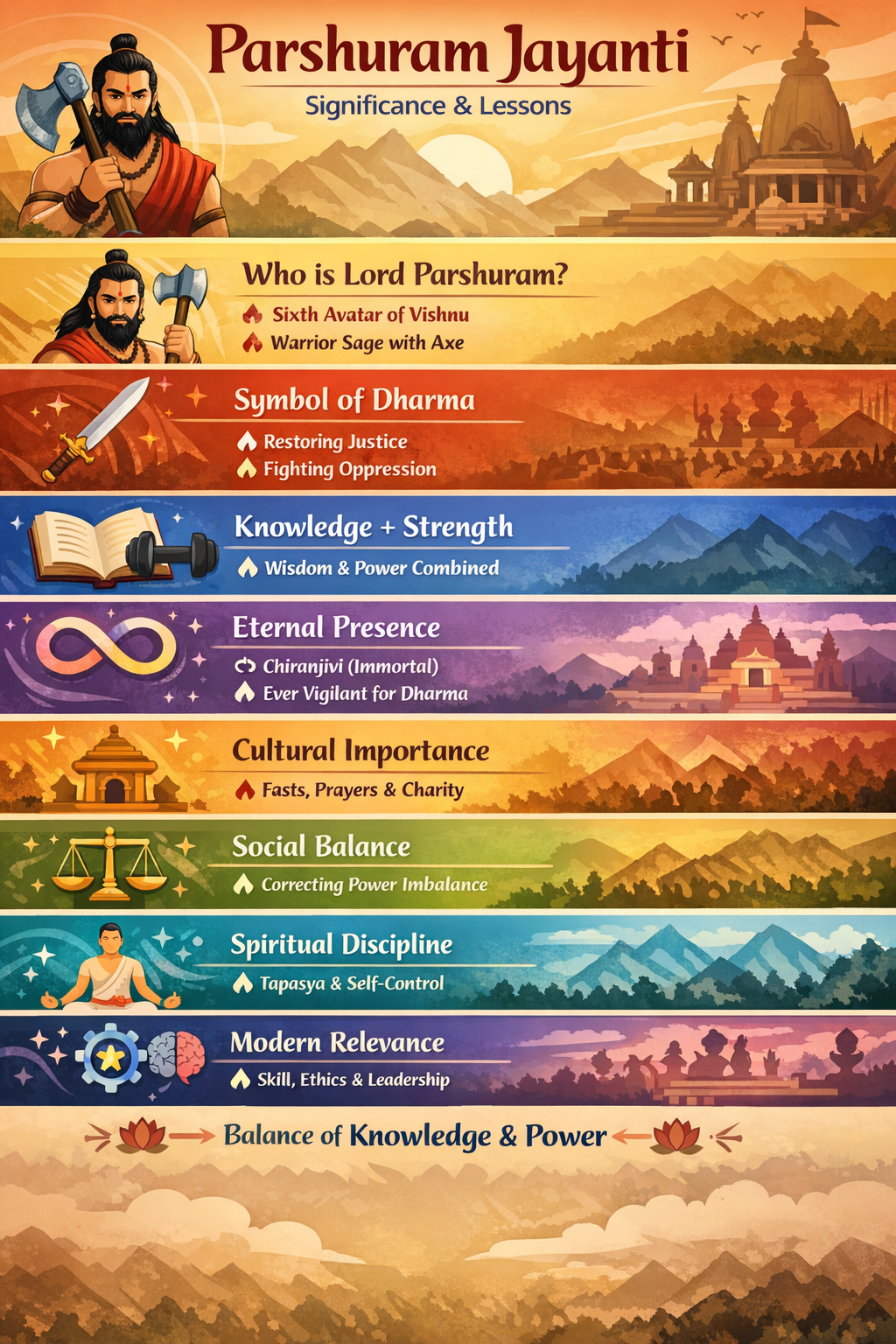
Parshuram Jayanti is a deeply significant Hindu festival that celebrates the birth of Lord Parshuram, the sixth incarnation of Lord Vishnu. It is observed on the third day (Tritiya) of the Shukla Paksha in the month of Vaishakha, often coinciding with Akshaya Tritiya.
Let’s break down its religious, cultural, and philosophical significance in detail:
Parshuram was born to sage Jamadagni and Renuka.
Warrior sage (Brahmin + Kshatriya qualities)
Master of warfare and weapons
Devotee of Lord Shiva
Known for his axe (Parshu), given by Shiva
👉 His life represents the balance between knowledge (Brahmin) and power (Kshatriya).
Parshuram Jayanti highlights the importance of restoring dharma.
According to Hindu texts, Parshuram eliminated corrupt and tyrannical rulers (Kshatriyas) 21 times.
His mission was not violence for power, but justice against oppression.
👉 Significance:
Teaches that power must be used ethically
Standing against injustice is a duty
Unlike most avatars, Parshuram is both:
A Brahmin (knowledge, wisdom)
A warrior (strength, action)
True leadership requires:
Intelligence
Discipline
Courage
👉 In modern terms:
Not just skills, but character + ethics + action matter
Parshuram is considered a Chiranjivi (immortal being).
He is still alive and will appear again as a mentor to Kalki.
👉 Significance:
Represents eternal vigilance of dharma
Good forces are always present, even if unseen
Parshuram Jayanti is especially important in:
North India (Brahmin communities)
Maharashtra
Gujarat
Fasting (vrat)
Temple visits
Recitation of scriptures
Charity and donations
👉 Cultural message:
Respect for teachers, discipline, and tradition
Parshuram’s story is often interpreted as:
A correction of power imbalance in society
No group should misuse authority
Systems must self-correct when corruption rises
👉 Very relevant today:
Governance, ethics, leadership accountability
Parshuram was known for intense penance (tapasya).
Inner strength > outer strength
Self-control leads to true power
👉 Practical takeaway:
Discipline, consistency, and focus are key to success
What Parshuram Jayanti teaches for your career:
Skill + Discipline = Power
Stand against shortcuts and unethical practices
Be both:
Thinker
Doer
👉 In simple words:
"Be sharp in mind, strong in action, and ethical in decisions."
Parshuram Jayanti is not just a religious festival—it represents:
Justice over injustice
Discipline over chaos
Balance of knowledge and power
Ethical leadership
 Continue With Google
  Religion and Spirituality