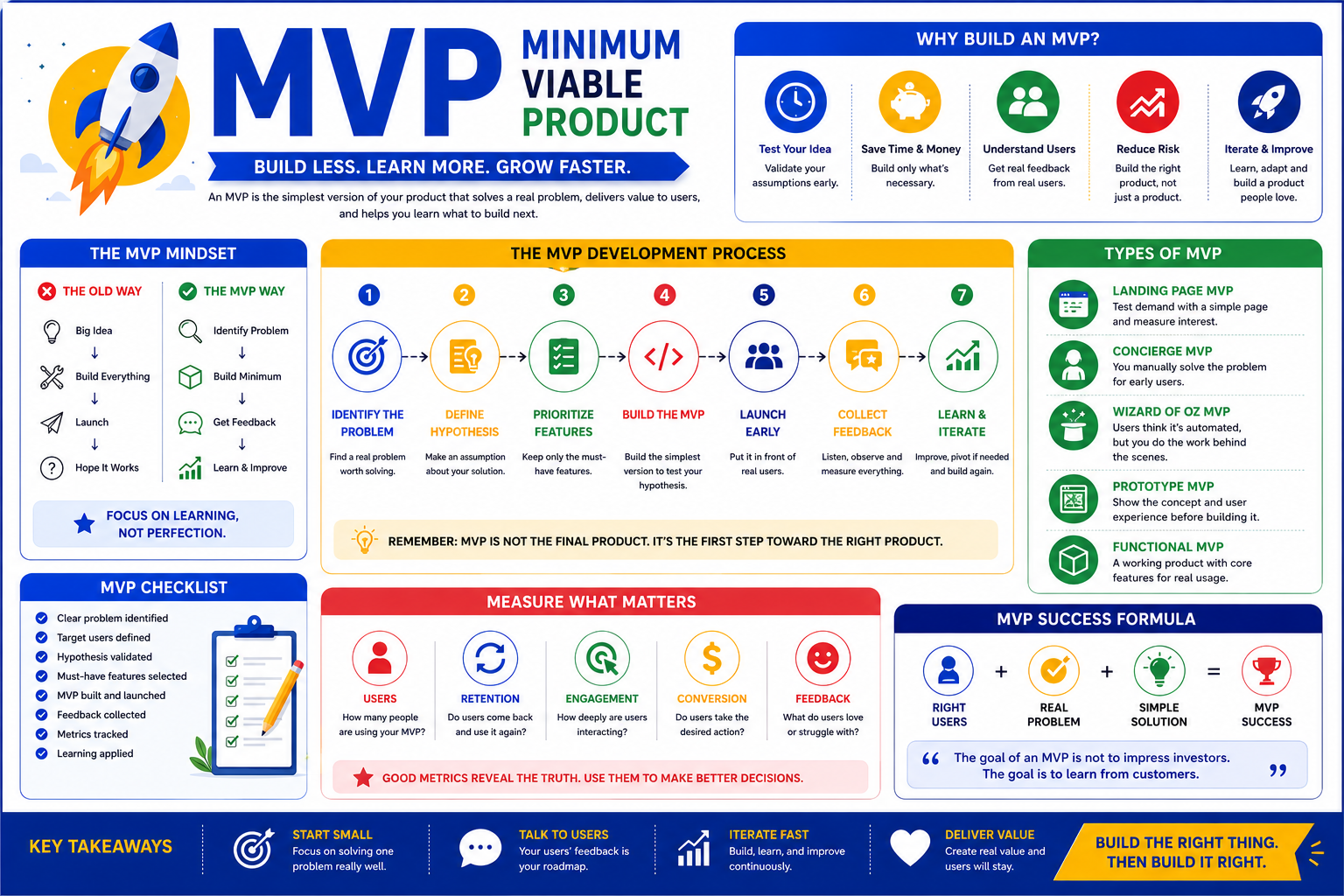
MVP stands for:
Minimum Viable Product
It is the simplest version of a product that:
Solves A Real Problem
          +
Can Be Used By Customers
          +
Allows Learning
An MVP is:
The smallest product you can build to test whether customers actually want your solution.
Imagine you want to open a restaurant.
Wrong Approach:
Build Huge Restaurant
      ↓
Hire Large Staff
      ↓
Spend ₹50 Lakh
      ↓
Then Test Demand
Huge risk.
Smart MVP Approach:
Small Food Stall
       ↓
Sell Food
       ↓
Collect Feedback
       ↓
Validate Demand
If people love it:
Expand Later
Many startups fail because they build:
Too Many Features
before knowing whether customers want them.
Without MVP
Big Idea
     ↓
Build Everything
     ↓
Spend Money
     ↓
Customers Don't Care
With MVP
Big Idea
     ↓
Build Minimum Version
     ↓
Get Feedback
     ↓
Improve Product
The goal is NOT:
Build Perfect Product
The goal is:
Learn Fast
Minimum Features
         +
Maximum Learning
Problem
   ↓
Solution Idea
   ↓
MVP
   ↓
Customer Feedback
   ↓
Learning
   ↓
Improvement
MVP
 ≠
 Finished Product
Wrong:
Buggy Product
      ↓
Call It MVP
MVP should still:
Work Properly
Solve Core Problem
Provide Value
Instead of asking:
What Can We Build?
Ask:
What Is The Smallest Thing
We Can Build To Learn?
Every MVP begins with a problem.
Bad Thinking
Build Cool Technology
Good Thinking
Solve Important Problem
Problem Discovery Flow
Customer Pain
       ↓
Problem
       ↓
Opportunity
Customers struggle with:
Managing Personal Expenses
Problem:
Expense Tracking Is Difficult
A hypothesis is an assumption.
Example:
If we build a simple expense tracker,
people will use it daily.
Hypothesis Flow
Assumption
      ↓
Build MVP
      ↓
Test Assumption
Validate Hypothesis
Many beginners try to include:
50 Features
MVP focuses on:
One Core Value
Example
Goal:
Help Users Track Expenses
Core Value:
Record Expense
View Summary
Not:
AI
Social Features
Gamification
Themes
Rewards
Problem
   ↓
Core Solution
   ↓
MVP
Ask:
Must Have?

or

Nice To Have?
Without them:
Product Doesn't Work
Can wait.
Example
Expense App MVP:
Must Have
Add Expense

View Expense

Category
Can Wait
AI Insights

Dark Mode

Social Sharing

Rewards
Feature Ideas
       ↓
Must Have
       ↓
Build MVP
Many founders overbuild.
Bad
Version 1
     ↓
Everything
Good
Version 1
     ↓
One Problem
One Solution
Core Features
      ↓
Build
      ↓
Launch
Simplest MVP.
Flow
Idea
 ↓
Landing Page
 ↓
Measure Interest
Goal:
Validate Demand
Interactive demonstration.
Flow
Concept
   ↓
Prototype
   ↓
User Feedback
Goal:
Validate Experience
Manual service.
Instead of software:
Humans Perform Tasks
Flow
Customer Request
       ↓
Manual Fulfillment
Goal:
Understand Customer Needs
Looks automated.
Actually manual behind the scenes.
Flow
Customer Uses Product
          ↓
Manual Processing
Goal:
Validate Solution
Before Building Technology
Real working product.
Flow
Core Features
      ↓
Real Users
Goal:
Validate Product-Market Fit
Many founders spend years building.
MVP Philosophy
Launch Early
Flow
Build
 ↓
Launch
 ↓
Learn
Customers reveal:
What Works

What Doesn't Work

What They Actually Want
After launch:
Don't guess.
Measure.
Track:
Users

Retention

Feedback

Engagement

Conversions
Measurement Flow
Users
  ↓
Behavior
  ↓
Insights
Do Users Sign Up?

Do They Return?

Do They Pay?

Would They Recommend It?
MVP is not the destination.
Flow
Build
 ↓
Launch
 ↓
Learn
 ↓
Improve
 ↓
Repeat
Version 1
      ↓
Feedback
      ↓
Version 2
      ↓
Feedback
      ↓
Version 3
Popularized by:
Eric Ries
Framework:
BUILD
   ↓
MEASURE
   ↓
LEARN
   ↓
BUILD AGAIN
| MVP | Full Product |
|---|---|
| Minimum Features | Many Features |
| Fast Build | Longer Development |
| Validate Assumptions | Scale Business |
| Learn Quickly | Optimize Growth |
| Lower Cost | Higher Cost |
Identify Problem
        ↓
Define Hypothesis
        ↓
Identify Core Value
        ↓
Select Must-Have Features
        ↓
Build MVP
        ↓
Launch
        ↓
Collect Feedback
        ↓
Iterate
Problem
 ↓
People Need Expense Tracking
 ↓
Build Simple Tracker
 ↓
Launch To 100 Users
 ↓
Collect Feedback
 ↓
Improve Features
 ↓
Grow Product
Building Too Many Features
MVP
 ↓
50 Features
Not MVP.
Trying To Be Perfect
Perfect Product
       ↓
Never Launch
Ignoring Customer Feedback
Launch
 ↓
Ignore Users
Building Before Validation
Build
 ↓
Build
 ↓
Build
 ↓
No Customers
No Success Metrics
Without metrics:
No Learning
□ Real Problem Identified

□ Hypothesis Defined

□ Core Value Clear

□ Must-Have Features Selected

□ MVP Built

□ Users Acquired

□ Metrics Tracked

□ Feedback Collected

□ Iterations Planned
Customer Problem
         ↓
Idea
         ↓
Hypothesis
         ↓
MVP
         ↓
Launch
         ↓
Feedback
         ↓
Learning
         ↓
Improvement
         ↓
Product-Market Fit
STEP 1
Find Real Customer Problem
           ↓
STEP 2
Define Hypothesis
           ↓
STEP 3
Identify Core Value
           ↓
STEP 4
Choose Must-Have Features
           ↓
STEP 5
Build Simplest Product
           ↓
STEP 6
Launch Quickly
           ↓
STEP 7
Measure Results
           ↓
STEP 8
Collect Feedback
           ↓
STEP 9
Improve Product
           ↓
STEP 10
Repeat
An MVP is not about:
Building Less
It is about:
Learning Faster
The essence of MVP Development is:
PROBLEM
    ↓
HYPOTHESIS
    ↓
MVP
    ↓
FEEDBACK
    ↓
LEARNING
    ↓
IMPROVEMENT
The most successful products are rarely built perfectly on the first attempt.
They start with a simple MVP, learn from real customers, and improve through continuous iteration until they achieve strong product-market fit.
 Continue With Google
  Business

