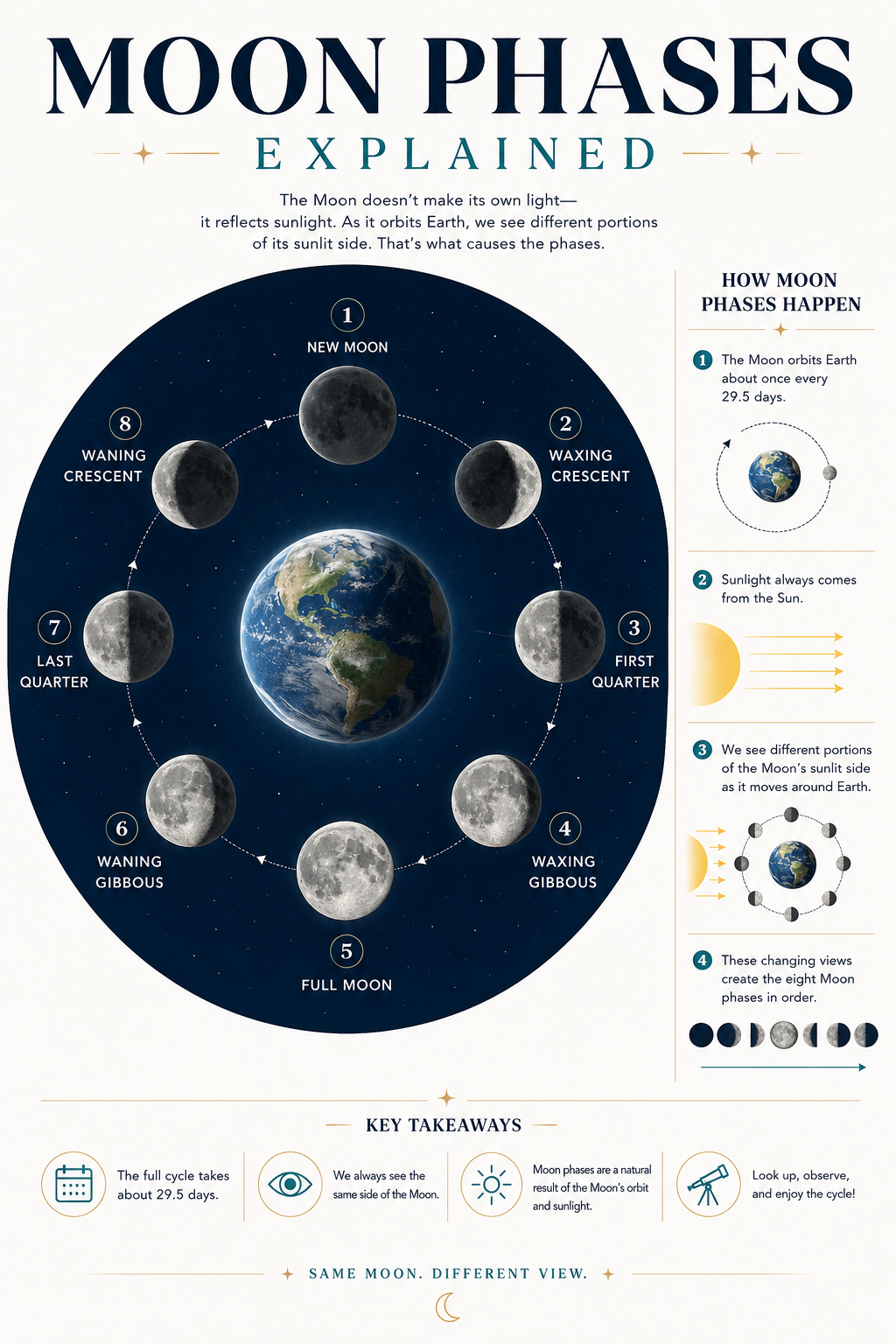
The Moon does not produce its own light. It reflects sunlight.
As the Moon orbits Earth, different portions of its sunlit side become visible from our perspective.
This changing visibility creates what we call moon phases.
The complete lunar cycle takes approximately 29.5 days.
The eight major phases are:
1. New Moon
The Moon is positioned between Earth and the Sun.
The illuminated side faces away from Earth, making the Moon nearly invisible from our view.
2. Waxing Crescent
A small portion of the Moon begins to appear.
“Waxing” means the visible illuminated portion is increasing.
3. First Quarter
Half of the Moon appears illuminated.
The Moon has completed roughly one quarter of its orbit around Earth.
4. Waxing Gibbous
More than half of the Moon is visible, but it is not yet fully illuminated.
5. Full Moon
Earth is positioned between the Sun and Moon.
The entire illuminated side faces Earth, making the Moon appear fully bright.
6. Waning Gibbous
After the full moon, the illuminated portion begins decreasing.
“Waning” means visible light is reducing.
7. Last Quarter
Half of the Moon is visible again, but the opposite side is illuminated compared to first quarter.
8. Waning Crescent
Only a small illuminated section remains visible before returning to a new moon.
Why Moon Phases Happen
Moon phases are caused by orbital position and changing viewing angles between:
Sun
Earth
Moon
The Moon itself does not change shape.
Important Idea
What appears to be transformation is actually changing light and perspective caused by celestial movement.
 Continue With Google
  Science
 Sanskrit and Vedas
 Education