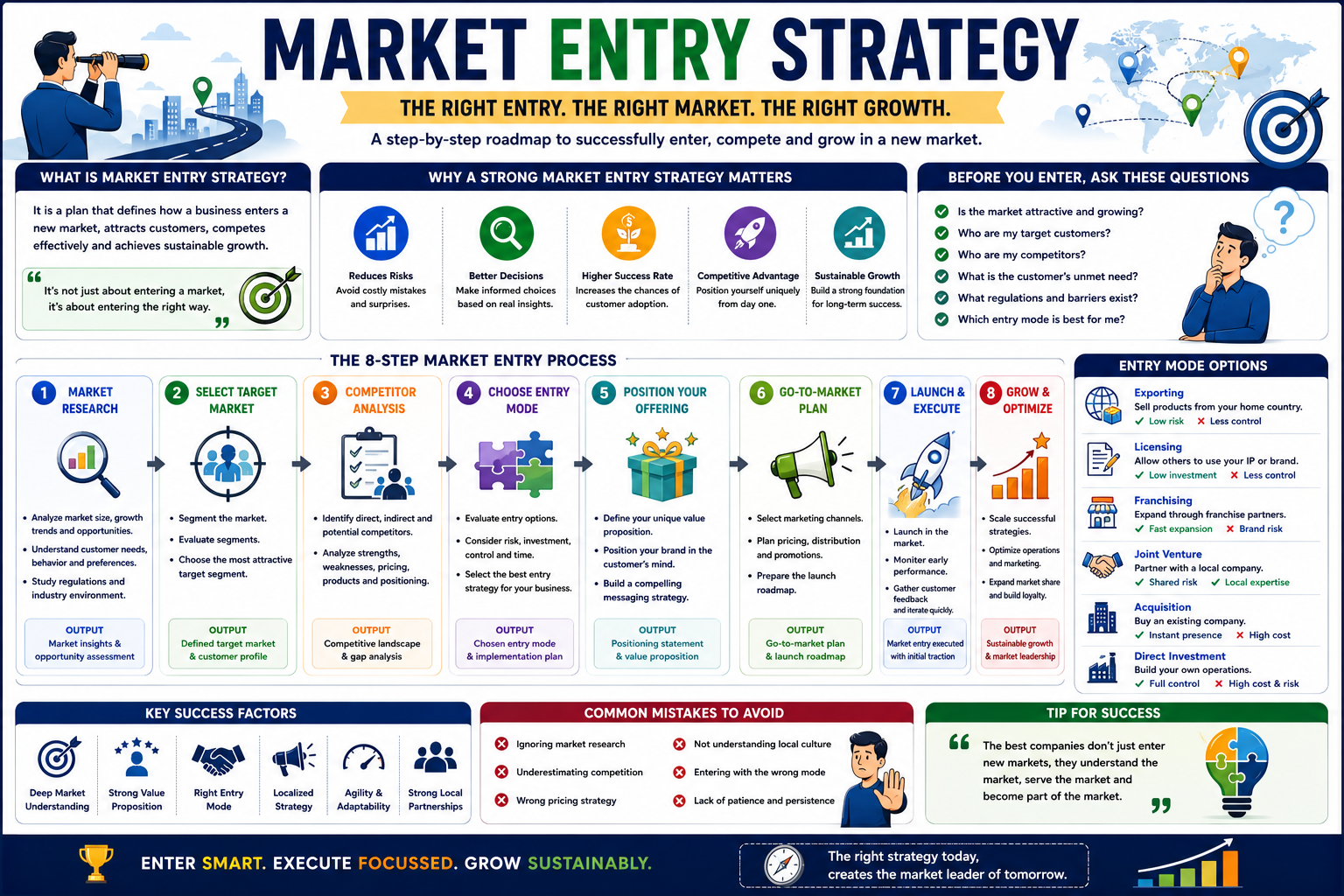
A Market Entry Strategy is a plan that explains:
How a business will enter a new market, attract customers, compete effectively, and generate revenue.
Simply put:
New Market
     ↓
Enter Market
     ↓
Acquire Customers
     ↓
Grow Business
Without a strategy:
Launch Product
      ↓
Hope For Success
With a strategy:
Research
   ↓
Plan
   ↓
Execute
   ↓
Grow
Imagine opening a restaurant in a new city.
Before opening, you need to know:
Who Lives Here?
What Food Do They Like?
Who Are Competitors?
What Prices Work?
Best Location?
Businesses entering new markets ask the same questions.
Many companies fail because they assume:
Success In One Market
          ↓
Automatic Success Everywhere
This is often wrong.
Different markets have:
Different Customers
Different Competitors
Different Cultures
Different Regulations
Different Buying Behaviors
Market Entry Strategy answers:
Which Market?
Who Are Customers?
How Will We Enter?
How Will We Compete?
How Will We Grow?
MARKET RESEARCH
        ↓
MARKET SELECTION
        ↓
ENTRY MODE
        ↓
POSITIONING
        ↓
LAUNCH
        ↓
GROWTH
Before entering a market:
Understand Market First
Never:
Launch First
Think Later
How Large Is The Market?

Is It Growing?

Who Are Customers?

Who Are Competitors?

What Problems Exist?

What Trends Are Emerging?
Market Data
      ↓
Customer Insights
      ↓
Business Opportunities
Suppose you want to launch an online fitness platform.
Research:
Market Size
Customer Demographics
Fitness Trends
Competitors
Pricing
Not every market is attractive.
Market Size
Growth Rate
Competition
Profitability
Entry Barriers
Customer Demand
Large Market
      +
Growing Demand
      +
Manageable Competition
      ↓
Attractive Market
Market A
Huge Demand
Low Competition
Attractive.
Market B
Small Demand
High Competition
Less attractive.
Many businesses fail because they target:
Everyone
Successful businesses target:
Specific Customer Segment
Age
Income
Location
Profession
Lifestyle
Needs
Instead of:
Fitness For Everyone
Target:
Busy Working Professionals
Age 25-40
Much clearer.
Market
   ↓
Segment
   ↓
Target Audience
   ↓
Positioning
Before entering:
Understand Existing Players
Study:
Pricing
Products
Features
Marketing
Customer Reviews
Strengths
Weaknesses
Competitor Research
         ↓
Identify Gaps
         ↓
Create Advantage
Customers complain about:
Slow Support
Complex Pricing
Opportunity:
Fast Support
Simple Pricing
This is one of the most important decisions.
Exporting
Licensing
Franchising
Partnership
Joint Venture
Acquisition
Direct Investment
Sell products directly into another market.
Flow
Manufacture Product
         ↓
Ship To Market
         ↓
Sell
Advantages
Low Risk
Low Investment
Disadvantages
Less Control
Logistics Challenges
Allow another company to use your intellectual property.
Flow
License Technology
        ↓
Partner Operates
        ↓
Receive Fees
Advantages
Low Cost
Fast Expansion
Disadvantages
Less Control
Popular in retail and food industries.
Flow
Business Model
      ↓
Franchise Partner
      ↓
Local Operations
Advantages
Rapid Expansion
Lower Capital Need
Partner with a local company.
Flow
Company A
      +
Company B
      ↓
Shared Business
Advantages
Local Expertise
Shared Risk
Buy an existing company.
Flow
Acquire Company
       ↓
Instant Market Presence
Advantages
Fast Entry
Existing Customers
Disadvantages
Expensive
Integration Risk
Build your own operations.
Flow
Build Office
     ↓
Hire Team
     ↓
Operate Directly
Advantages
Maximum Control
Disadvantages
Highest Cost
Highest Risk
Positioning answers:
Why should customers choose us?
Target Customer
       ↓
Customer Problem
       ↓
Unique Value
       ↓
Positioning Message
Lowest Cost
Highest Quality
Fastest
Easiest
Newest Technology
Customer Need
       ↓
Unique Solution
       ↓
Market Position
Now launch.
SEO
Content Marketing
Social Media
YouTube
Ads
Partnerships
Referrals
Email Marketing
Awareness
    ↓
Interest
    ↓
Trial
    ↓
Purchase
After launch:
Measure
     ↓
Learn
     ↓
Improve
     ↓
Scale
Customer Acquisition Cost
Revenue
Market Share
Retention Rate
Customer Satisfaction
Growth Rate
Identify Opportunity
         ↓
Research Market
         ↓
Evaluate Competition
         ↓
Choose Target Customer
         ↓
Select Entry Mode
         ↓
Develop Positioning
         ↓
Launch Product
         ↓
Acquire Customers
         ↓
Optimize Strategy
         ↓
Scale Business
Market entry often falls into:
Existing Product
      +
New Market
This is called:
Market Development
Flow
Existing Product
       ↓
New Geography
       ↓
New Customers
       ↓
Growth
| Entry Method | Cost | Risk | Control |
|---|---|---|---|
| Exporting | Low | Low | Low |
| Licensing | Low | Low | Low |
| Franchising | Medium | Medium | Medium |
| Joint Venture | Medium | Medium | Medium |
| Acquisition | High | High | High |
| Direct Investment | Very High | Very High | Very High |
No Market Research
Assumption
     ↓
Wrong Decisions
Ignoring Local Preferences
Works Here
     ↓
Fails There
Entering Highly Competitive Markets
Without differentiation.
Wrong Pricing Strategy
Too Expensive
     ↓
No Customers

Too Cheap
     ↓
No Profit
Choosing Wrong Entry Mode
High Investment
        ↓
Limited Demand
MARKET ATTRACTIVENESS
          ↓
CUSTOMER DEMAND
          ↓
COMPETITOR ANALYSIS
          ↓
ENTRY MODE
          ↓
POSITIONING
          ↓
GO-TO-MARKET
          ↓
SCALING
STEP 1
Identify Market Opportunity
          ↓
STEP 2
Conduct Market Research
          ↓
STEP 3
Select Target Customers
          ↓
STEP 4
Analyze Competitors
          ↓
STEP 5
Choose Entry Strategy
          ↓
STEP 6
Create Positioning
          ↓
STEP 7
Launch Product
          ↓
STEP 8
Measure Results
          ↓
STEP 9
Optimize & Scale
Market Entry Strategy is not simply:
Enter New Market
It is a structured process:
Research
    ↓
Understand Customers
    ↓
Analyze Competitors
    ↓
Choose Entry Method
    ↓
Position Correctly
    ↓
Launch
    ↓
Scale
The most successful companies don't enter markets because they look attractive.
They enter markets where:
✅ Customer demand exists
✅ A clear competitive advantage exists
✅ The entry model fits the business
✅ Growth can be sustained over time
That is the essence of a Market Entry Strategy.
 Continue With Google
  Economics
 Business

