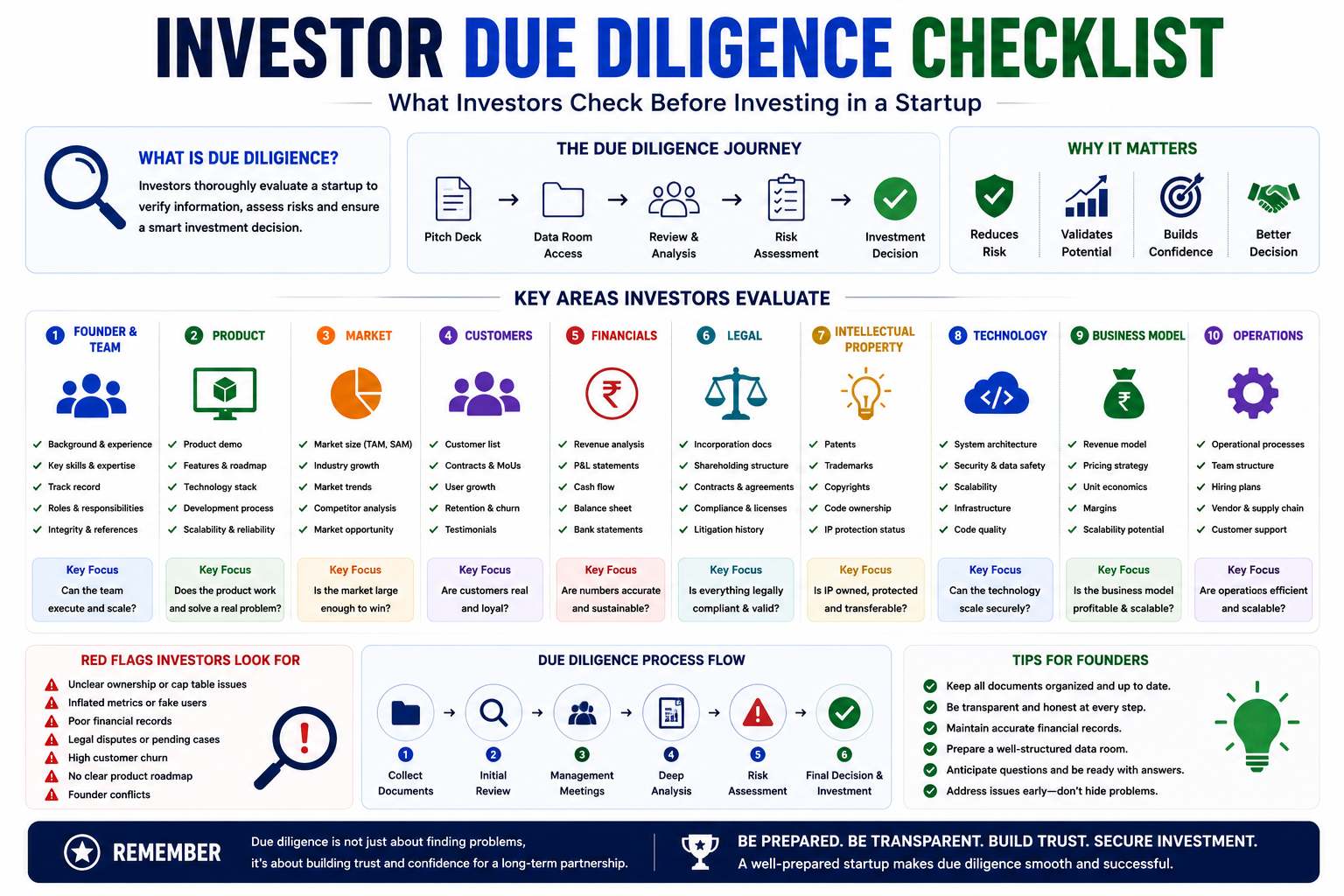
Investor Due Diligence is the process where investors thoroughly investigate a startup before investing money.
Think of it as:
Investor
    ↓
Trust But Verify
    ↓
Due Diligence
    ↓
Investment Decision
Imagine buying a house.
Before paying ₹1 Crore, you check:
Ownership Documents
Construction Quality
Location
Legal Issues
Water Supply
Electricity
You don't buy first and verify later.
Investors do the same.
Before investing:
Startup Claims
       ↓
Verification
       ↓
Investment
Investors want to reduce risk.
Without Due Diligence
Startup Pitch
      ↓
Blind Investment
      ↓
High Risk
With Due Diligence
Startup Pitch
      ↓
Verification
      ↓
Confidence
      ↓
Investment
Investors ask:
Is this startup
really what it claims to be?
TEAM
 ↓
PRODUCT
 ↓
MARKET
 ↓
CUSTOMERS
 ↓
FINANCIALS
 ↓
LEGAL
 ↓
OPERATIONS
 ↓
RISKS
 ↓
INVESTMENT DECISION
Most investors invest in people first.
Founders
Leadership Team
Experience
Skills
Track Record
Integrity
Can this team execute?

Can they handle growth?

Can they survive challenges?

Do they understand the market?
Founders
     ↓
Capabilities
     ↓
Execution Potential
Resumes
LinkedIn Profiles
Employment History
References
Founder Disputes
Frequent Job Hopping
Unclear Responsibilities
Poor Leadership
Investors verify the product.
Questions:
Does it work?

Is it unique?

Can it scale?

Does it solve a real problem?
Problem
    ↓
Solution
    ↓
Customer Value
Product Demo
Features
Roadmap
Technology Stack
Development Process
Product Claim
       ↓
Live Demonstration
       ↓
Verification
Product Not Working
No Clear Roadmap
Unstable Technology
Investors evaluate market opportunity.
Questions:
How big is the market?

Is it growing?

Can this become large?
Industry
    ↓
Target Market
    ↓
Market Size
    ↓
Growth Potential
Industry Reports
Competitor Analysis
Customer Demand
Market Trends
Tiny Market
Declining Industry
No Demand
Investors verify customers are real.
Questions:
Who are the customers?

Do they love the product?

Will they stay?
Users
   ↓
Feedback
   ↓
Retention
   ↓
Revenue
Customer Lists
Contracts
Testimonials
Retention Data
Usage Metrics
Customer Growth
Retention Rate
Churn Rate
Customer Satisfaction
Fake Users
Low Retention
High Churn
No Engagement
One of the most important areas.
Revenue
Expenses
Profitability
Cash Flow
Debt
Revenue
    ↓
Expenses
    ↓
Cash Position
    ↓
Financial Health
Profit & Loss Statements
Balance Sheets
Cash Flow Statements
Bank Statements
Tax Returns
Are revenues real?

Are expenses accurate?

How long will cash last?
Inflated Revenue
Hidden Debt
Missing Records
Poor Accounting
Investors ensure there are no legal surprises.
Company Formation
Shareholding
Contracts
Compliance
IP Ownership
Legal Documents
        ↓
Verification
        ↓
Risk Assessment
Incorporation Certificate
Shareholder Agreements
Employment Contracts
Vendor Contracts
Customer Contracts
Who owns the company?

Who owns the IP?

Are contracts valid?
Ownership Disputes
Missing Contracts
Regulatory Violations
Pending Lawsuits
Critical for technology startups.
Patents
Trademarks
Copyrights
Trade Secrets
Innovation
     ↓
Ownership
     ↓
Protection
Who owns the code?

Who owns the patents?

Can competitors copy it?
No IP Protection
Ownership Issues
Open-Source Violations
Especially important for software startups.
Architecture
Security
Scalability
Infrastructure
Code Quality
Technology
      ↓
Reliability
      ↓
Scalability
Can it handle growth?

Is it secure?

Is the code maintainable?
Security Vulnerabilities
Poor Architecture
Technical Debt
Investors verify:
How money is made
Customer
     ↓
Payment
     ↓
Revenue
Is revenue predictable?

Can margins improve?

Can the model scale?
No Revenue Model
Unsustainable Economics
Poor Margins
Investors check how the company runs daily.
Processes
Hiring
Operations
Supply Chain
Customer Support
People
   ↓
Processes
   ↓
Execution
Can operations scale?

Are processes documented?

Can growth be managed?
Founder Dependency
No Processes
Operational Chaos
Most startups create a:
Contains:
Financial Documents
Legal Documents
Product Information
Customer Data
Team Information
Company Documents
         ↓
Financials
         ↓
Legal
         ↓
Product
         ↓
Customers
Typically:
Initial Meeting
       ↓
Pitch Deck Review
       ↓
Data Room Access
       ↓
Management Meetings
       ↓
Deep Analysis
       ↓
Investment Decision
Pitch Deck
     ↓
Investor Interest
     ↓
Initial Meetings
     ↓
Document Collection
     ↓
Team Review
     ↓
Product Review
     ↓
Market Review
     ↓
Financial Review
     ↓
Legal Review
     ↓
Risk Assessment
     ↓
Investment Decision
☐ Incorporation Documents

☐ Cap Table

☐ Shareholder Agreements
☐ Founder Background

☐ Key Employees

☐ Employment Contracts
☐ Product Demo

☐ Roadmap

☐ Technology Review
☐ Customer List

☐ Contracts

☐ Retention Metrics
☐ Revenue Statements

☐ Cash Flow

☐ Bank Statements

☐ Tax Records
☐ Licenses

☐ Compliance

☐ Litigation History
☐ Patents

☐ Trademarks

☐ Code Ownership
Messy Documentation
Investor Requests Document
          ↓
Cannot Find It
Inflated Metrics
Investors verify everything.
Weak Financial Records
No Accurate Accounting
creates distrust.
Ignoring Legal Issues
Small legal problems become big investment blockers.
No Data Room
Creates delays and frustration.
LOW RISK
       ↓
Clean Records
Strong Team
Good Growth

MEDIUM RISK
       ↓
Minor Issues
Manageable Risks

HIGH RISK
       ↓
Legal Problems
Financial Issues
Weak Team
TEAM
 ↓
PRODUCT
 ↓
MARKET
 ↓
TRACTION
 ↓
FINANCIALS
 ↓
LEGAL
 ↓
RISK
 ↓
INVEST?
STEP 1
Organize Company Documents
           ↓
STEP 2
Prepare Financial Statements
           ↓
STEP 3
Document Product & Technology
           ↓
STEP 4
Prepare Customer Metrics
           ↓
STEP 5
Review Legal Compliance
           ↓
STEP 6
Create Data Room
           ↓
STEP 7
Answer Investor Questions
           ↓
STEP 8
Complete Due Diligence
Investor Due Diligence is not about proving your startup is perfect.
It is about proving that:
Your Claims
      ↓
Match Reality
The essence of due diligence is:
VERIFY
   ↓
VALIDATE
   ↓
ASSESS RISK
   ↓
BUILD CONFIDENCE
   ↓
INVESTMENT
A startup that is organized, transparent, and prepared for due diligence dramatically increases its chances of securing investment and building long-term investor trust.
 Continue With Google
  Economics
 Business

