Introduction
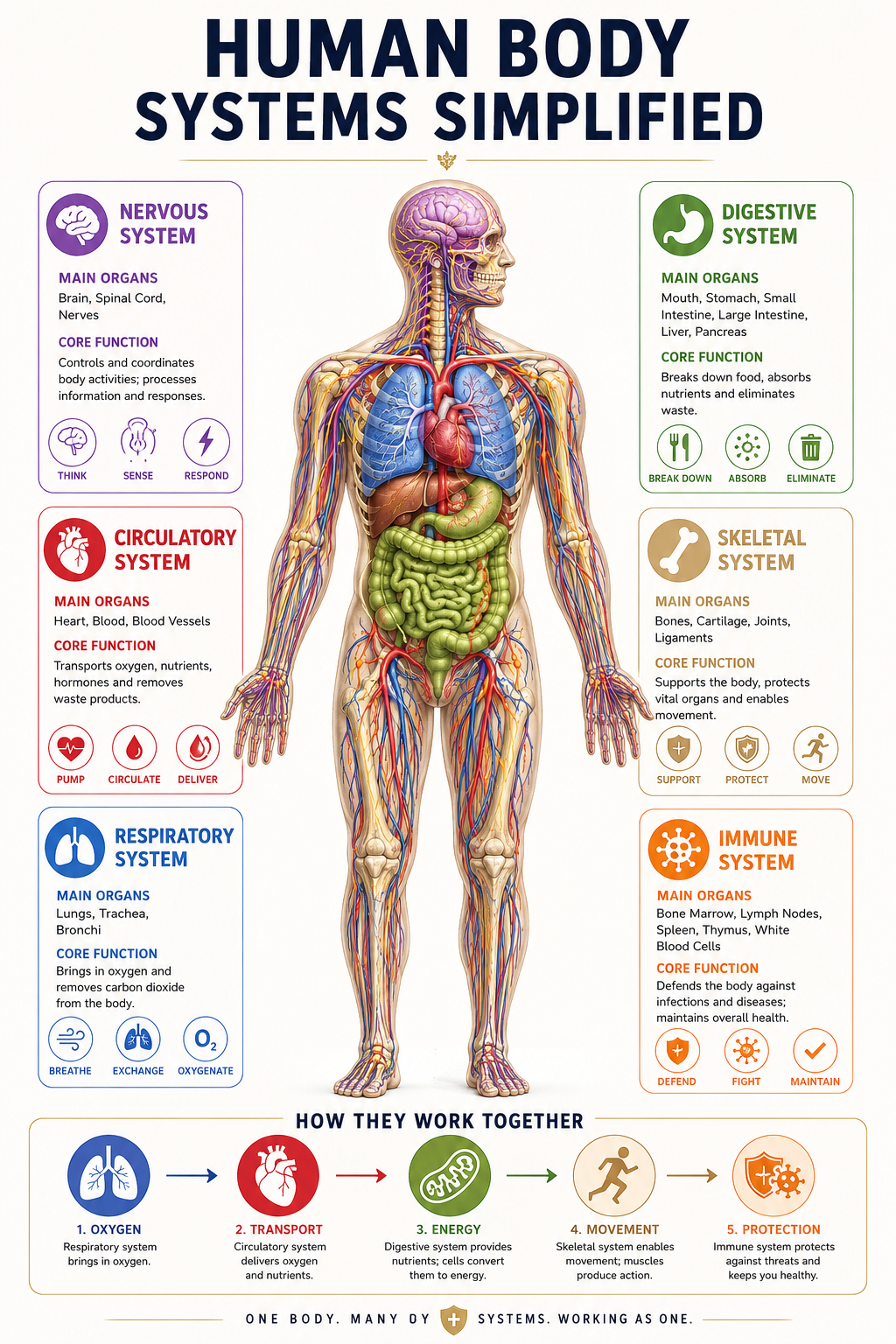
The human body functions through multiple organ systems that work together to maintain life. Each system performs specialized tasks, but no system operates independently. Survival depends on coordination between all of them.
1. Nervous System
The nervous system controls communication throughout the body.
Main organs:
- Brain
- Spinal cord
- Nerves
Functions:
- Sends signals
- Processes information
- Controls movement
- Regulates responses
It acts as the body’s command network.
2. Circulatory System
The circulatory system transports oxygen, nutrients and hormones throughout the body.
Main organs:
- Heart
- Blood vessels
- Blood
Functions:
- Delivers oxygen
- Removes waste
- Maintains circulation
It acts as the body’s transport system.
3. Respiratory System
The respiratory system helps the body exchange gases.
Main organs:
- Lungs
- Trachea
- Diaphragm
Functions:
- Brings in oxygen
- Removes carbon dioxide
It supports energy production.
4. Digestive System
The digestive system breaks down food into usable nutrients.
Main organs:
- Stomach
- Intestines
- Liver
Functions:
- Digests food
- Absorbs nutrients
- Removes waste
It powers the body.
5. Skeletal and Muscular System
These systems work together to provide movement and structure.
Functions:
- Support posture
- Protect organs
- Enable movement
They form the body’s structural framework.
6. Immune System
The immune system protects the body from harmful pathogens.
Functions:
- Detects threats
- Fights infections
- Builds defense mechanisms
It protects long-term health.
How They Work Together
The respiratory system brings oxygen.
The circulatory system transports it.
The digestive system provides nutrients.
The nervous system coordinates responses.
The skeletal and muscular systems enable movement.
The immune system protects the entire system.
Important Idea
The human body is not a collection of isolated organs.
It is an interconnected biological network where every system supports another.
 Continue With Google
  Science
 Health
 Education