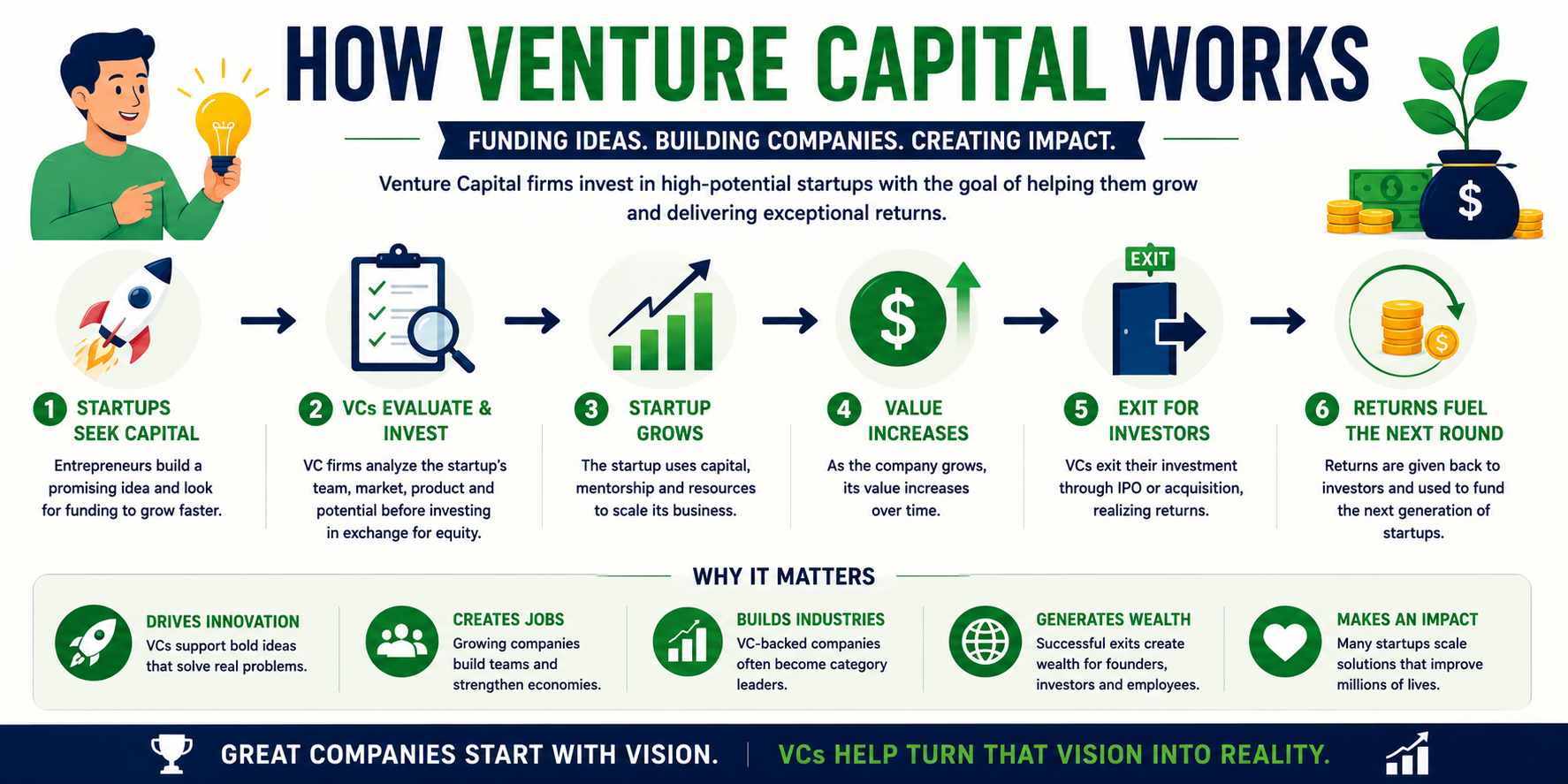
Venture Capital (VC) is a type of investment where investors provide money to startups and high-growth companies in exchange for ownership (equity).
Simply put:
Investor Gives Money
          ↓
Startup Gets Funding
          ↓
Investor Gets Ownership
Unlike a bank loan:
Bank
 ↓
Loan
 ↓
Must Repay
VC funding works like:
Investor
 ↓
Investment
 ↓
Ownership Share
No monthly EMI.
No fixed repayment.
Imagine you have a great idea:
Online Education Platform
But you need:
Developers
Marketing
Servers
Operations
You need:
₹2 Crore
but don't have the money.
An investor says:
I will invest ₹2 Crore
In return:
I want 20% ownership
Now:
Founder Owns 80%

Investor Owns 20%
This is Venture Capital.
Many startups have:
Big Opportunity
but:
Limited Cash
VC helps bridge the gap.
Flow:
Great Idea
     ↓
Need Capital
     ↓
VC Funding
     ↓
Business Growth
VC investors do not invest because they like ideas.
They invest because they expect returns.
Goal:
Invest Small
      ↓
Startup Grows
      ↓
Company Value Increases
      ↓
Sell Ownership
      ↓
Earn Huge Return
Investor:
Invests ₹1 Crore
for:
10% Equity
Five years later:
Company Worth ₹500 Crore
Investor's stake:
10% of ₹500 Crore
Value:
₹50 Crore
Huge return.
Several players are involved.
Needs money.
Founder
     ↓
Build Business
Provides funding.
VC Firm
      ↓
Invests Money
Provide money to VC firms.
Examples:
Pension Funds
Universities
Corporations
Wealthy Individuals
Limited Partners
        ↓
VC Fund
        ↓
Startup
        ↓
Business Growth
VC firms do not usually invest their own money.
Flow:
Investors (LPs)
       ↓
VC Fund
       ↓
Startup Investments
VC firms manage the money.
Raise Fund
     ↓
Find Startups
     ↓
Invest
     ↓
Help Startup Grow
     ↓
Exit
     ↓
Return Profits
Not all startups receive the same amount.
Funding happens in stages.
Founder uses personal resources.
Flow:
Founder Savings
       ↓
Business
Advantages:
100% Ownership
Disadvantages:
Limited Capital
Early support.
Flow:
Friends
Family
     ↓
Small Investment
Usually:
₹1 Lakh – ₹50 Lakh
Individual investors.
Definition:
Wealthy Individuals
        ↓
Invest Early
Example:
Angel Investor
      ↓
₹50 Lakh Investment
Purpose:
Validate Business
Build MVP
Acquire Early Customers
First major institutional funding.
Flow:
Startup
    ↓
Seed VC Investment
Used for:
Product Development
Hiring
Marketing
Growth
Focus:
Product-Market Fit
Company has:
Customers
Revenue
Growth
Goal:
Scale Business
Focus:
Expansion
Used for:
New Markets
New Teams
New Products
Focus:
Rapid Scaling
Global Expansion
Acquisitions
Bootstrap
     ↓
Friends & Family
     ↓
Angel
     ↓
Seed
     ↓
Series A
     ↓
Series B
     ↓
Series C+
     ↓
IPO / Acquisition
Equity means ownership.
Example
Company ownership:
Founder A = 60%

Founder B = 40%
VC invests.
New ownership:
Founder A = 48%

Founder B = 32%

Investor = 20%
This is called:
Equity Dilution
Every funding round:
New Investors Join
       ↓
Ownership Shares Change
Flow:
Funding
    ↓
New Shares
    ↓
Dilution
Valuation = Estimated company worth.
Example
VC says:
Your Startup Is Worth ₹10 Crore
This is:
Pre-Money Valuation
VC invests:
₹2 Crore
Company value becomes:
₹12 Crore
This is:
Post-Money Valuation
Visualization
Pre-Money
₹10 Crore
      +
Investment
₹2 Crore
      ↓
Post-Money
₹12 Crore
VCs evaluate several factors.
Most important.
Questions:
Can They Execute?

Can They Adapt?

Can They Build?
VCs prefer large opportunities.
Flow:
Large Market
      ↓
Large Growth Potential
Questions:
Does It Solve A Real Problem?
Investors love:
Fast Growth
Examples:
Brand
Technology
Network Effects
Data
Community
Team
 ↓
Market
 ↓
Product
 ↓
Growth
 ↓
Moat
 ↓
Investment Decision
VCs do more than provide money.
They often help with:
Hiring
Partnerships
Strategy
Fundraising
Introductions
Flow
Money
  +
Guidance
  +
Network
VCs eventually want their money back.
Another company buys the startup.
Flow:
Startup
    ↓
Acquired
    ↓
Investors Get Paid
Initial Public Offering.
Flow:
Private Company
       ↓
Public Company
       ↓
Investors Sell Shares
VCs know:
Many Startups Fail
Portfolio Example:
10 Investments

6 Fail
2 Break Even
1 Moderate Success
1 Massive Success
That one winner often generates:
Most Returns
Raise Fund
      ↓
Invest In Startups
      ↓
Help Companies Grow
      ↓
Successful Exit
      ↓
Generate Returns
      ↓
Raise Bigger Fund
      ↓
Invest Again
Build Product
      ↓
Show Traction
      ↓
Prepare Pitch Deck
      ↓
Meet Investors
      ↓
Due Diligence
      ↓
Negotiate Terms
      ↓
Receive Funding
Raising Too Early
No Product
No Customers
Taking Money From Wrong Investors
Money
 ≠
 Good Investor
Focusing Only On Valuation
Higher valuation isn't always better.
Ignoring Dilution
Too much dilution can reduce founder control.
Thinking VC Is Free Money
VC money comes with:
Expectations
Growth Pressure
Accountability
| Factor | Venture Capital | Bank Loan |
|---|---|---|
| Ownership | Gives Equity | No Equity |
| Repayment | No EMI | Must Repay |
| Risk | Investor Takes Risk | Founder Takes Risk |
| Growth Focus | High Growth | Stable Business |
| Guidance | Often Yes | Usually No |
| Dilution | Yes | No |
Startup Idea
      ↓
Build MVP
      ↓
Gain Customers
      ↓
Raise Seed Funding
      ↓
Achieve Product-Market Fit
      ↓
Raise Series A
      ↓
Scale Business
      ↓
Raise Series B/C
      ↓
Expand
      ↓
IPO or Acquisition
      ↓
Investor Exit
STEP 1
Build Valuable Product
         ↓
STEP 2
Validate Customer Demand
         ↓
STEP 3
Show Growth
         ↓
STEP 4
Prepare Pitch Deck
         ↓
STEP 5
Meet Investors
         ↓
STEP 6
Raise Capital
         ↓
STEP 7
Scale Business
         ↓
STEP 8
Create Exit Opportunity
Venture Capital is not simply:
Getting Money
It is a partnership where:
Investors Provide Capital
            ↓
Startups Grow Faster
            ↓
Company Value Increases
            ↓
Both Sides Benefit
The essence of Venture Capital is:
Capital
   +
Growth
   +
Ownership
   +
Scale
   +
Exit
A successful VC-backed company turns:
Big Idea
    ↓
Growing Startup
    ↓
Scalable Business
    ↓
High-Value Company
and creates returns for founders, employees, and investors alike.
 Continue With Google
  Economics
 Business

