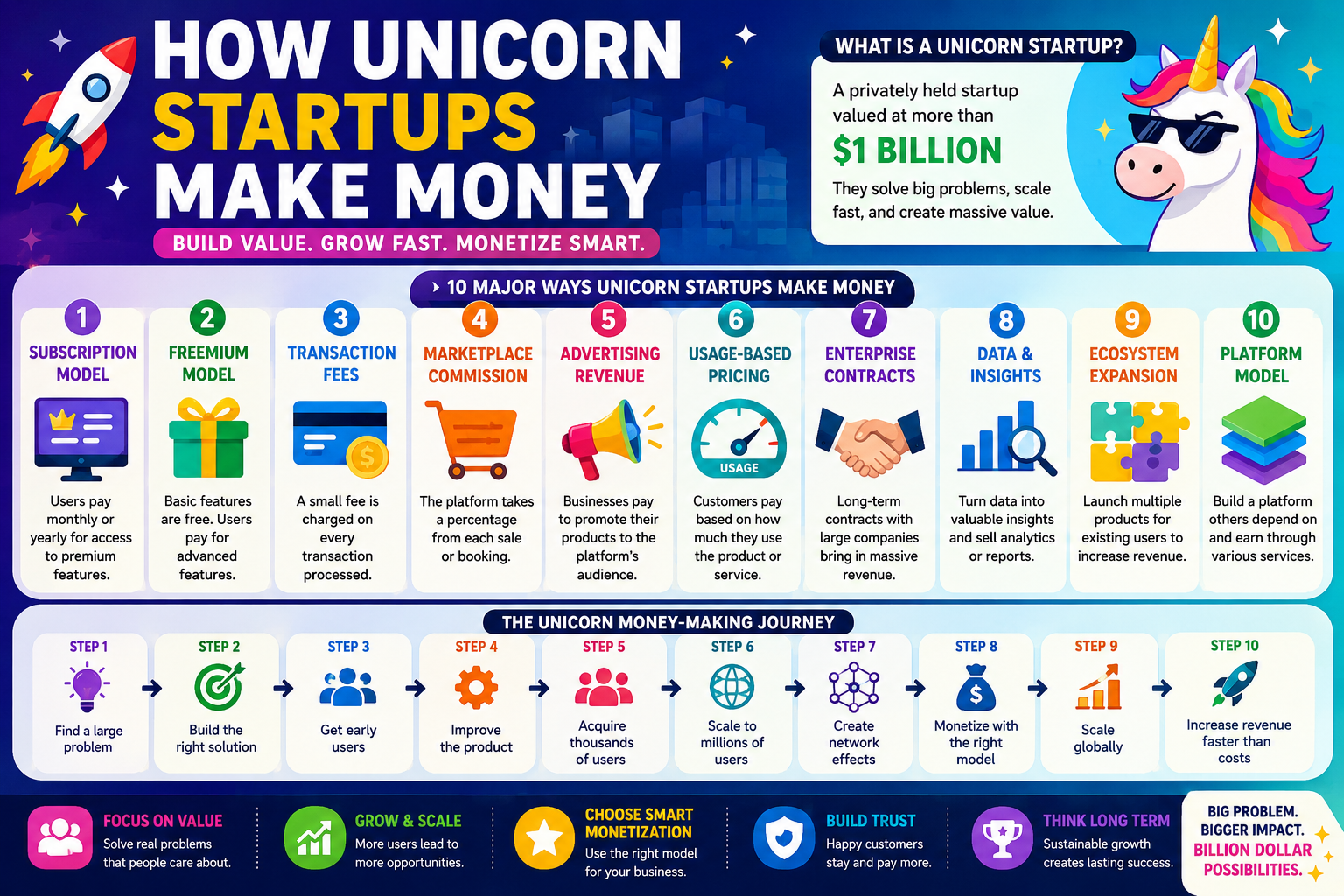
A Unicorn Startup is a privately held startup valued at more than $1 billion.
Examples include:
Stripe
Canva
Databricks
OpenAI
Many beginners think:
"If a company is worth billions, it must be making billions."
Not necessarily.
Some unicorns earn huge profits.
Some earn revenue but lose money.
Some focus on growth first and profits later.
Every unicorn startup eventually needs:
Revenue > Cost
Where:
Revenue = Money Coming In

Cost = Money Going Out

Profit = Revenue - Cost
Before making money, they create value.
Build Product
      │
      ▼
Sell Product
      │
      ▼
Earn Money
Solve Large Problem
        │
        ▼
Acquire Millions of Users
        │
        ▼
Create Network Effects
        │
        ▼
Monetize Users
        │
        ▼
Scale Revenue
Most common SaaS model.
Customers pay every month or year.
Examples:
Canva
Notion
Figma
Free User
     │
     ▼
Uses Product
     │
     ▼
Needs More Features
     │
     ▼
Buys Subscription
     │
     ▼
Monthly Revenue
Free Plan:
5 Projects
Premium Plan:
Unlimited Projects
Advanced Features
Priority Support
User upgrades and pays monthly.
Recurring Revenue
      +
Predictable Income
      +
High Customer Retention
One of the most powerful startup models.
90% Users = Free

10% Users = Paid
Those 10% often pay enough to support the business.
Millions Join Free
         │
         ▼
Product Becomes Popular
         │
         ▼
Some Need Premium Features
         │
         ▼
Upgrade to Paid
         │
         ▼
Revenue Generated
The free users become marketers.
More Users
      │
      ▼
More Visibility
      │
      ▼
More Paid Customers
The startup takes a small percentage from every transaction.
Examples:
Stripe
Coinbase
Customer Pays Seller
        │
        ▼
Platform Processes Payment
        │
        ▼
Platform Takes Fee
        │
        ▼
Remaining Amount Sent
Customer Pays ₹1000

Platform Fee = ₹30

Seller Receives ₹970
Scale this to millions of transactions.
The platform connects buyers and sellers.
Buyer
   │
   ▼
Marketplace
   │
   ▼
Seller
Platform earns commission.
Seller Price = ₹1000

Commission = 15%

Platform Earns ₹150
The platform doesn't own inventory.
More Sellers
      │
      ▼
More Buyers
      │
      ▼
More Transactions
      │
      ▼
More Revenue
Users don't pay.
Advertisers pay.
Examples:
Meta
Snap
Users Create Attention
          │
          ▼
Advertisers Want Attention
          │
          ▼
Advertisers Pay Platform
          │
          ▼
Platform Earns Revenue
Users are not the customer.
Advertisers are the customer.
Users are the audience.
Customers pay according to usage.
Examples:
OpenAI
Snowflake
Use More
   │
   ▼
Consume More Resources
   │
   ▼
Pay More
AI API
100 Requests = ₹X

1000 Requests = ₹10X
Revenue grows automatically with customer growth.
One company can be worth thousands of small customers.
Startup
    │
    ▼
Large Enterprise
    │
    ▼
Annual Contract
    │
    ▼
Millions in Revenue
Instead of:
10,000 Customers × ₹500
One enterprise may pay:
₹50,00,000+
per year.
Large Revenue
Long Contracts
High Retention
Some startups generate valuable business intelligence.
User Activity
      │
      ▼
Aggregate Data
      │
      ▼
Generate Insights
      │
      ▼
Sell Analytics Products
Important:
This is usually done with aggregated and compliant data practices, not by selling individual user information.
Many unicorns start with one product.
Then expand.
Product A
    │
    ▼
Large User Base
    │
    ▼
Launch Product B
    │
    ▼
Launch Product C
    │
    ▼
Increase Revenue
Acquiring customers is expensive.
Selling more products to existing customers is cheaper.
The most powerful model.
The startup becomes infrastructure.
Examples:
Stripe
Databricks
Developers
Businesses
Consumers
       │
       ▼
Use Platform
       │
       ▼
Depend on Platform
       │
       ▼
Platform Earns Revenue
Because they prioritize growth.
Spend ₹100
Acquire Customer
Customer lifetime value:
₹1000
So losing money today may create profit later.
Short-Term Loss
        │
        ▼
More Users
        │
        ▼
Market Leadership
        │
        ▼
Long-Term Profit
Many unicorns become huge because of network effects.
More Users
      │
      ▼
More Valuable Product
      │
      ▼
More New Users
      │
      ▼
Even More Value
This creates a growth loop.
STEP 1
Find Large Problem
      │
      ▼
STEP 2
Build Solution
      │
      ▼
STEP 3
Get Early Users
      │
      ▼
STEP 4
Improve Product
      │
      ▼
STEP 5
Acquire Thousands of Users
      │
      ▼
STEP 6
Acquire Millions of Users
      │
      ▼
STEP 7
Create Network Effects
      │
      ▼
STEP 8
Choose Monetization Model
      │
      ├─ Subscription
      ├─ Ads
      ├─ Commission
      ├─ Transaction Fees
      ├─ Enterprise Contracts
      ├─ Usage-Based Pricing
      └─ Platform Revenue
      │
      ▼
STEP 9
Scale Globally
      │
      ▼
STEP 10
Increase Revenue Faster Than Costs
      │
      ▼
Long-Term Sustainable Business
Most successful unicorns do not start by asking "How do I make money?"
They first ask:
What massive problem can I solve?
Then:
Can I solve it better than existing solutions?
Then:
Can I scale this solution to millions of users?
Only after creating significant value do they optimize the monetization model.
That is why the biggest unicorns focus on:
Problem
   ▼
Value
   ▼
Users
   ▼
Scale
   ▼
Revenue
   ▼
Profit
rather than starting with revenue alone.
 Continue With Google
  Business