Introduction
Taxes are payments collected by governments to fund public systems and services. They support infrastructure such as roads, schools, healthcare, defense and public administration. Although taxes can seem complicated, the basic system rests on a few key ideas.
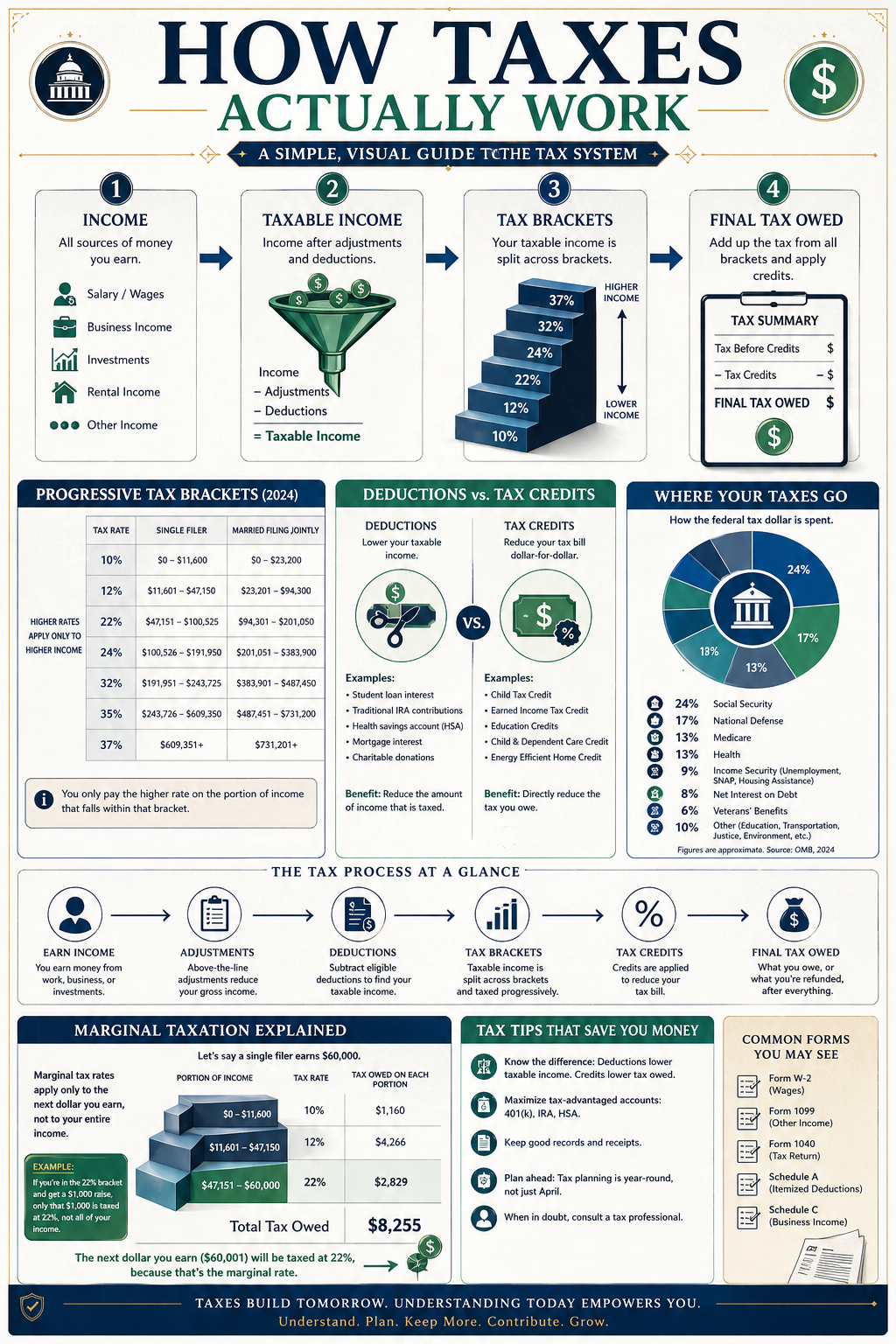
1. Income and Taxable Income
Income is what a person earns.
Taxable income is the portion of income on which taxes are calculated after allowed deductions or exemptions.
This distinction matters because taxes are often not applied to gross income in the simplest way many assume.
2. Tax Brackets
Many tax systems use progressive tax brackets.
This means income may be taxed in layers, with different portions taxed at different rates.
A common misunderstanding is believing all income is taxed at the highest bracket reached.
In a progressive system, only the portion within a bracket is taxed at that bracket’s rate.
This is called marginal taxation.
3. Deductions
Deductions reduce taxable income.
Examples may include:
- Certain investments
- Eligible expenses
- Specific allowances
If taxable income is reduced, the tax calculated may also decrease.
4. Tax Credits
Credits differ from deductions.
A deduction reduces income subject to tax.
A credit reduces the actual tax owed.
This distinction is important because credits often have direct impact on the final tax bill.
5. Where Taxes Go
Tax revenue is generally used to fund shared systems such as:
- Infrastructure
- Education
- Public services
- Social programs
- National administration
In this sense, taxes are part of how societies finance collective needs.
A Simple Flow
Income → Taxable Income → Tax Calculation → Tax Owed
Understanding this flow removes much of the confusion.
Important Idea
Taxes are not simply money taken away.
They are part of an economic system for distributing the cost of shared public functions.
Understanding brackets, deductions and credits makes taxation far less mysterious.
 Continue With Google
  Account and Finance
 Education