Introduction
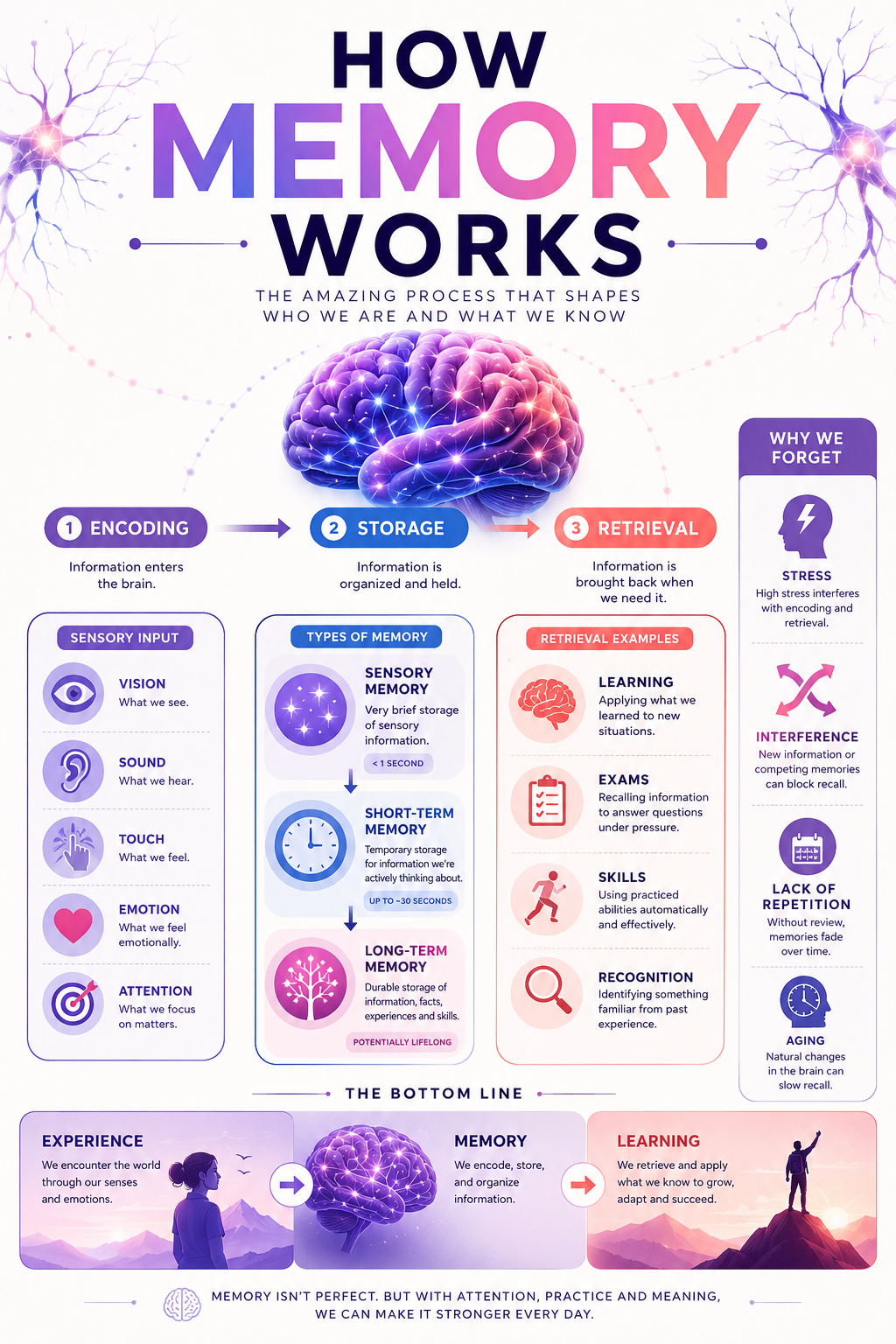
Memory is the brain’s ability to encode, store and retrieve information. It allows humans to learn from experience, retain knowledge and use past information to make decisions. Memory is not a single process—it involves multiple systems working together.
1. Encoding
Encoding is the process of converting information from experiences into a form the brain can store.
This begins when we pay attention to information through:
- Sight
- Sound
- Touch
- Emotion
- Meaning
Information that receives stronger attention or emotional significance is often encoded more effectively.
Example:
You may forget a random conversation but clearly remember an emotionally important event.
2. Storage
Once information is encoded, it moves into storage.
There are different memory systems:
Sensory Memory
Holds information for a few seconds.
Short-Term Memory
Temporarily stores small amounts of information for immediate use.
Long-Term Memory
Stores information for extended periods ranging from days to decades.
Long-term memory includes:
- Facts
- Skills
- Personal experiences
- Learned behaviors
3. Retrieval
Retrieval is the ability to access stored information when needed.
This happens when:
- recalling an answer during an exam
- remembering a name
- performing a learned skill
Strong retrieval often depends on how well information was encoded and stored.
Why Memory Fails
Memory is not a perfect recording system.
Forgetting may happen because of:
- weak attention
- lack of repetition
- interference from other memories
- stress
- aging
Memory can also be reconstructed incorrectly, which is why false memories can occur.
How Memory Works as a System
Experience → Encoding → Storage → Retrieval
This cycle repeats continuously as humans learn and adapt.
Important Idea
Memory is not simply storing information.
It is an active system that helps the brain learn, organize and reconstruct experiences.
 Continue With Google
  Science
 Education