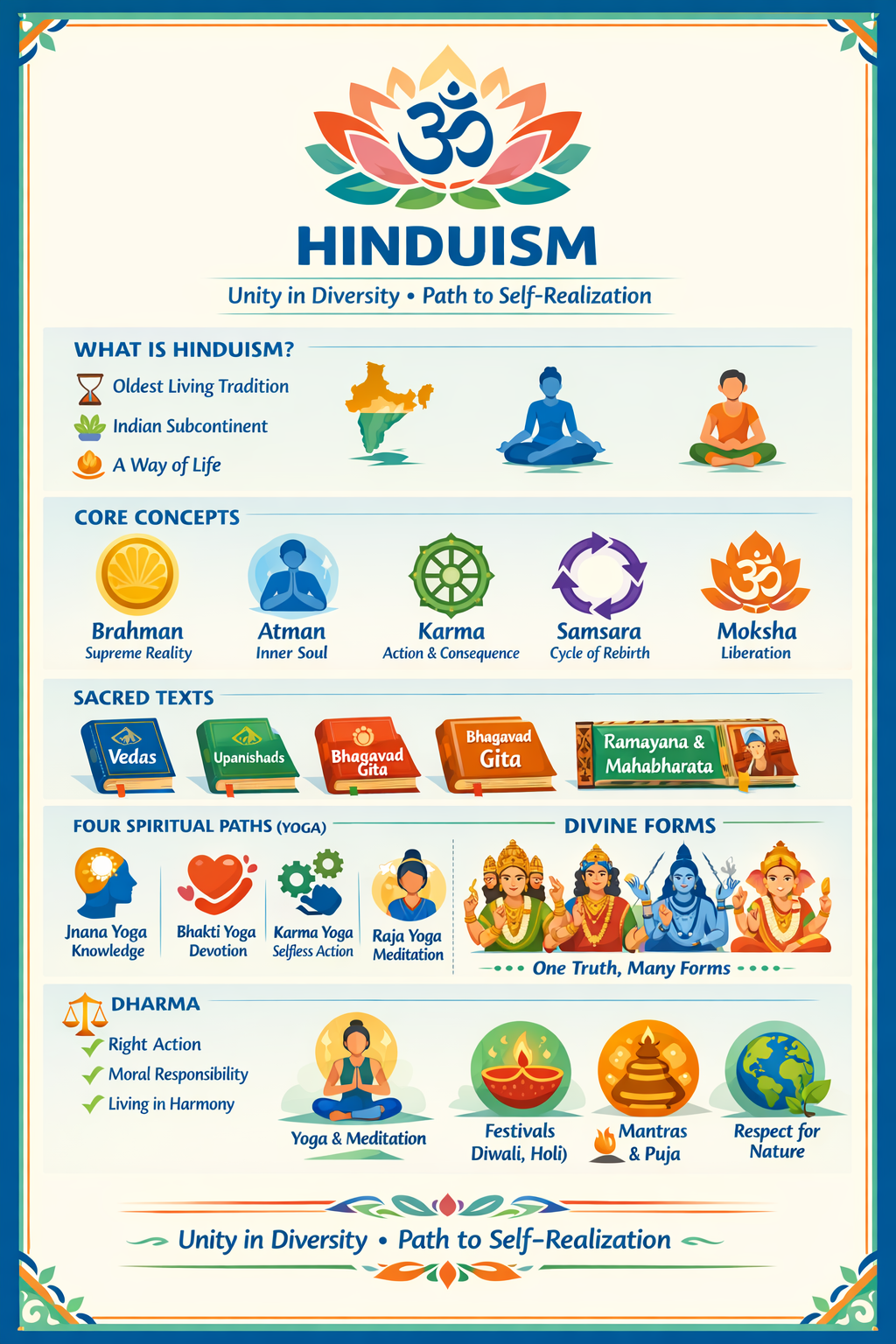
Hinduism is one of the world’s oldest living spiritual traditions, originating in the Indian subcontinent over 4,000 years ago. It is not a single religion, but a vast family of philosophies, rituals, and ways of life.
No single founder
No single holy book
Multiple paths to truth
Flexible beliefs – from devotion to deep philosophy
Hinduism allows people to believe, question, explore, and experience spirituality in their own way.
“Truth is one, the wise call it by many names.” — Rig Veda
The supreme, formless, infinite reality
Everything in the universe is an expression of Brahman
The soul within every being
Atman is ultimately one with Brahman
Every action has a consequence
Good actions → positive results
Bad actions → suffering
Birth → Life → Death → Rebirth
Driven by karma
Freedom from the cycle of rebirth
Realization of unity with Brahman
Ultimate goal of life
Rig Veda
Yajur Veda
Sama Veda
Atharva Veda
Philosophical teachings
Nature of soul, reality, and consciousness
Dialogue between Krishna and Arjuna
Explains duty, devotion, knowledge, and selfless action
Ramayana – Life of Lord Rama
Mahabharata – Dharma, war, and human struggles
Hinduism offers multiple paths based on human nature:
Wisdom and self-inquiry
Love and surrender to God
Selfless service without attachment
Mind control, meditation, discipline
Hinduism recognizes one supreme reality, expressed in many forms:
Brahma – Creator
Vishnu – Preserver
Shiva – Transformer
Popular deities include:
Krishna, Rama
Durga, Lakshmi, Saraswati
Ganesha, Hanuman
Each represents different aspects of the same divine truth.
Dharma means:
Duty
Righteous living
Ethical responsibility
Dharma varies by:
Age
Role in society
Stage of life
Brahmacharya – Student life
Grihastha – Householder
Vanaprastha – Withdrawal
Sannyasa – Renunciation
Life is seen as a spiritual journey, not just material success.
Yoga & Meditation
Puja (worship)
Chanting Mantras (Om, Gayatri)
Fasting & Festivals (Diwali, Holi, Navratri)
Pilgrimage to sacred places
✔️ Both
Hinduism guides:
How you think
How you act
How you relate to nature, society, and yourself
It embraces science, philosophy, psychology, and spirituality together.
Hinduism is a timeless spiritual civilization that teaches unity in diversity, self-realization, and harmony with the universe.
 Continue With Google
  Religion and Spirituality