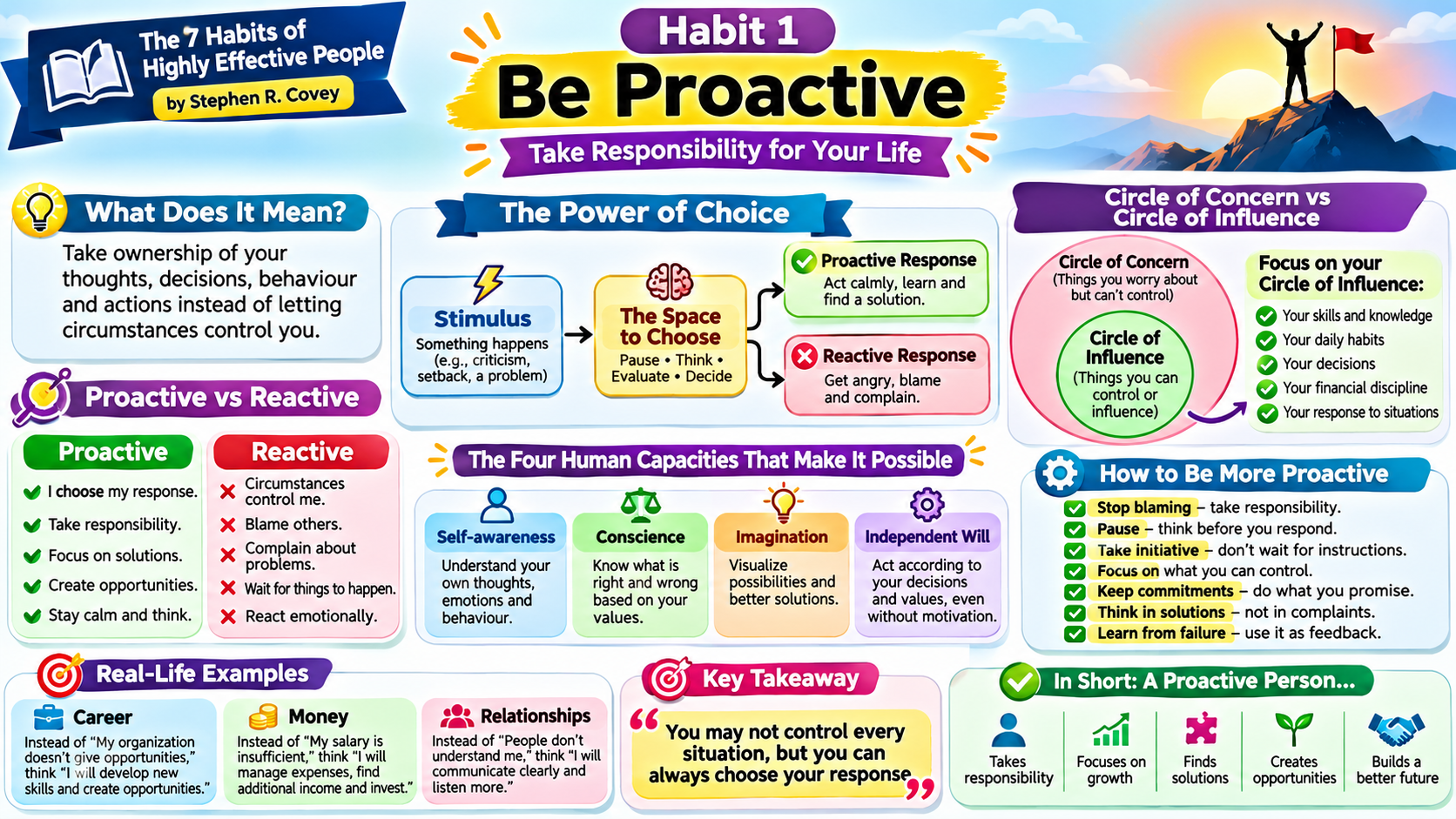
Based on Habit 1 from The 7 Habits of Highly Effective People — Stephen R. Covey
Take ownership • Act • Improve
Blame • Complain • Make excuses
Being proactive means taking responsibility for your thoughts, decisions, behaviour and actions rather than allowing external circumstances to control your life.
It means:
Instead of blaming others, identify what you can improve.
Instead of waiting for opportunities, create them.
Instead of complaining about problems, find solutions.
Instead of reacting emotionally, respond thoughtfully.
Instead of waiting for motivation, develop discipline.
The fundamental principle:
You may not control every situation, but you can choose your response to that situation.
Let's understand this through everyday situations.
Situation | Reactive response | Proactive response |
|---|---|---|
You fail an exam | The teacher was unfair. | What should I improve? |
You lose your job | My luck is bad. | Which skills should I develop? |
Someone insults you | Immediately get angry. | Respond calmly and wisely. |
You have no money | Everything is expensive. | Review expenses and income. |
You lack knowledge | I don't have time. | Schedule 30 minutes of learning. |
Business is not growing | Customers are not good. | Improve the product and marketing. |
The difference in thinking
"Why does this always happen to me?"
"What can I do to improve this situation?"
Covey explains that human beings have the ability to choose their response.
Something happens in your life
Example: Someone criticizes your work.
Pause • Think • Evaluate • Decide
REACTIVE
Get angry, argue and blame.
PROACTIVE
Understand feedback and improve.
Your response influences your results and future opportunities.
Important: The space between stimulus and response is where you exercise self-awareness, conscience, imagination and independent will.
These are four human capacities highlighted by Covey.
These capacities help us move from reactive behaviour to proactive behaviour.
Self-awareness
Understand your own thoughts, emotions and behaviour.
Example: Recognize that you are getting angry before responding.
Conscience
Understand what is right and wrong according to your values.
Example: Choose honesty even when dishonesty seems easier.
Imagination
Visualize possibilities and imagine better solutions.
Example: Imagine building your own successful business.
Independent will
Act according to your decisions and values, even when you don't feel motivated.
Example: Study for 30 minutes even when you feel tired.
One of the most important concepts in this habit.
There are two categories of things in your life:
Government policies
Other people's opinions
Past mistakes
Economic conditions
Other people's behaviour
Shift your attention
to
Your skills and knowledge
Your daily habits
Your decisions
Your financial discipline
Your communication
Your response to situations
The principle: Reactive people spend more time worrying about their Circle of Concern. Proactive people invest their energy in their Circle of Influence.
As you consistently take constructive action, your influence can grow.
Here are seven practical techniques.
Technique | What to practise |
|---|---|
Stop blaming | Accept responsibility for your part. |
Pause before reacting | Take a breath before responding emotionally. |
Take initiative | Don't wait for someone to tell you what to do. |
Think about solutions | Ask what you can do next. |
Keep commitments | Do what you promise yourself and others. |
Focus on controllables | Spend energy where your actions matter. |
Learn from failure | Treat mistakes as feedback, not identity. |
What am I blaming others for?
What can I control today?
What important action am I postponing?
Am I reacting emotionally or responding thoughtfully?
What one action can improve my future?
These questions help build self-awareness and accountability.
Consider these three situations.
Scenario A: Career growth
"My career isn't growing because my organization doesn't provide opportunities."
"I will learn new skills, build projects, improve my professional network and explore opportunities."
Scenario B: Financial growth
"My salary is insufficient to become wealthy."
"I will manage expenses, develop additional income streams, increase my skills and invest consistently."
Scenario C: Personal relationships
"People don't understand me."
"I will communicate clearly, listen patiently and understand their perspective."
Your progress
Being proactive does not mean that you can control everything in life. It means refusing to surrender your choices to circumstances.
Your circumstances may influence your life, but your decisions and actions shape your direction.
Knowledge check
1. Your colleague criticizes your work. What is the most proactive response?
2. Which circle should receive most of your energy?
3. You want to develop a new skill. What should you do?
 Continue With Google
 Motivation

