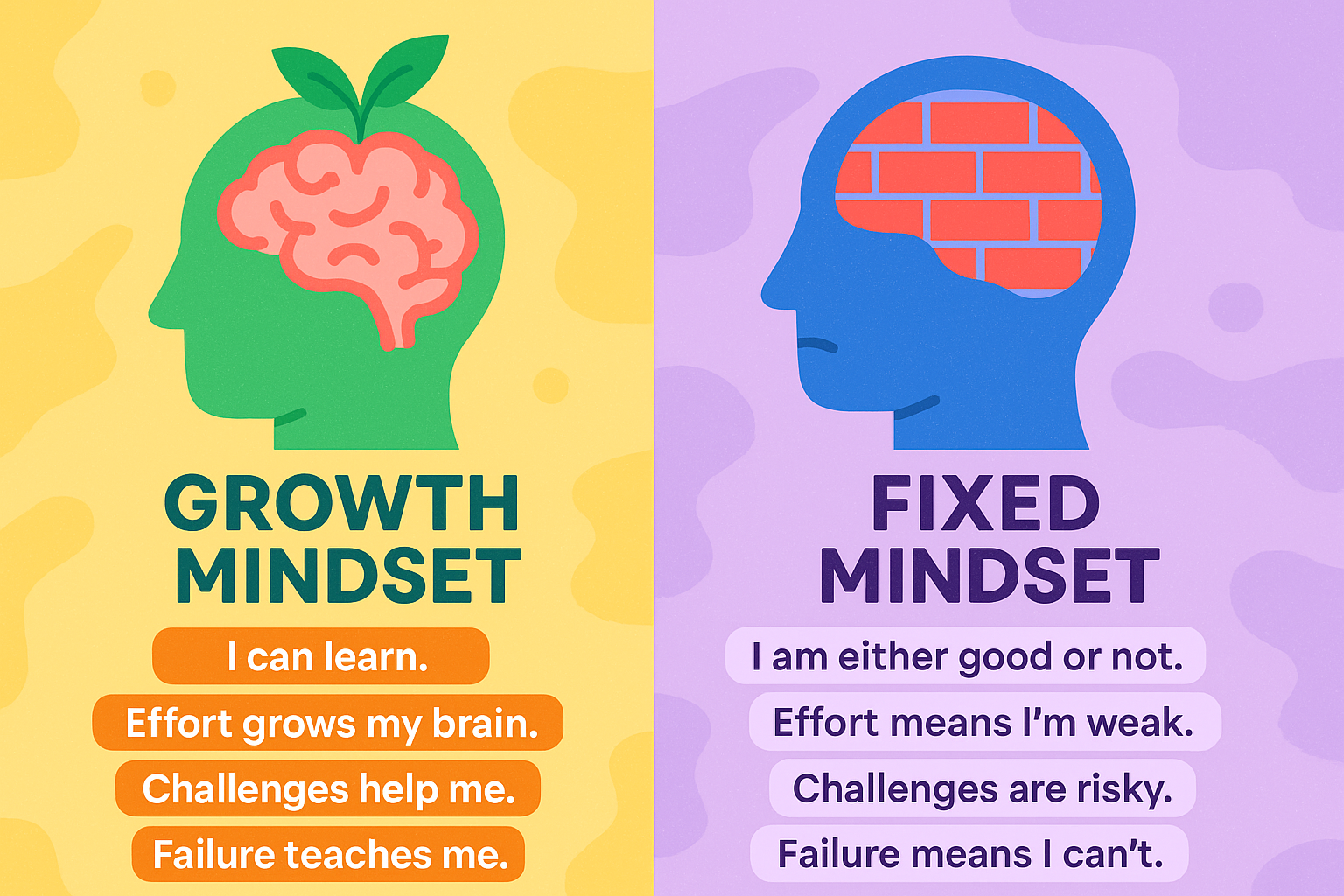
🧠 1. What is a Mindset?
A mindset is a mental framework that shapes how you interpret challenges, failures, success, and effort.
Psychologist Dr. Carol Dweck discovered two major types:
Fixed Mindset
Growth Mindset
Your mindset influences your motivation, learning, resilience, and ultimately — your success.
People with a Fixed Mindset believe:
Intelligence is static
Talent is natural
Effort means you are not smart
Failure is proof of lack of ability
Challenges should be avoided
“I’m just not good at maths.”
“If I fail, it means I’m not talented.”
“Others succeed because they are gifted.”
The fixed mindset ignores neuroplasticity — the brain’s ability to grow and strengthen its connections based on learning and practice.
Brains do not stop growing after childhood.
But people with a fixed mindset assume abilities remain the same forever.
Fear of failure
Low resilience
Giving up easily
Avoiding new skills
Plateau in growth
People with a Growth Mindset believe:
Intelligence can grow
Skills improve with practice
Challenges are opportunities
Failure teaches
Effort builds mastery
“I can learn this with practice.”
“Failure is feedback.”
“My brain gets stronger when I try hard.”
Growth mindset aligns with neuroplasticity, where:
Repeated effort forms new neural pathways
Difficult tasks strengthen cognitive circuits
Learning increases synaptic density
The brain physically rewires itself as you learn — like a muscle growing after exercise.
Higher achievement
Greater resilience
More curiosity
Willingness to take risks
Continuous improvement
| 🌱 Growth Mindset | 🧱 Fixed Mindset |
|---|---|
| 💡 I can improve through effort | ❗ I am born with fixed abilities |
| 🔍 Embraces challenges | 🚫 Avoids challenges |
| ✔️ Learns from criticism | ❌ Takes criticism personally |
| 🔁 Keeps trying after failure | ⛔ Gives up easily |
| 🧪 Believes in neuroplasticity | 🧊 Believes abilities are static |
| 📈 Loves learning | 🏁 Wants to look smart |
| 🎯 Focuses on progress | 🪨 Focuses on proving ability |
🔒 “I can’t do this.”
➡️ 🌱 “I can learn this with time.”
Your brain strengthens when it works hard.
Every mistake teaches you what to improve next.
Challenges = new neural connections.
Each win = motivation boost + dopamine reward.
A famous neuroscience study found that London taxi drivers had a larger hippocampus, the brain region for navigation and memory.
Why?
Years of practice and challenge rewired and expanded their brain.
This is growth mindset in action, proven biologically.
🌱 GROWTH MINDSET
- I can learn.
- Effort grows my brain.
- Challenges help me.
- Failure teaches me.

🧱 FIXED MINDSET
- I am either good or not.
- Effort means I'm weak.
- Challenges are risky.
- Failure means I can't. Continue With Google
  Health

