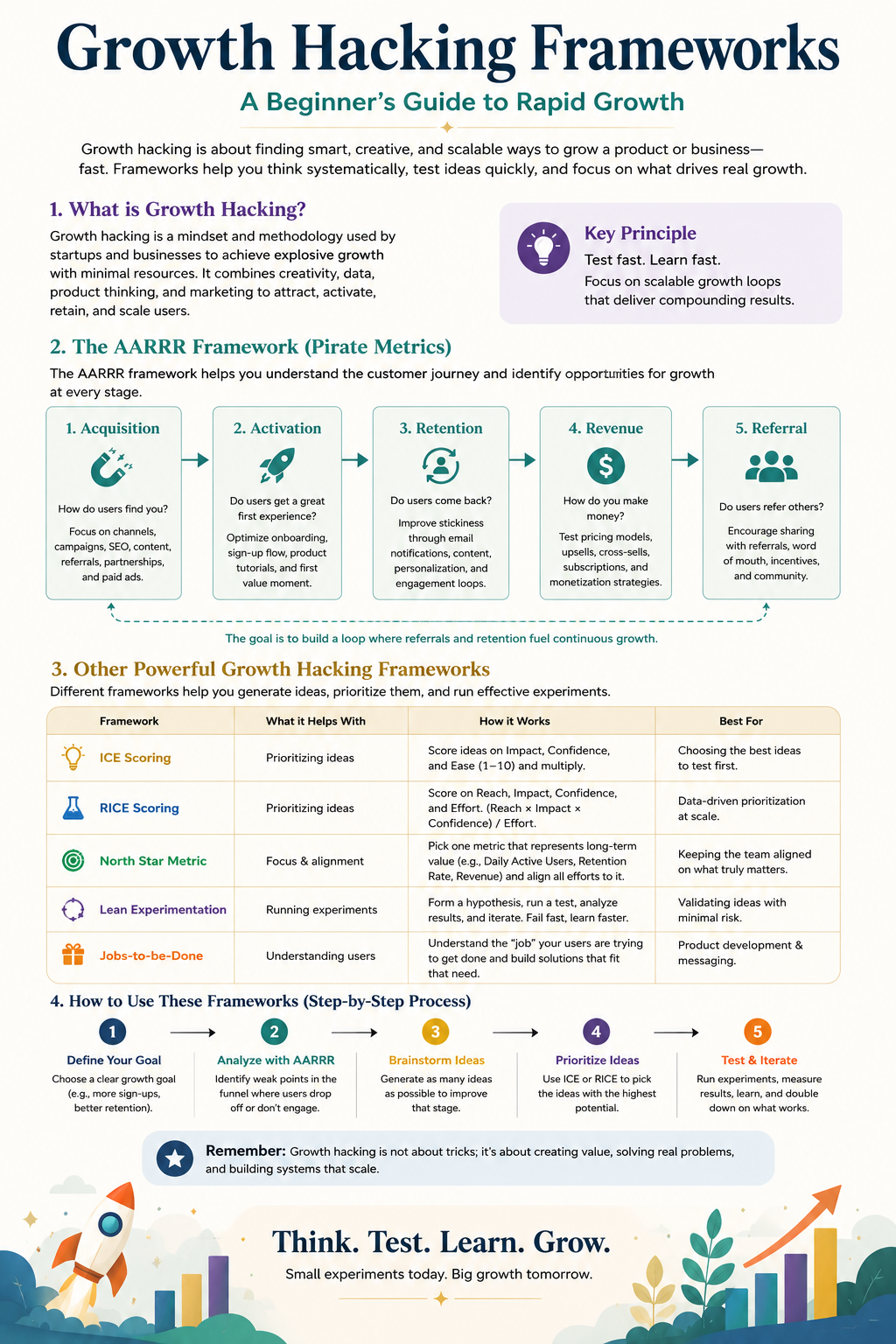
Growth Hacking is a systematic process of finding creative, low-cost, and data-driven ways to grow a business faster.
Traditional marketing focuses on:
Brand awareness
Advertising
Long-term campaigns
Growth Hacking focuses on:
✅ User acquisition
✅ User activation
✅ User retention
✅ Revenue growth
✅ Referral growth
✅ Rapid experimentation
Think of it like:
Traditional Marketing = Planting seeds and waiting
Growth Hacking = Testing multiple fertilizers until you find the one that makes plants grow fastest
Instead of asking:
"How do we market this product?"
Growth hackers ask:
"What is the fastest and cheapest way to get more users?"
Everything becomes an experiment.
IDEA
  ↓
EXPERIMENT
  ↓
MEASURE
  ↓
LEARN
  ↓
IMPROVE
  ↓
SCALE
Repeat this cycle continuously.
The most famous Growth Hacking Framework was created by
Dave McClure
It is called:
A = Acquisition
A = Activation
R = Retention
R = Revenue
R = Referral
Some people call it:
Because it sounds like:
"ARRRR!"
STRANGERS
    ↓
ACQUISITION
    ↓
ACTIVATION
    ↓
RETENTION
    ↓
REVENUE
    ↓
REFERRAL
    ↓
MORE USERS
Bring visitors to your product.
How do people find us?
Google Search
Social Media
YouTube
Blog Content
Communities
Email Marketing
Partnerships
Referrals
Ads
Imagine a startup selling fitness coaching.
Possible acquisition channels:
YouTube videos
Instagram reels
Fitness blogs
Google SEO
Facebook groups
| Metric | Meaning |
|---|---|
| Website Visitors | Number of visitors |
| Click Through Rate | % clicking links |
| Cost Per Click | Ad cost |
| Cost Per Acquisition | Cost to acquire user |
Instead of:
Spend more on ads
Ask:
Which channel brings users at lowest cost?
Make users experience value quickly.
Did the user understand the product?
User signs up for a fitness app.
Bad Activation:
Sign Up
↓
Confused Dashboard
↓
Leaves
Good Activation:
Sign Up
↓
Personal Fitness Plan Generated
↓
User Excited
The point where users say:
"Wow, this is useful."
This is called:
User listens to first song.
User watches first movie.
User creates first design.
| Metric | Meaning |
|---|---|
| Sign-up Rate | Visitors → Users |
| Onboarding Completion | Users completing setup |
| First Action Rate | Users taking first action |
Keep users coming back.
Why would users return tomorrow?
Bad Scenario
Visit Once
↓
Never Return
Good Scenario
Visit
↓
Get Value
↓
Return
↓
Build Habit
"We miss you."
Suggested content
Suggested products
New features
Updates
Alerts
Points
Rewards
Badges
| Metric | Meaning |
|---|---|
| DAU | Daily Active Users |
| MAU | Monthly Active Users |
| Churn Rate | Users leaving |
| Retention Rate | Users staying |
Convert users into paying customers.
How does the business make money?
Subscriptions
One-time purchases
Advertising
Commissions
Licensing
Premium features
Freemium Model
Free Version
      ↓
Uses Product
      ↓
Needs More Features
      ↓
Upgrades To Paid Plan
| Metric | Meaning |
|---|---|
| Revenue | |
| Conversion Rate | |
| Average Order Value | |
| Customer Lifetime Value |
Users bring more users.
Why would customers recommend us?
User
 ↓
Gets Value
 ↓
Shares Product
 ↓
New User
 ↓
Gets Value
 ↓
Shares Again
Invite Friend
↓
Get ₹500 Credit
Share achievement
Share content
Share progress
Promoter earns commission
| Metric | Meaning |
|---|---|
| Referral Rate | |
| Viral Coefficient | |
| Invite Acceptance Rate |
Growth hackers run hundreds of experiments.
Example
10000 Visitors
↓
500 Signups
↓
50 Customers
Problem:
Signup Conversion Low
If we simplify signup form,
conversion will increase.
Version A
10 Fields
Version B
3 Fields
A = 5% Conversion

B = 9% Conversion
Implement Version B
DATA
 ↓
INSIGHT
 ↓
HYPOTHESIS
 ↓
TEST
 ↓
RESULT
 ↓
LEARNING
 ↓
NEW TEST
This loop never ends.
Refer Friend
↓
Get Extra Storage
Result:
Massive user growth.
Cross-post listings
to multiple platforms
Result:
More visibility.
Added:
"Get your free email"
at the bottom of every email.
Result:
Millions of users.
Invite Friend
↓
Both Get Ride Credit
Result:
Rapid city expansion.
A growth hacker monitors:
Traffic
↓
Signups
↓
Activated Users
↓
Returning Users
↓
Paying Customers
↓
Referrals
If one stage drops:
Investigate
↓
Experiment
↓
Improve
Acquire Users
       ↓
Activate Users
       ↓
Retain Users
       ↓
Generate Revenue
       ↓
Encourage Referrals
       ↓
Acquire More Users
       ↓
Repeat Forever
Growth Hacking is not a marketing trick.
It is a disciplined process of:
Measure
  ↓
Experiment
  ↓
Learn
  ↓
Optimize
  ↓
Scale
The companies that grow fastest are usually not the ones spending the most money.
They are the ones that:
✅ Understand user behavior
✅ Track the right metrics
✅ Run continuous experiments
✅ Improve every step of the customer journey
✅ Build systems that create self-sustaining growth loops
That's the essence of the Growth Hacking Framework.
 Continue With Google
  Economics
 Business

