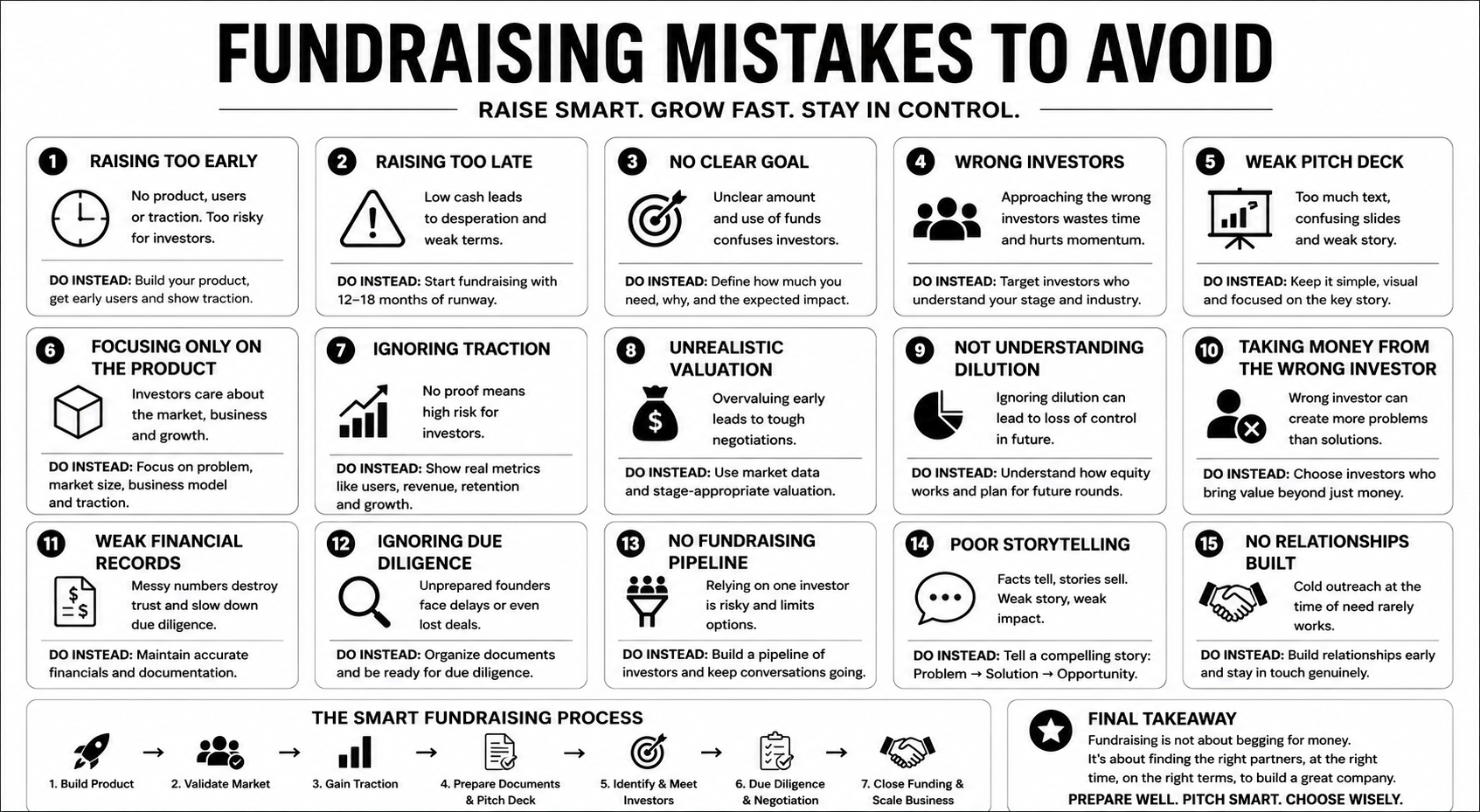
Fundraising is the process of obtaining capital from investors to grow a business.
Simple flow:
Business Idea
      ↓
Need Capital
      ↓
Meet Investors
      ↓
Raise Funds
      ↓
Grow Business
Many founders think:
Good Product
      ↓
Investors Will Invest
Unfortunately, fundraising doesn't work like that.
Investors evaluate:
Team
Market
Product
Growth
Financials
Risk
all together.
Wrong Investor
      ↓
Bad Terms
      ↓
Loss of Control
      ↓
Future Problems
PREPARATION MISTAKES
          ↓
PITCHING MISTAKES
          ↓
NEGOTIATION MISTAKES
          ↓
POST-FUNDING MISTAKES
One of the most common mistakes.
Many founders do:
Idea
 ↓
Fundraising
Investors prefer:
Idea
 ↓
Product
 ↓
Users
 ↓
Traction
 ↓
Fundraising
Without proof:
High Risk
for investors.
Questions investors ask:
Who are the customers?

What evidence exists?

What traction do you have?
Build MVP
      ↓
Get Users
      ↓
Show Growth
      ↓
Raise Capital
The opposite mistake.
Some founders wait until:
Cash Almost Gone
before fundraising.
Problem:
Low Cash
      ↓
Desperation
      ↓
Weak Negotiation Position
Start fundraising when:
12-18 Months Runway Remains
Visualization
Healthy Cash
      ↓
Fundraising
      ↓
Strong Position
Bad:
Need Money
Good:
Need ₹5 Crore
For:
Product Development
Hiring
Marketing
Expansion
Investors want to know:
How Much?
Why?
Expected Outcome?
Funding
    ↓
Activities
    ↓
Milestones
    ↓
Growth
Not every investor is suitable.
Bad Strategy
Contact Everyone
Smart Strategy
Identify Relevant Investors
          ↓
Understand Their Focus
          ↓
Approach Strategically
Some investors prefer:
Seed Startups
Others prefer:
Growth Stage Companies
Startup Stage
       ↓
Appropriate Investor
       ↓
Higher Success Probability
Many founders overload slides.
Bad Pitch
50 Slides
Tiny Fonts
Too Much Text
Good Pitch
Clear Story
Simple Data
Strong Evidence
Problem
   ↓
Solution
   ↓
Market
   ↓
Growth
   ↓
Investment Opportunity
Founders love talking about features.
Investors care about:
Market
Growth
Revenue
Business Model
Bad Pitch
Feature
Feature
Feature
Feature
Better Pitch
Problem
Solution
Business Opportunity
Traction is evidence.
Without traction:
Idea
With traction:
Proof
Examples
Customers
Revenue
Growth
Retention
Partnerships
Users
 ↓
Growth
 ↓
Confidence
Many founders overvalue their startups.
Example
Startup:
No Revenue
Few Customers
Founder wants:
₹500 Crore Valuation
Investor reaction:
Unrealistic Expectations
Use:
Market Comparisons
Revenue Multiples
Growth Metrics
Reality
   ↓
Market Data
   ↓
Reasonable Valuation
Many founders focus only on money.
They forget:
Funding
      ↓
Ownership Changes
Example
Raise Capital
      ↓
Issue Shares
      ↓
Dilution
Cash Received
       +
Ownership Retained
Money isn't everything.
Bad Investor:
No Industry Knowledge
No Network
No Support
Good Investor:
Capital
Experience
Connections
Guidance
Money
  +
Expertise
  +
Network
Investors verify numbers.
Bad:
Guessing Revenue
Missing Expenses
No Accounting
Good:
Accurate Records
Financial Statements
Cash Flow Reports
Track Revenue
      ↓
Track Expenses
      ↓
Maintain Records
      ↓
Investor Confidence
Many founders focus only on pitching.
Reality:
Pitch
 ↓
Due Diligence
 ↓
Investment
Investors verify:
Legal Documents
Financials
Customers
Technology
Organized Documents
          ↓
Fast Verification
          ↓
Faster Funding
Some founders talk to:
One Investor
and wait.
Risky.
Better:
Multiple Investor Conversations
             ↓
More Options
             ↓
Better Negotiation
100 Investors Researched
          ↓
30 Conversations
          ↓
10 Serious Discussions
          ↓
3 Term Sheets
          ↓
1 Investment
Investors remember stories.
Not spreadsheets.
Weak Pitch
Random Information
Strong Pitch
Problem
 ↓
Solution
 ↓
Market
 ↓
Growth
 ↓
Vision
Customer Pain
        ↓
Your Solution
        ↓
Business Opportunity
Many founders only contact investors when money is needed.
Better Strategy
Build Relationship
        ↓
Share Updates
        ↓
Build Trust
        ↓
Fundraising Becomes Easier
Meet Investor
      ↓
Provide Updates
      ↓
Build Trust
      ↓
Fundraising Opportunity
Investors become concerned when they see:
Founder Conflicts
High Churn
No Growth
Messy Financials
Unclear Business Model
Unrealistic Claims
Legal Problems
□ Product Exists

□ Customers Exist

□ Growth Metrics Available

□ Financials Prepared

□ Pitch Deck Ready

□ Data Room Ready

□ Target Investors Identified

□ Fund Usage Planned

□ Valuation Reasonable

□ Due Diligence Ready
Build Product
      ↓
Validate Market
      ↓
Gain Traction
      ↓
Prepare Pitch Deck
      ↓
Prepare Financials
      ↓
Identify Investors
      ↓
Start Conversations
      ↓
Pitch
      ↓
Due Diligence
      ↓
Negotiate Terms
      ↓
Close Funding
| Mistake | Better Approach |
|---|---|
| Raise Too Early | Show Traction First |
| Raise Too Late | Start Early |
| Unrealistic Valuation | Market-Based Valuation |
| Weak Financials | Organized Records |
| Wrong Investors | Targeted Outreach |
| Poor Pitch Deck | Clear Storytelling |
| No Pipeline | Multiple Investor Discussions |
| Ignore Dilution | Model Ownership Changes |
| Focus Only on Product | Focus on Business |
| No Due Diligence Prep | Data Room Ready |
STEP 1
Build Product
         ↓
STEP 2
Validate Customer Demand
         ↓
STEP 3
Generate Traction
         ↓
STEP 4
Prepare Financial Records
         ↓
STEP 5
Create Pitch Deck
         ↓
STEP 6
Build Investor List
         ↓
STEP 7
Start Investor Meetings
         ↓
STEP 8
Complete Due Diligence
         ↓
STEP 9
Negotiate Smartly
         ↓
STEP 10
Close Funding
Most fundraising failures happen because founders believe:
Money Solves Problems
Successful fundraising happens when founders demonstrate:
Strong Team
      +
Real Problem
      +
Growing Market
      +
Customer Demand
      +
Execution Ability
The essence of avoiding fundraising mistakes is:
PREPARE
    ↓
VALIDATE
    ↓
PITCH
    ↓
VERIFY
    ↓
NEGOTIATE
    ↓
FUND
The best founders don't treat fundraising as a desperate search for money.
They treat it as a strategic process of finding the right partners, at the right time, on the right terms, to accelerate growth.
 Continue With Google
  Business

