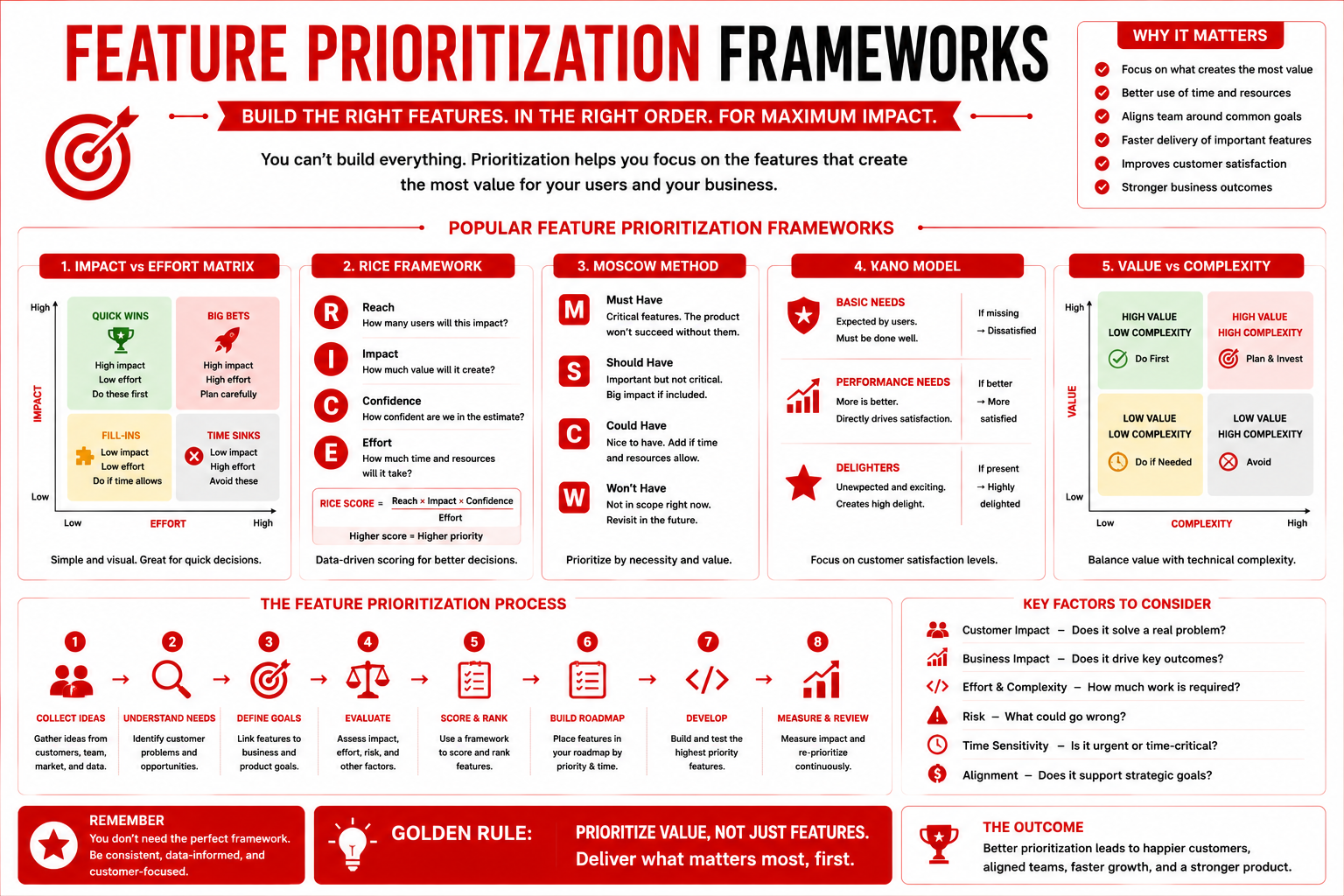
Feature Prioritization is the process of deciding:
Which Features To Build
          ↓
In What Order
          ↓
Based On Maximum Value
Simply put:
You have 100 ideas but resources to build only 10.
Which 10 should you choose?
That's Feature Prioritization.
Imagine you have:
₹50,000 Budget
and want to:
Buy Laptop
Buy Phone
Buy TV
Buy Bike
Go On Vacation
You cannot buy everything.
So you prioritize.
You ask:
Most Important?

Most Useful?

Most Urgent?
Businesses do the same with features.
Without prioritization:
Many Features
      ↓
Resource Waste
      ↓
Delayed Growth
With prioritization:
Best Features
      ↓
Maximum Impact
      ↓
Better Results
Ideas
  ↓
Evaluation
  ↓
Prioritization
  ↓
Development
  ↓
Release
Before building a feature ask:
Will customers use it?

Will it increase revenue?

Will it improve retention?

How much effort is required?

Does it support company goals?
Imagine these features:
Feature A
High Impact
Low Effort

Feature B
High Impact
High Effort

Feature C
Low Impact
Low Effort
Which should be built first?
Frameworks help answer this.
One of the easiest and most popular frameworks.
Compare:
Impact
   vs
Effort
Visualization
                IMPACT
                   ↑

 Quick Wins    |   Big Bets
               |
---------------+--------------→ EFFORT
               |
 Fill-ins      |   Time Sinks
High Impact
Low Effort
Build immediately.
Examples:
Simple UX Improvements

Performance Fixes

Small Automations
High Impact
High Effort
Strategic projects.
Examples:
Mobile App

AI Features

Marketplace Platform
Low Impact
Low Effort
Do when resources are available.
Low Impact
High Effort
Usually avoid.
Feature Idea
       ↓
Estimate Impact
       ↓
Estimate Effort
       ↓
Prioritize
Very popular in product management.
RICE stands for:
R = Reach

I = Impact

C = Confidence

E = Effort
Reach
   ↓
Impact
   ↓
Confidence
   ↓
Effort
   ↓
Priority Score
Question:
How many users benefit?
Example:
100 Users

1000 Users

10000 Users
Question:
How much value does it create?
Example:
Low Impact

Medium Impact

High Impact
Question:
How sure are we?
Example:
90% Confidence

70% Confidence

50% Confidence
Question:
How much work?
Example:
1 Week

1 Month

6 Months
(Reach × Impact × Confidence)
            ÷
          Effort
Higher score:
Build First
Feature
   ↓
Calculate Score
   ↓
Compare Features
   ↓
Prioritize
Simple and beginner-friendly.
MoSCoW stands for:
M = Must Have

S = Should Have

C = Could Have

W = Won't Have
Critical.
Without it:
Product Fails
Examples:
Login

Payments

Security
Important but not critical.
Examples:
Advanced Search

Analytics
Nice-to-have.
Examples:
Themes

Animations

Customization
Not now.
Examples:
Future Ideas
Feature
   ↓
Must?
   ↓
Should?
   ↓
Could?
   ↓
Won't?
Focuses on customer satisfaction.
Basic Features

Performance Features

Delighters
Customers expect them.
Example:
Secure Login

Reliable Performance
Without them:
Customers Angry
More is better.
Examples:
Speed

Storage

Battery Life
Unexpected surprises.
Examples:
AI Suggestions

Smart Automation
Feature
   ↓
Customer Reaction
   ↓
Satisfaction Level
Basic
 ↓
Expected

Performance
 ↓
Desired

Delighters
 ↓
Loved
Very similar to Impact vs Effort.
Questions:
Customer Value?

Business Value?

Technical Complexity?
Visualization
High Value
      +
Low Complexity
      ↓
Highest Priority
Low Value
      +
High Complexity
      ↓
Lowest Priority
Feature
   ↓
Estimate Value
   ↓
Estimate Complexity
   ↓
Prioritize
Customer-driven framework.
Ask customers:
How Important Is This?

How Satisfied Are You Today?
Gap:
High Importance
      +
Low Satisfaction
      ↓
Opportunity
Flow
Customer Need
        ↓
Measure Gap
        ↓
Build Feature
Focuses on urgency.
Question:
What happens if we don't build this?
Example
Feature A delayed:
Lose ₹10 Lakh
Feature B delayed:
Lose ₹1 Lakh
Build A first.
Cost of Delay Flow
Delay
  ↓
Lost Value
  ↓
Priority
| Framework | Best For | Complexity |
|---|---|---|
| Impact vs Effort | Quick Decisions | Easy |
| RICE | Data-Driven Teams | Medium |
| MoSCoW | Agile Teams | Easy |
| Kano | Customer Experience | Medium |
| Value vs Complexity | Product Teams | Easy |
| Opportunity Scoring | Customer Research | Medium |
| Cost of Delay | Strategic Decisions | Medium |
Collect Ideas
       ↓
Understand Customer Needs
       ↓
Evaluate Business Value
       ↓
Estimate Effort
       ↓
Apply Framework
       ↓
Rank Features
       ↓
Build Roadmap
Customer Feedback
        ↓
Feature Ideas
        ↓
Prioritization Framework
        ↓
Product Roadmap
        ↓
Development
        ↓
Release
Building Everything Customers Request
Bad:
Customer Asks
      ↓
Build Immediately
Good:
Customer Request
        ↓
Evaluate
        ↓
Prioritize
Ignoring Business Goals
Feature may be popular but:
No Revenue Impact
No Strategic Value
Ignoring Technical Complexity
Looks simple.
Actually:
6 Months Of Work
Prioritizing Based on Opinion
Bad:
CEO Likes It
      ↓
Build It
Better:
Data
 +
Customer Need
 +
Business Impact
Never Re-Prioritizing
Markets change.
Customers change.
Roadmaps change.
Customer Need
       ↓
Business Value
       ↓
Strategic Alignment
       ↓
Technical Effort
       ↓
Risk Assessment
       ↓
Prioritization Score
       ↓
Roadmap Placement
STEP 1
Collect Feature Ideas
          ↓
STEP 2
Understand Customer Problems
          ↓
STEP 3
Estimate Business Impact
          ↓
STEP 4
Estimate Development Effort
          ↓
STEP 5
Choose Prioritization Framework
          ↓
STEP 6
Rank Features
          ↓
STEP 7
Build Product Roadmap
          ↓
STEP 8
Review Regularly
Start with:
Impact vs Effort Matrix
RICE Framework
Kano Model
MoSCoW Method
Feature prioritization is not about:
Building More Features
It is about:
Building The Right Features
The essence of Feature Prioritization is:
Ideas
   ↓
Evaluation
   ↓
Value
   ↓
Priority
   ↓
Execution
The best product teams don't win because they build everything.
They win because they consistently choose the features that create the highest customer value, strongest business impact, and best return on effort.
 Continue With Google
  Business

