Introduction
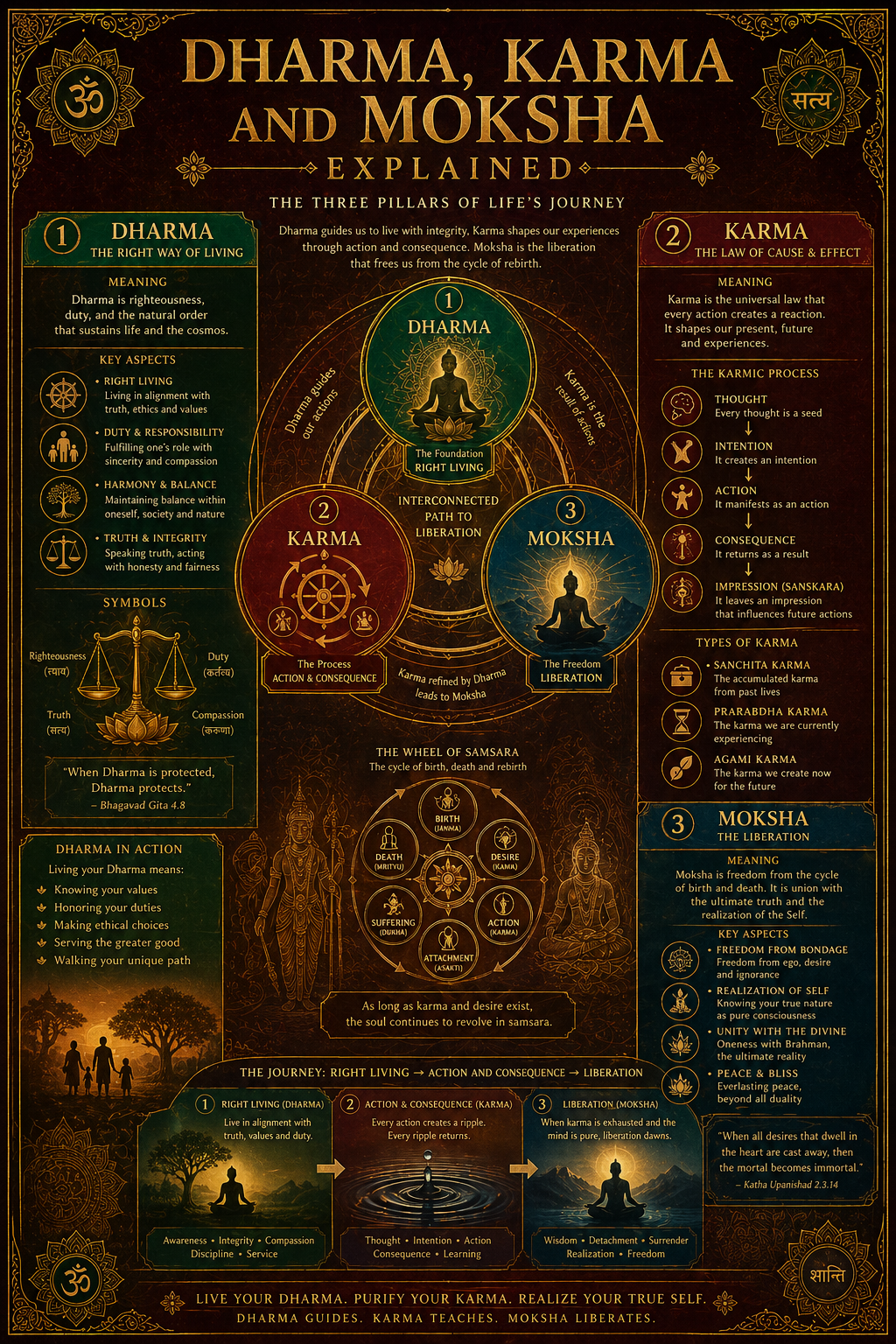
Many schools of Indian philosophy can be understood through three foundational ideas: Dharma, Karma and Moksha. Together they address three essential questions: How should one live? How do actions shape life? What does liberation mean?
1. Dharma
Dharma is often translated as duty, but its meaning is broader. It refers to right order, right conduct and living in alignment with truth.
Dharma can operate at multiple levels:
- Personal dharma: responsibilities shaped by one’s role and character
- Social dharma: actions that sustain harmony and justice
- Universal dharma: principles that uphold moral and cosmic order
Dharma is not simply following rules. It is acting in a way that sustains balance rather than disorder.
A simple way to understand dharma:
It asks not “What do I want to do?”
but “What is the right thing to do?”
2. Karma
Karma means action, but philosophically it refers to the law of cause and effect.
Every action produces consequences.
Thoughts have consequences.
Words have consequences.
Choices have consequences.
Karma is often misunderstood as fate or punishment. It is better understood as causation.
Actions shape tendencies.
Tendencies shape character.
Character shapes destiny.
In this sense, karma is not merely about future results, but about how action continuously shapes life.
Its central question is:
What follows from how I act?
3. Moksha
Moksha means liberation.
It refers to freedom from ignorance, attachment and the repetitive cycles of suffering.
In many Indian traditions, moksha is considered the highest human aim.
It is not escape from life, but awakening to reality more fully.
It points toward:
- inner freedom
- self-realization
- release from limiting identification
Its central question is:
What does true freedom look like?
How They Connect
These ideas are deeply linked.
Dharma guides right action.
Right action shapes karma.
Understanding karma and living wisely points toward moksha.
This creates a philosophical progression:
Dharma → Right Living
Karma → Consequence
Moksha → Liberation
Seen together, they form not just religious concepts, but a framework for ethics, responsibility and human purpose.
 Continue With Google
  Sanskrit and Vedas