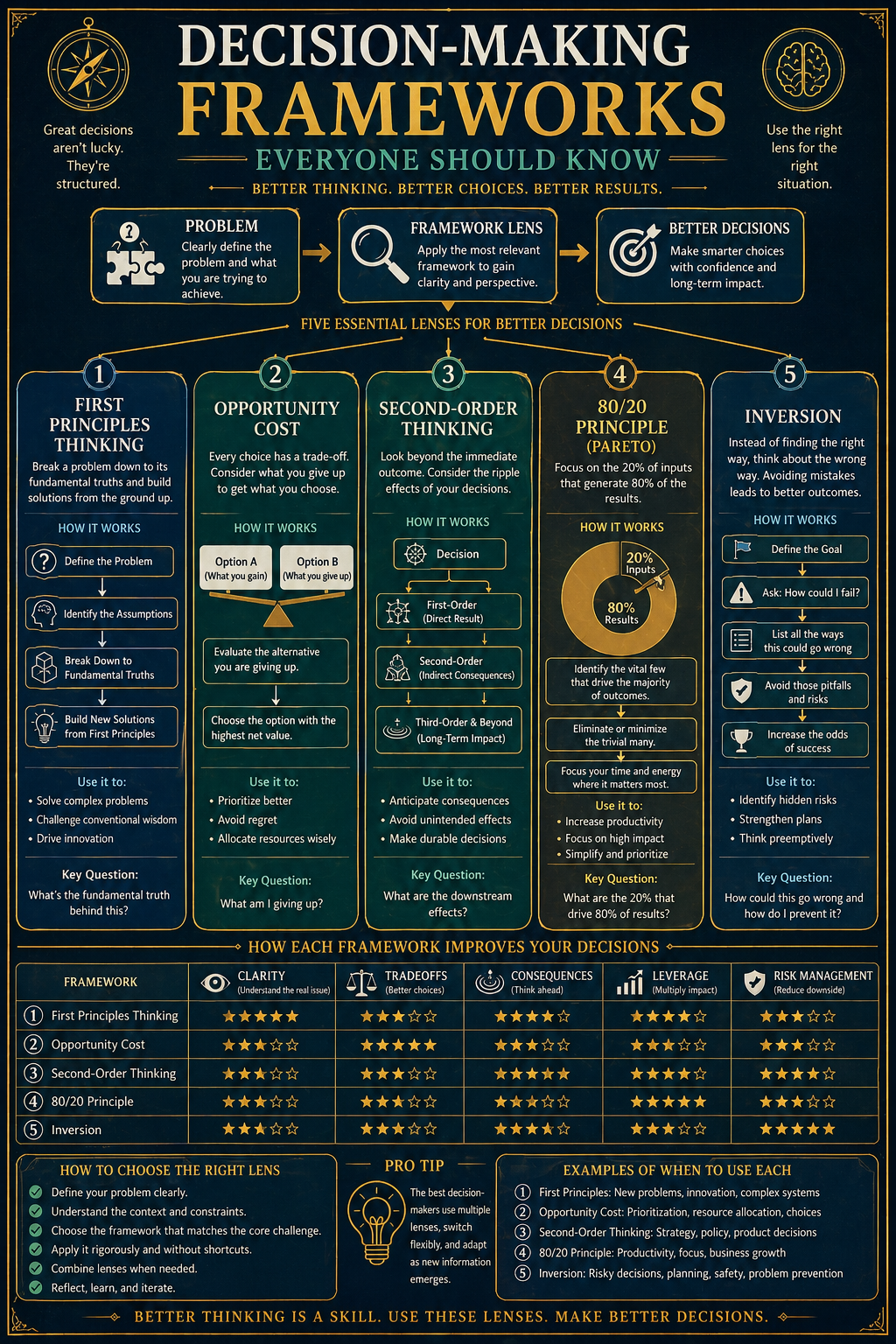
Introduction
Good decisions are often less about instinct and more about using useful mental frameworks. Decision frameworks help simplify complexity, improve judgment and reduce avoidable mistakes. They do not make decisions for us, but they improve how we think through them.
1. First Principles Thinking
First principles thinking means breaking a problem down into its most fundamental truths and reasoning upward from there.
Instead of copying existing solutions, it asks:
What do we know to be true at the most basic level?
From those fundamentals, new solutions can be built.
It helps challenge assumptions and encourages original thinking.
2. Opportunity Cost
Every decision involves tradeoffs.
Choosing one option often means giving up another.
Opportunity cost is the value of what is sacrificed when making a choice.
It shifts thinking from:
“What do I gain?”
to
“What do I give up?”
This framework improves decisions about time, money and priorities.
3. Second-Order Thinking
Many people stop at immediate outcomes.
Second-order thinking asks:
What happens after that?
It considers downstream consequences.
A decision may look good in the short term but create problems later.
This framework helps move from reaction to foresight.
4. The 80/20 Principle
Also called the Pareto Principle, it suggests a small number of inputs often produce a large share of results.
Examples:
- A few efforts may create most outcomes
- A few customers may drive most revenue
- A few habits may shape most progress
The framework helps identify leverage.
It asks:
What matters disproportionately?
5. Inversion
Inversion approaches a problem backwards.
Instead of asking:
How do I succeed?
It asks:
How do I avoid failure?
By identifying what causes bad outcomes, decisions often improve.
Sometimes avoiding mistakes is more powerful than chasing optimization.
How These Frameworks Help
Each framework improves a different part of thinking:
First Principles → Clarity
Opportunity Cost → Tradeoffs
Second-Order Thinking → Consequences
80/20 → Leverage
Inversion → Risk Awareness
Together they help transform decision-making from impulse into structured reasoning.
Important Idea
Better decisions often begin not with better answers,
but with better ways of thinking.
 Continue With Google
  Science
 Education