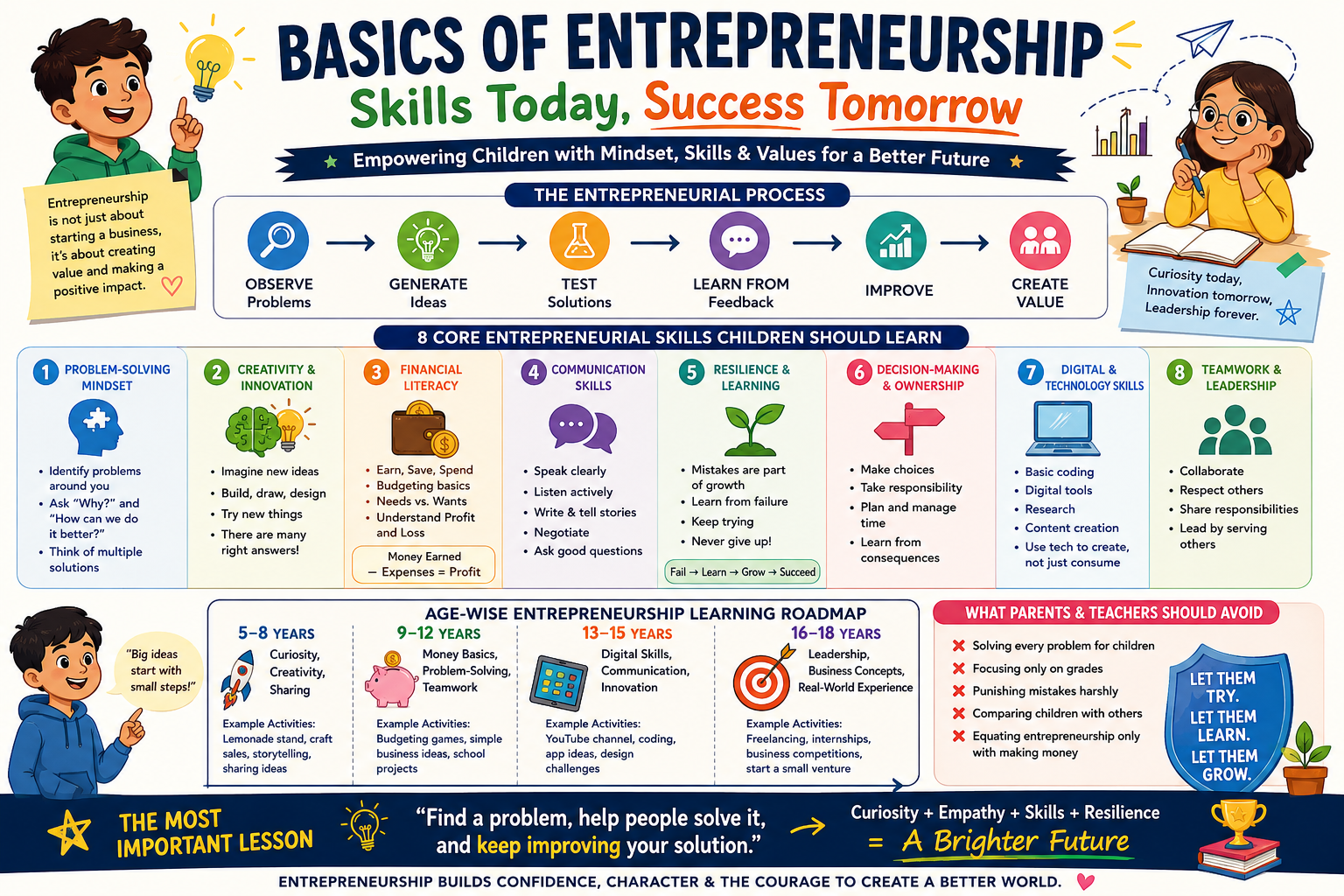
Teaching children entrepreneurship is less about starting a company early and more about helping them develop a mindset: curiosity, problem-solving, resilience, creativity, and financial awareness.
Observe Problems → Generate Ideas → Test Solutions → Learn from Feedback → Improve → Create Value
Teach children to ask:
"What problem does this solve?"
"How can this be done better?"
"What frustrates people around me?"
Encourage them to identify everyday problems at home, school, or in their community.
Activity: Ask them to find one problem each week and suggest three possible solutions.
Entrepreneurs connect ideas in new ways.
Encourage:
Building things with blocks or recycled materials
Storytelling and imaginative play
Drawing product ideas
Simple design challenges
Remember: there are often multiple right answers.
Children should understand how money works early.
Teach:
Earning vs. spending
Saving and investing
Budgeting
Profit and loss
Needs vs. wants
Simple formula:
Money Earned − Expenses = Profit
Use pocket money, small savings goals, or family budgeting activities.
Entrepreneurs must explain ideas clearly.
Help children practice:
Public speaking
Active listening
Writing and storytelling
Negotiation
Asking thoughtful questions
Teach them that mistakes are part of growth.
Replace:
❌ "You failed."
With:
✅ "What did you learn?"
Share stories of successful entrepreneurs who faced setbacks, such as Steve Jobs, Sara Blakely, and Elon Musk.
Allow children to make age-appropriate decisions.
Examples:
Planning a family outing within a budget
Managing a small allowance
Choosing how to spend their project time
Let them experience both success and consequences.
Future entrepreneurs will use technology extensively.
Encourage learning:
Basic coding
Content creation
Digital research
AI tools
Design thinking
Focus on using technology to create, not just consume.
Teach children to:
Collaborate with others
Respect diverse opinions
Share responsibilities
Lead by serving others
Group projects, sports, and community activities help build these skills.
| Age | Focus Areas | Example Activities |
|---|---|---|
| 5–8 years | Curiosity, creativity, sharing | Lemonade stand, craft sales, storytelling |
| 9–12 years | Money basics, problem-solving | Budgeting games, simple business ideas |
| 13–15 years | Digital skills, communication | YouTube channel, coding, school projects |
| 16–18 years | Leadership, business concepts | Freelancing, internships, business competitions |
Solving every problem for children
Focusing only on grades
Punishing mistakes harshly
Comparing children with others
Equating entrepreneurship only with making money
Entrepreneurship is fundamentally about creating value for others.
Teach children this simple principle:
"Find a problem, help people solve it, and keep improving your solution."
If they learn curiosity, empathy, financial literacy, communication, and resilience, they will be prepared not only to become entrepreneurs but also to thrive in any future career.
 Continue With Google
  Ideas and Innovation
 Business

