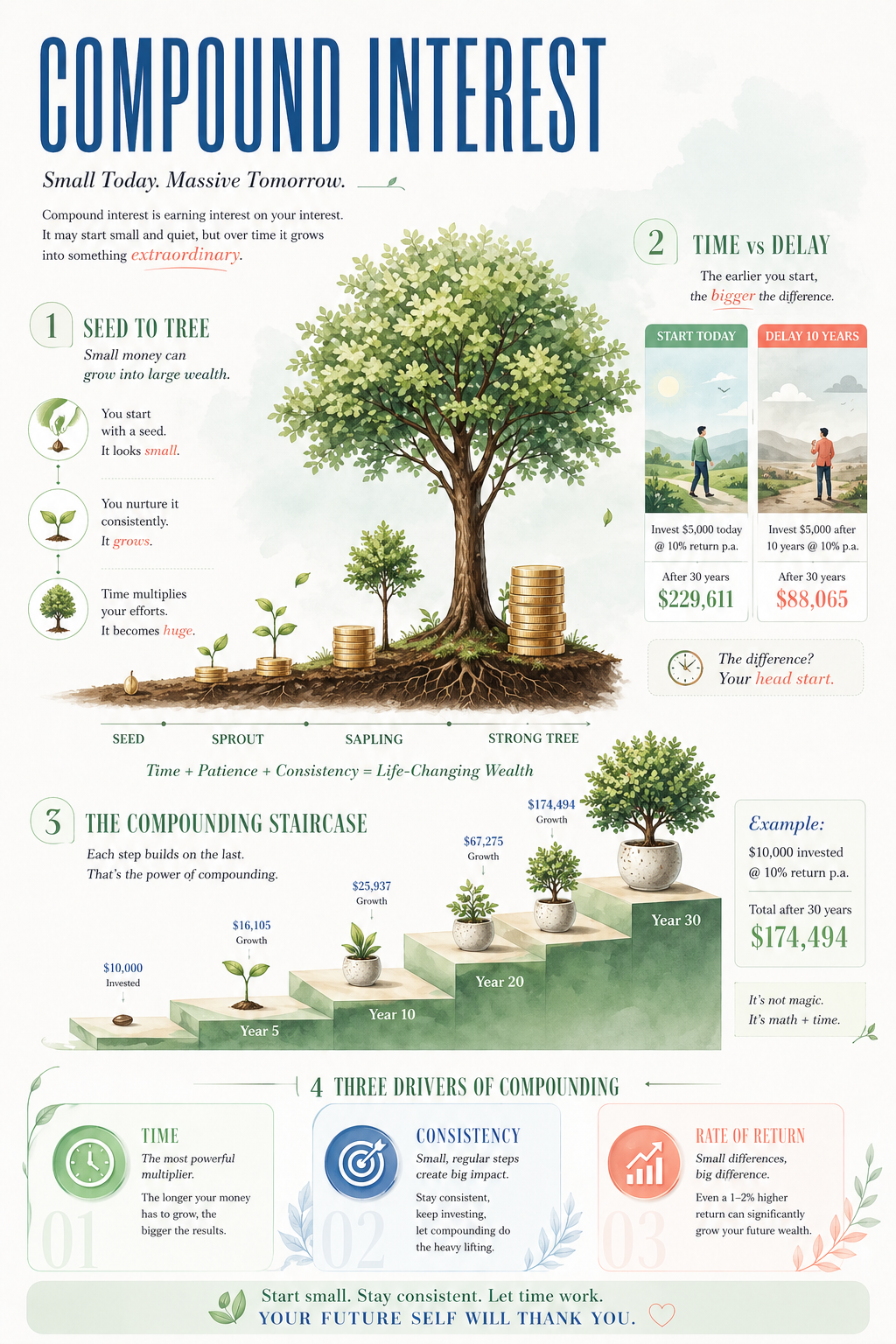
Compound interest is the process in which money earns returns, and those returns begin earning returns themselves. Unlike simple interest, where growth happens only on the original amount invested, compound interest allows growth to build on previous growth, which is why it can become powerful over time.
For example, if ₹10,000 earns 10% annually, after one year it becomes ₹11,000. In the second year, interest is calculated on ₹11,000 rather than the original ₹10,000. This process continues, causing growth to accelerate over long periods.
What makes compounding remarkable is that its power often comes less from large starting amounts and more from time and consistency. A person who begins investing small amounts early can often accumulate more than someone who invests larger sums but starts much later.
Three factors largely drive compound growth:
1. Time
The longer money stays invested, the more compounding layers build upon each other. Time is often the strongest contributor.
2. Consistency
Regular contributions can significantly increase long-term growth, even when the amounts are modest.
3. Rate of Return
Higher returns can accelerate compounding, though even moderate returns become meaningful over time.
Compound interest is often illustrated as a curve rather than a straight line because growth may seem slow initially and then increase rapidly later. This delayed acceleration is why people often underestimate its effect.
The principle of compounding also extends beyond finance. Skills improve through repeated practice, habits shape identity through repetition, and knowledge deepens through accumulated learning. In that sense, compounding reflects a broader principle: small gains repeated over time can lead to significant outcomes.
A useful takeaway is that compounding rewards patience more than intensity. Its strength lies not in dramatic action, but in steady accumulation.
 Continue With Google
  Account and Finance
 Education