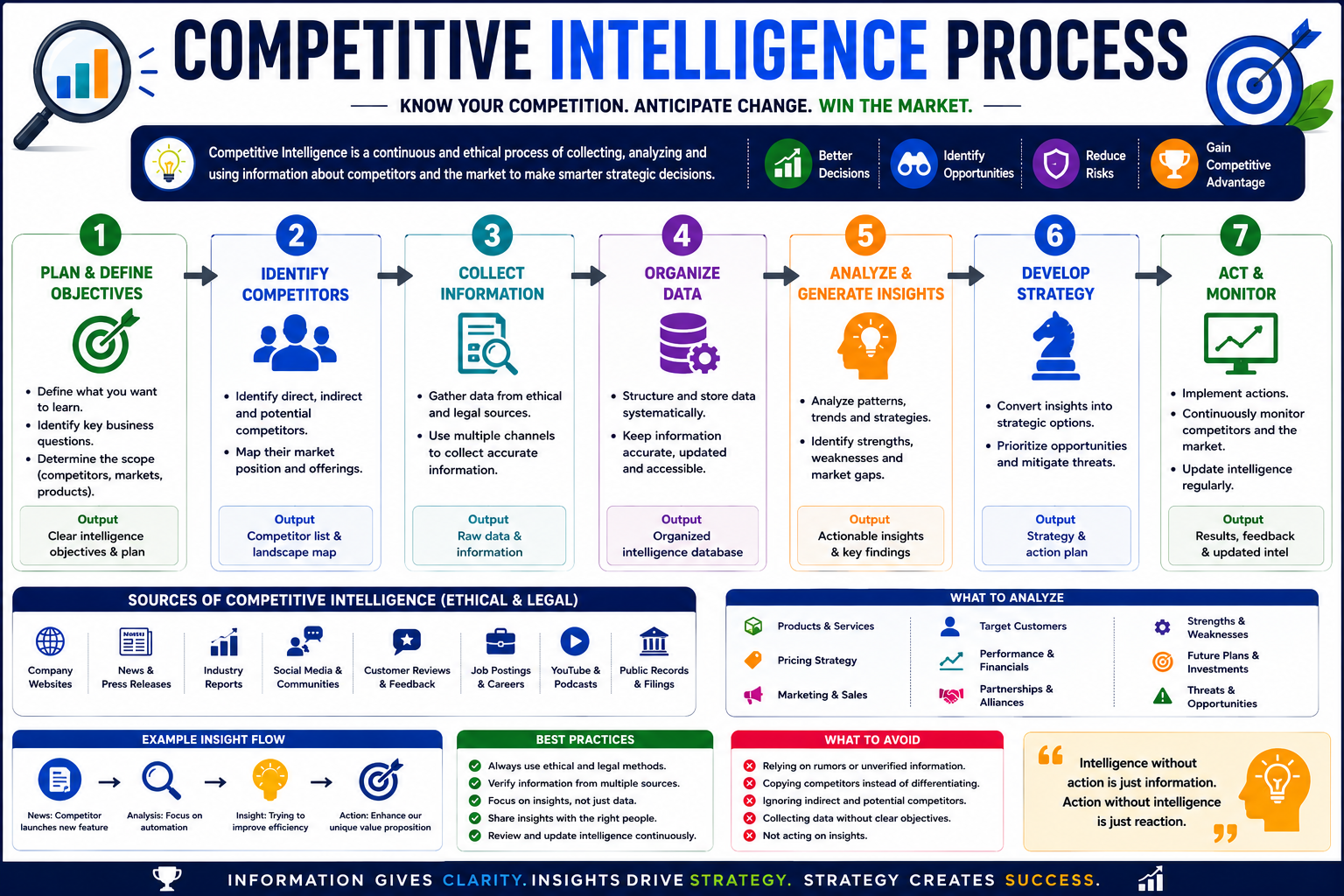
Competitive Intelligence (CI) is the process of:
Collecting Information
         ↓
Analyzing Competitors
         ↓
Finding Opportunities
         ↓
Making Better Decisions
Simply put:
Competitive Intelligence helps businesses understand competitors, customers, and market changes before making important decisions.
Imagine you are preparing for a cricket match.
Before the match, you study:
Opponent's Best Batsmen
Opponent's Best Bowlers
Pitch Conditions
Recent Performance
Weaknesses
This preparation increases your chances of winning.
Businesses do exactly the same thing.
Many businesses operate like this:
Build Product
      ↓
Launch Product
      ↓
Hope For Success
Smart businesses operate like this:
Study Market
      ↓
Study Competitors
      ↓
Identify Gaps
      ↓
Build Strategy
      ↓
Launch
Competitive Intelligence helps answer:
Who are our competitors?
What are they doing?
What are they doing well?
Where are they weak?
What opportunities exist?
How can we differentiate?
COLLECT
    ↓
ANALYZE
    ↓
INSIGHTS
    ↓
STRATEGY
    ↓
ACTION
    ↓
MONITOR
This cycle never stops.
Before collecting intelligence, identify competitors.
Solve the same problem.
Your Product
      ↓
Same Audience
      ↓
Same Solution
Solve the same problem differently.
Customer Need
       ↓
Different Solution
Not competing today but could enter tomorrow.
DIRECT
    ↓
INDIRECT
    ↓
POTENTIAL
Features
Pricing
Quality
Updates
Roadmap
Website
SEO
Content
Social Media
Ads
Campaigns
Offers
Discounts
Pricing Strategy
Sales Process
Reviews
Testimonials
Complaints
Ratings
Feedback
Partnerships
Investments
Hiring Trends
Expansion Plans
Company Websites
Customer Reviews
Social Media
Blogs
YouTube
Industry Reports
Job Postings
News Articles
Communities
Competitor Sources
        ↓
Raw Information
        ↓
Database
Most beginners make this mistake:
Collect Data
      ↓
Store Randomly
Better approach:
Competitor
     ↓
Category
     ↓
Insights
Competitor A
   ├─ Pricing
   ├─ Features
   ├─ Marketing
   ├─ Customers
   └─ Reviews
Raw data is not intelligence.
Analysis creates intelligence.
Example:
Competitor Reduced Price
is data.
But:
Competitor Reduced Price
          ↓
May Be Losing Market Share
is intelligence.
Data
 ↓
Pattern
 ↓
Insight
 ↓
Decision
Create a comparison table.
| Factor | Company A | Company B | Company C |
|---|---|---|---|
| Pricing | Low | Medium | High |
| Features | Medium | High | Medium |
| Brand | Strong | Medium | Weak |
| Support | Good | Average | Good |
This reveals positioning gaps.
Use a mini SWOT analysis for each competitor.
Strong Brand
Large Customer Base
Better Technology
Strong Distribution
Poor Support
High Prices
Complex Product
Slow Innovation
Competitor Strength
          ↓
Threat To Us

Competitor Weakness
          ↓
Opportunity For Us
This is where competitive intelligence becomes valuable.
Ask:
What are customers still unhappy about?
Example
Customers complain about:
Slow Delivery
Poor Support
Complicated Pricing
Opportunity:
Faster Delivery
Better Support
Simpler Pricing
Customer Complaint
        ↓
Market Gap
        ↓
Business Opportunity
Now convert insights into actions.
Don't Copy
Instead:
Differentiate
Competitor wins on:
Price
You may win on:
Quality
Experience
Convenience
Competitor Strength
         ↓
Avoid Direct Battle
         ↓
Differentiate
Competitive intelligence is not a one-time activity.
Markets change.
Competitors change.
Customers change.
Continuous Monitoring
Track
 ↓
Analyze
 ↓
Learn
 ↓
Adapt
 ↓
Repeat
Track:
Competitor Pricing
Competitor Features
Competitor Marketing
Customer Reviews
Industry News
New Product Launches
Hiring Trends
LAYER 1
Competitors
      ↓

LAYER 2
Products
      ↓

LAYER 3
Customers
      ↓

LAYER 4
Industry Trends
      ↓

LAYER 5
Strategic Insights
Important difference.
Legal and ethical.
Uses public information.
Websites
Reviews
Reports
News
Illegal or unethical.
Stealing Data
Hacking
Trade Secrets
Never do this.
Imagine an online education company.
Competitor Pricing
Customer Reviews
Features
Marketing Campaigns
Customers complain:
Complex Interface
Poor Customer Support
Create:
Simple Interface
Fast Support
Competitor Weakness
         ↓
Our Opportunity
Collect Information
         ↓
Analyze Information
         ↓
Generate Insights
         ↓
Improve Strategy
         ↓
Improve Product
         ↓
Gain Customers
         ↓
Collect More Information
         ↓
Repeat
Weekly:
Who are our biggest competitors?

What changed this week?

What new products were launched?

What are customers complaining about?

What market trends are emerging?

What opportunities are being ignored?

How can we differentiate?
Evaluate each competitor.
| Category | Score (1-10) |
|---|---|
| Product Quality | |
| Pricing | |
| Brand Strength | |
| Customer Support | |
| Innovation | |
| Marketing | |
| Customer Satisfaction |
This creates an objective comparison.
Copying Competitors
Competitor Does X
         ↓
We Copy X
This rarely creates advantage.
Ignoring Customer Feedback
Customers reveal competitor weaknesses.
Only Monitoring Features
Competitive intelligence is much broader.
Products
Customers
Market
Pricing
Brand
Strategy
all matter.
Collecting Data Without Analysis
Data
 ↓
No Insight
 ↓
No Action
creates no value.
Identify Competitors
         ↓
Collect Information
         ↓
Organize Information
         ↓
Analyze Patterns
         ↓
Identify Strengths
         ↓
Identify Weaknesses
         ↓
Find Market Gaps
         ↓
Develop Strategy
         ↓
Execute
         ↓
Monitor Continuously
STEP 1
List Competitors
        ↓
STEP 2
Track Products & Pricing
        ↓
STEP 3
Monitor Marketing Activities
        ↓
STEP 4
Analyze Customer Reviews
        ↓
STEP 5
Identify Strengths & Weaknesses
        ↓
STEP 6
Find Market Gaps
        ↓
STEP 7
Create Differentiation Strategy
        ↓
STEP 8
Monitor Continuously
        ↓
REPEAT FOREVER
Competitive Intelligence is not about obsessing over competitors.
It is about understanding:
Competitors
      +
Customers
      +
Industry Trends
      +
Market Gaps
to make smarter decisions.
The essence of Competitive Intelligence is:
Collect
   ↓
Analyze
   ↓
Learn
   ↓
Strategize
   ↓
Execute
   ↓
Monitor
The businesses that win are rarely the ones with the most information.
They are the ones that convert information into actionable insights faster and more effectively than everyone else.
 Continue With Google
  Economics
 Business

