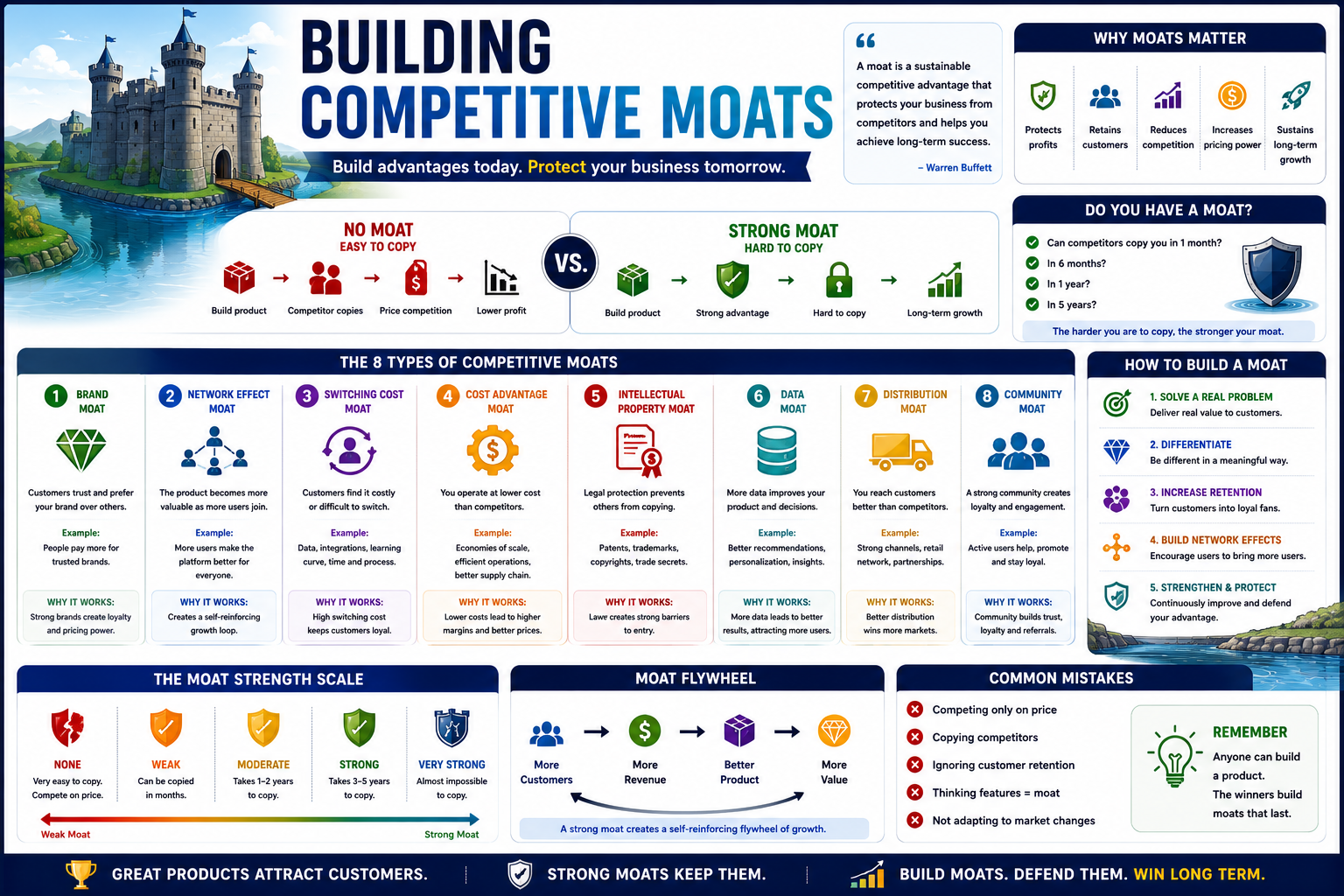
The term Competitive Moat became popular through:
Warren Buffett
A Competitive Moat is:
A sustainable advantage that protects a business from competitors.
Think of a medieval castle.
A castle survives because it has:
Castle
   ↓
Protective Moat
   ↓
Enemies Cannot Easily Attack
Business works similarly.
Business
   ↓
Competitive Moat
   ↓
Competitors Cannot Easily Copy
Without a moat:
Build Product
      ↓
Competitor Copies
      ↓
Price Competition
      ↓
Lower Profit
With a moat:
Build Product
      ↓
Strong Advantage
      ↓
Hard To Copy
      ↓
Long-Term Growth
A moat helps a business:
✅ Protect profits
✅ Retain customers
✅ Reduce competition
✅ Increase market share
✅ Sustain growth
A moat should answer:
Why can't competitors
easily copy us?
If the answer is:
They can copy us tomorrow
then you likely don't have a moat.
VALUE
  ↓
ADVANTAGE
  ↓
PROTECTION
  ↓
SUSTAINABILITY
The strongest companies usually have multiple moats.
Customers trust and prefer your brand.
When customers think:
This brand is reliable
they often pay more.
Brand Awareness
       ↓
Trust
       ↓
Preference
       ↓
Sales
Higher Pricing Power
More Customer Loyalty
Lower Marketing Cost
Customer
     ↓
Chooses Cheapest Option
Customer
     ↓
Chooses Trusted Brand
The product becomes more valuable as more users join.
More Users
     ↓
More Value
     ↓
More Users
     ↓
Even More Value
Communication platforms.
1 User
 ↓
Little Value

1000 Users
 ↓
Much More Value
Competitors must convince many users to leave simultaneously.
Very difficult.
Customers find it difficult to switch.
Example
Data
Integrations
Workflows
Training
Customer Uses Product
         ↓
Invests Time
         ↓
Builds Process
         ↓
Switching Becomes Difficult
High Switching Effort
          ↓
Customer Stays
Easy Switching
      ↓
Customer Leaves
Ability to operate at lower cost than competitors.
Lower Production Cost
          ↓
Lower Prices
          ↓
Competitive Advantage
Lower Costs
      ↓
Higher Margins
      ↓
More Investment
      ↓
Stronger Position
Scale
Automation
Supply Chain
Technology
Operational Efficiency
Legal protection.
Examples
Patents
Trademarks
Copyrights
Trade Secrets
Innovation
     ↓
Legal Protection
     ↓
Limited Competition
Competitors cannot legally copy certain innovations.
Accumulated data improves the business over time.
More Users
     ↓
More Data
     ↓
Better Product
     ↓
More Users
Recommendation systems.
The more users interact:
More Learning
      ↓
Better Recommendations
Ability to reach customers better than competitors.
Better Distribution
        ↓
More Customers
        ↓
More Revenue
Retail Network
Partnerships
Reseller Channels
Sales Teams
Even great products fail without distribution.
Customers form a community around the business.
Customers
    ↓
Community
    ↓
Relationships
    ↓
Loyalty
Trust
Engagement
Referrals
Retention
Most founders ask:
How do we get customers?
Better question:
Why will customers stay?
Create Value
      ↓
Deliver Value Better
      ↓
Build Advantage
      ↓
Protect Advantage
      ↓
Strengthen Advantage
No moat can compensate for:
No Customer Value
Flow
Problem
   ↓
Solution
   ↓
Customer Value
Ask:
Why are we different?
Differentiation Examples
Better Quality
Lower Cost
Faster Service
Unique Features
Retention creates moat.
Flow
Customer Value
       ↓
Repeat Usage
       ↓
Habit
       ↓
Loyalty
Encourage:
Users Bringing Users
Flow
More Users
      ↓
More Value
      ↓
More Users
Consistency creates trust.
Flow
Positive Experience
         ↓
Trust
         ↓
Loyalty
Ask:
Can competitors copy us in:

1 Month?
6 Months?
1 Year?
5 Years?
Easy To Copy
      ↓
Weak Moat
Difficult To Copy
      ↓
Strong Moat
The strongest businesses create self-reinforcing loops.
More Customers
       ↓
More Revenue
       ↓
Better Product
       ↓
More Value
       ↓
More Customers
A company may have:
Strong Brand
      +
Network Effect
      +
Data Advantage
      +
Community
This creates:
Multi-Layer Protection
Many people confuse these.
Current Advantage
Example:
Better Feature
Long-Term Protection
Example:
Feature + Brand + Network Effect
Advantage
    ↓
Protected
    ↓
Moat
Competing Only on Price
Lower Price
      ↓
Competitor Lowers Price
No moat.
Copying Competitors
Same Product
      ↓
Same Market
      ↓
No Protection
Ignoring Retention
Acquire Users
      ↓
Users Leave
Weak moat.
Thinking Features Are Moats
Most features can be copied.
Evaluate your business.
| Moat Type | Weak | Medium | Strong |
|---|---|---|---|
| Brand | |||
| Network Effect | |||
| Switching Costs | |||
| Data | |||
| Cost Advantage | |||
| Distribution | |||
| Community |
Identify Customer Problem
          ↓
Create Valuable Solution
          ↓
Differentiate
          ↓
Build Loyalty
          ↓
Create Network Effects
          ↓
Strengthen Brand
          ↓
Develop Switching Costs
          ↓
Improve Continuously
          ↓
Strengthen Moat
STEP 1
Solve Real Problem
         ↓
STEP 2
Create Unique Value
         ↓
STEP 3
Build Brand Trust
         ↓
STEP 4
Increase Retention
         ↓
STEP 5
Develop Network Effects
         ↓
STEP 6
Create Switching Costs
         ↓
STEP 7
Improve Continuously
         ↓
STEP 8
Protect Advantage
A Competitive Moat is not:
Having A Good Product
Many companies have good products.
A moat is:
A Sustainable Advantage
That Competitors
Cannot Easily Copy
The strongest businesses build multiple layers:
Brand
   +
Network Effects
   +
Switching Costs
   +
Data
   +
Community
   +
Distribution
The essence of a Competitive Moat is:
Create Value
      ↓
Protect Value
      ↓
Strengthen Value
      ↓
Sustain Growth
The wider the moat, the harder it becomes for competitors to take customers away, and the easier it becomes to achieve long-term success.
 Continue With Google
  Economics
 Business

