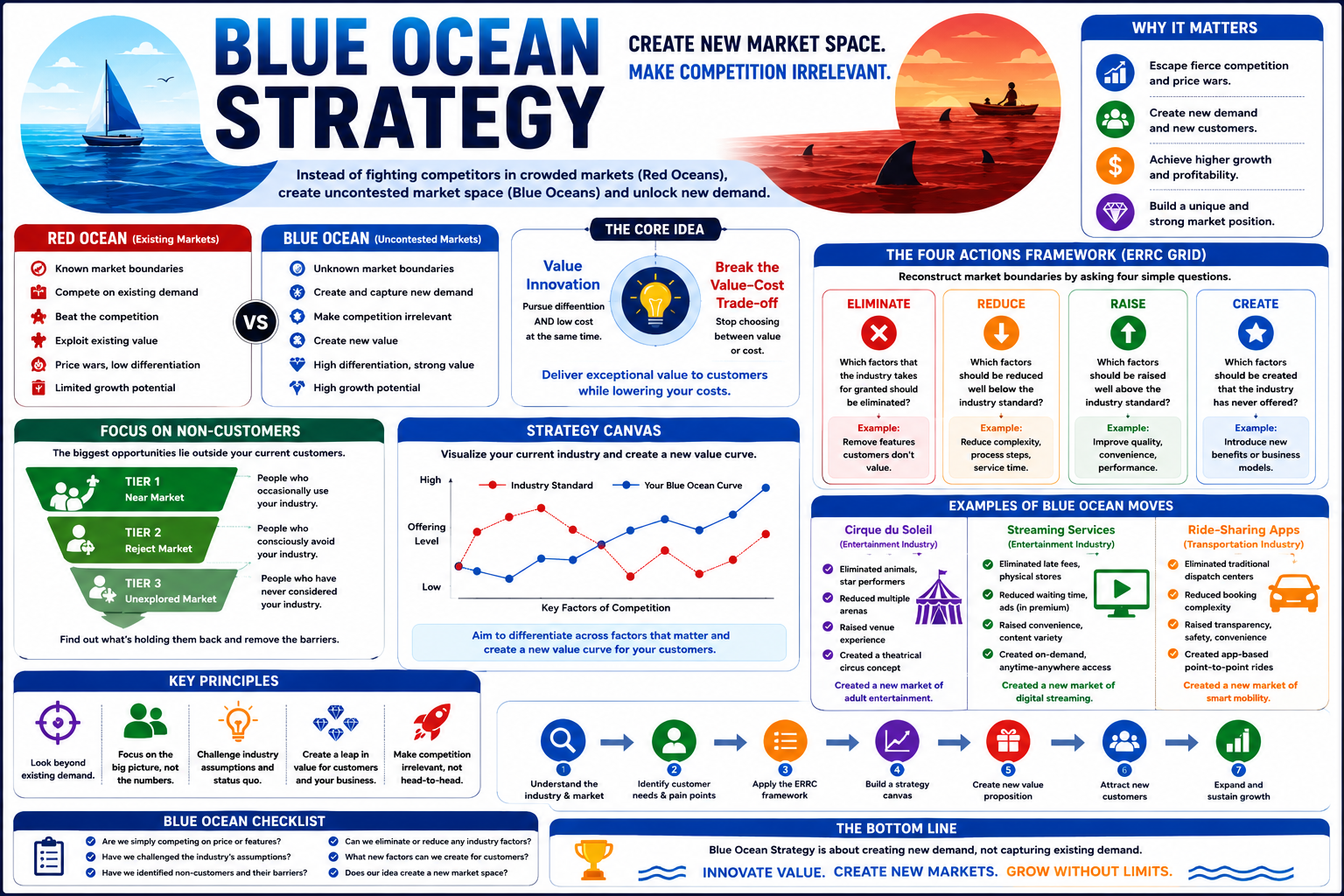
Blue Ocean Strategy is a business strategy developed by:
W. Chan Kim and Renée Mauborgne
The idea is simple:
Instead of competing in crowded markets, create a new market where competition becomes irrelevant.
Most businesses think:
Find Competitors
      ↓
Compete Harder
      ↓
Win Customers
Blue Ocean Strategy says:
Create New Value
        ↓
Create New Market
        ↓
Attract New Customers
Existing market.
Many competitors.
Everyone fights for customers.
Competitor A
      ⚔
Competitor B
      ⚔
Competitor C
      ⚔
Competitor D
Result:
Price Wars
Heavy Marketing
Lower Profit
Create a unique market space.
New Idea
    ↓
New Value
    ↓
New Customers
    ↓
Little Competition
Result:
Higher Profit
More Growth
Less Competition
Imagine two oceans.
Many Sharks
     ↓
Fighting For Food
     ↓
Water Turns Red
Symbolizes:
Competition
Price Wars
Crowded Markets
Open Ocean
     ↓
No Sharks
     ↓
Plenty Of Space
Symbolizes:
Innovation
New Markets
Growth Opportunities
Analyze Competitors
         ↓
Beat Competitors
         ↓
Gain Market Share
Analyze Customer Problems
           ↓
Create New Value
           ↓
Create New Market
Imagine opening a restaurant.
Another Pizza Shop
        ↓
Compete With 100 Pizza Shops
Create Healthy Personalized
Nutrition Meals For Busy Professionals
Now:
Different Market
Different Customers
Different Value
Blue Ocean Strategy is built on:
Most companies choose:
Low Cost
OR
High Value
Blue Ocean aims for:
Low Cost
    +
High Value
at the same time.
Increase Customer Value
          ↓
Reduce Business Costs
          ↓
Create New Market Space
Understand Industry
         ↓
Identify Industry Assumptions
         ↓
Challenge Assumptions
         ↓
Create New Value
         ↓
Attract New Customers
         ↓
Create Blue Ocean
One of the most important Blue Ocean tools.
Ask four questions.
Industry Standard Features
That Customers Don't Need
Example
Complicated Processes
Excessive Add-ons
Flow
Unnecessary Element
         ↓
Eliminate
         ↓
Lower Cost
Features Over-Served
By Industry
Example
Too Many Product Variants
Flow
Excessive Investment
          ↓
Reduce
          ↓
Efficiency
Customer Benefits
Example
Better Experience
Faster Delivery
Higher Convenience
Flow
Customer Pain Point
          ↓
Improve
          ↓
Higher Value
This is where Blue Oceans are born.
Example
New Service
New Experience
New Business Model
Flow
Unmet Need
      ↓
New Solution
      ↓
New Market
ELIMINATE
      ↓

REDUCE
      ↓

RAISE
      ↓

CREATE
Or:
E
R
R
C
Traditional Industry Focus:
Large Screens
Snacks
Movie Selection
Blue Ocean Thinking:
Ask:
What else do people want?
Possible innovation:
Interactive Experiences
Immersive Events
Social Entertainment
New value is created.
Most businesses focus on:
Existing Customers
Blue Ocean focuses on:
People Who Are Not Customers Yet
Traditional Thinking
Current Customers
       ↓
Sell More
Blue Ocean Thinking
Non-Customers
       ↓
Why Don't They Buy?
       ↓
Remove Barriers
People who occasionally use the industry.
Near Market
People who consciously avoid the industry.
Reject Market
People who never considered the industry.
Untapped Market
Current Customers
        ↓

Tier 1 Non-Customers
        ↓

Tier 2 Non-Customers
        ↓

Tier 3 Non-Customers
The largest growth often exists outside the current market.
A tool used in Blue Ocean Strategy.
Purpose:
Compare Industry Value
          vs
Your New Value
Flow
Industry Standards
        ↓
Identify Similarities
        ↓
Create Differentiation
Suppose all competitors compete on:
Price
Features
Advertising
You might compete on:
Convenience
Simplicity
Experience
creating a new value curve.
Unique Market
      ↓
Fewer Rivals
Unique Value
      ↓
Premium Pricing
New Market
      ↓
New Customers
Different
    ↓
Memorable
Market Education Required
New Concept
      ↓
Need To Educate Customers
Uncertain Demand
New Market
      ↓
Unknown Adoption
Imitation
Success
    ↓
Competitors Copy
| Factor | Red Ocean | Blue Ocean |
|---|---|---|
| Market | Existing | New |
| Competition | High | Low |
| Focus | Beat Rivals | Create Value |
| Customers | Existing | New + Existing |
| Pricing | Competitive | Often Premium |
| Growth Potential | Limited | High |
| Innovation | Incremental | Transformational |
STEP 1
Study Industry
        ↓
STEP 2
Identify Customer Frustrations
        ↓
STEP 3
Challenge Industry Assumptions
        ↓
STEP 4
Apply ERRC Framework
        ↓
STEP 5
Create New Value Proposition
        ↓
STEP 6
Target Non-Customers
        ↓
STEP 7
Launch New Market Space
        ↓
STEP 8
Continuously Innovate
Current Market
       ↓
Find Industry Rules
       ↓
Question Those Rules
       ↓
Remove Unnecessary Elements
       ↓
Improve Important Elements
       ↓
Create New Value
       ↓
Attract New Customers
       ↓
Build New Market
Customer Problems
         ↓
Value Innovation
         ↓
New Market Space
         ↓
New Customers
         ↓
Revenue Growth
         ↓
More Innovation
         ↓
More Market Space
         ↓
Repeat
Before launching a business or product, ask:
□ Are we simply copying competitors?

□ What assumptions exist in this industry?

□ What can we eliminate?

□ What can we reduce?

□ What can we raise?

□ What can we create?

□ Which non-customers are ignored?

□ What unique value can we offer?
Most businesses fight in:
Red Oceans
where competition is intense.
Blue Ocean Strategy encourages you to think differently:
Don't Fight For Market Share
            ↓
Create New Market Space
The essence of Blue Ocean Strategy is:
Value Innovation
        +
New Customer Demand
        +
Reduced Competition
        =
Blue Ocean
The companies that create the biggest opportunities are often not the ones that compete the hardest—they are the ones that redefine the market and make competition less relevant.
 Continue With Google
  Economics
 Business

