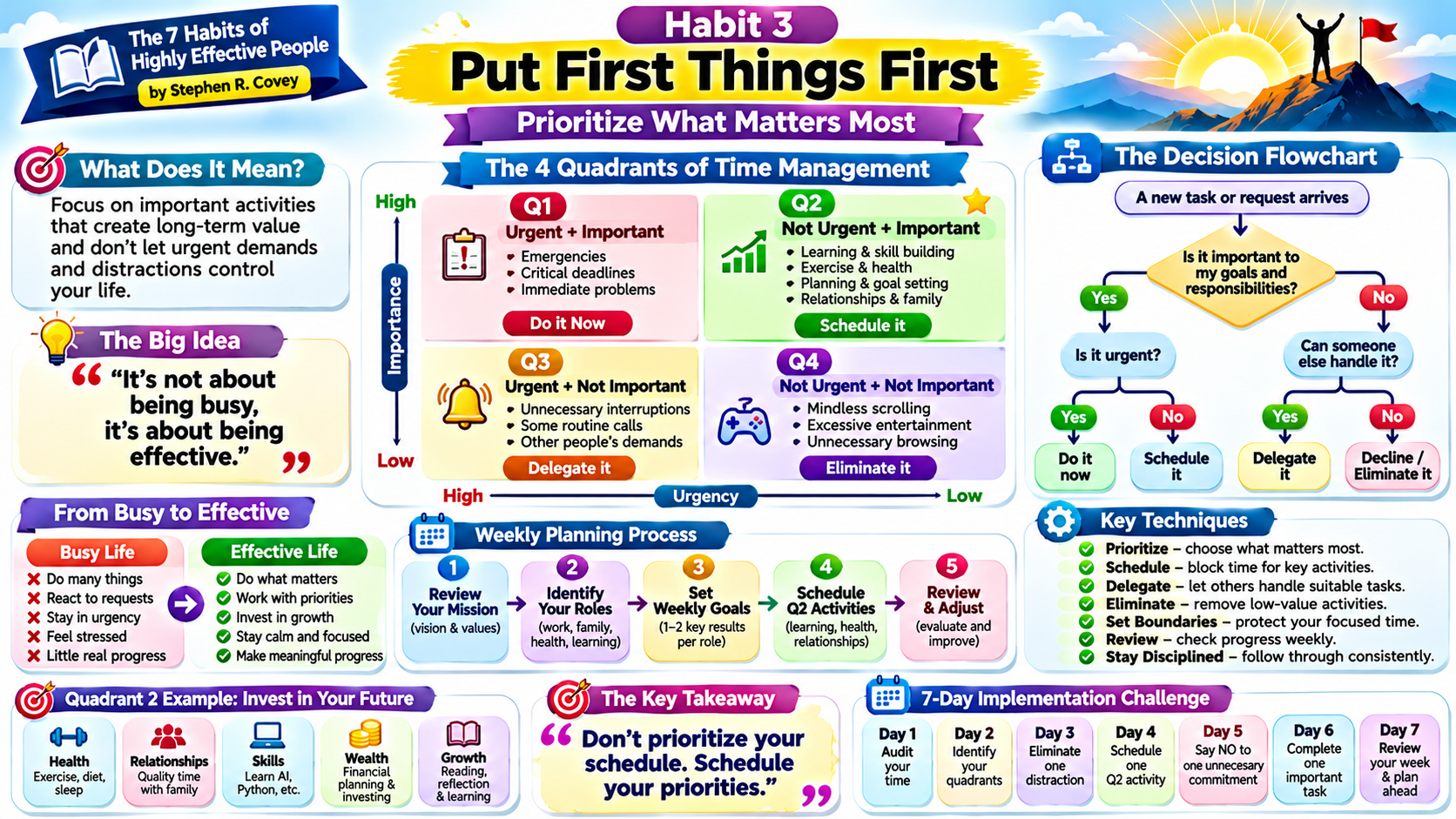
Based on Habit 3 from The 7 Habits of Highly Effective People by Stephen R. Covey.
The central message of this habit is:
Don't spend your entire life being busy. Spend your time doing what is truly important.
You may have 24 hours a day, just like everyone else. Yet some people consistently make progress towards their goals, while others remain busy without achieving much.
The difference is often not the amount of time available. It is how they prioritize their time.
Habit 3 teaches you how to turn your vision into action through discipline, prioritization and effective time management.
Imagine you have ten tasks to complete today.
Reply to WhatsApp messages.
Check emails.
Attend meetings.
Learn a new skill.
Exercise.
Spend time with family.
Work on your business.
Read a book.
Plan your finances.
Watch social media videos.
You cannot give equal attention to everything.
The important question is:
Which activities will make the biggest difference to my future?
Covey teaches us to prioritize important activities instead of allowing urgent activities to consume our entire day.
Doing many things without clear priorities.
Identify what is important and what can wait.
Invest time in activities that produce meaningful results.
This is one of the most valuable concepts in the entire book.
Covey divides our activities into four categories based on two factors:
Urgency: Does this require immediate attention?
Importance: Does this contribute significantly to my goals and values?
DO IT NOW
- Emergencies
- Critical deadlines
- Immediate problems
SCHEDULE IT
- Learning new skills
- Exercise and health
- Planning and relationships
DELEGATE IT
- Unnecessary interruptions
- Some routine calls
- Other people's avoidable demands
ELIMINATE IT
- Mindless scrolling
- Excessive entertainment
- Unnecessary browsing
Quadrant 1 — The necessity quadrant
These are activities that demand immediate attention and have significant consequences.
Examples:
Completing an important project deadline.
Handling a medical emergency.
Resolving an urgent customer issue.
Paying a bill before a penalty deadline.
Some Q1 activities are unavoidable.
However, if your entire life is spent in Q1, you will experience stress, pressure and exhaustion.
Quadrant 2 — The quality quadrant
This is where long-term success is developed.
Examples:
Learning AI and new technologies.
Building your business.
Exercising regularly.
Spending quality time with family.
Planning investments.
Developing meaningful relationships.
Reading and improving your knowledge.
These activities rarely demand immediate attention, but they have tremendous long-term value.
This is the quadrant you should deliberately protect.
Quadrant 3 — The deception quadrant
These activities appear urgent but are not necessarily important to your own priorities.
Examples:
Answering every phone call immediately.
Attending unnecessary meetings.
Responding to every notification.
Allowing other people's priorities to dominate your schedule.
Learn to delegate, postpone or set boundaries.
Quadrant 4 — The waste quadrant
These activities provide little meaningful value.
Examples:
Endless social media scrolling.
Watching random videos for hours.
Unnecessary internet browsing.
Repeatedly checking messages without purpose.
Relaxation is important, but mindless time consumption is different from intentional rest.
Covey emphasizes increasing the time spent in Quadrant 2.
Examples:
Exercise before health problems arise.
Learn before your skills become outdated.
Save before financial emergencies occur.
Build relationships before you need help.
Maintain systems before they break down.
Prevention and preparation reduce future crises.
Think about this:
If you consistently ignore exercise, you may eventually face health problems.
If you ignore skill development, you may struggle with career opportunities.
If you ignore financial planning, you may face financial stress.
Many important problems can be reduced through consistent Quadrant 2 activities.
One of the hardest skills in life is saying NO.
Every time you say YES to something, you are allocating your time and attention to it.
Consider:
Saying YES to unnecessary meetings means less time for important work.
Saying YES to endless entertainment means less time for learning.
Saying YES to every request means less time for your own priorities.
A powerful principle:
You must say NO to some good opportunities to make room for your most important opportunities.
A new task or opportunity arrives
Is it important to my goals and responsibilities?
Is it urgent?
Yes: Do it now.
No: Schedule it.
Does someone else need to handle it?
Yes: Delegate it.
No: Decline or eliminate it.
Covey's approach goes beyond conventional time management.
You cannot control every minute of your day, but you can manage your choices and commitments.
He emphasizes four generations of time management:
Generation | Approach |
|---|---|
1 | Notes and checklists |
2 | Calendars and scheduling |
3 | Priorities, goals and planning |
4 | Managing life through importance, relationships and results |
The fourth generation focuses on effectiveness rather than simply doing more tasks.
The objective is not to fill every minute.
The objective is to spend your time on what matters.
One of the most practical ways to implement Habit 3 is to plan your week rather than just reacting to each day.
Think about your different life roles:
Professional
Entrepreneur
Spouse
Parent
Family member
Learner
Individual responsible for health and well-being
Each role has important responsibilities.
Review your mission
Remember your long-term vision and values.
Identify your life roles
Professional, family, health, business and learning.
Set weekly goals
Choose one or two meaningful results for each important role.
Schedule Quadrant 2 activities
Reserve time for learning, health, planning and relationships.
Review and adjust
Evaluate your progress and make changes when needed.
Suppose you have a professional job, a business, family responsibilities and personal learning goals.
Your daily schedule could look like this:
Time | Activity | Priority |
|---|---|---|
6:00–6:30 AM | Exercise | Q2 |
6:30–7:00 AM | Reading and planning | Q2 |
7:00–9:00 AM | Family and personal routine | Q2 |
Work hours | Professional responsibilities | Q1/Q2 |
Evening | Family time | Q2 |
8:00–9:00 PM | Business development / AI learning | Q2 |
9:00–9:15 PM | Review tomorrow's priorities | Q2 |
This is an illustrative schedule, not a fixed prescription.
The lesson is to schedule important activities before your calendar gets filled by other demands.
Technique | Practical application |
|---|---|
Prioritize | Identify your top three important tasks. |
Schedule | Reserve time for important activities. |
Delegate | Let others handle appropriate tasks. |
Eliminate | Remove activities with little value. |
Set boundaries | Avoid unnecessary interruptions. |
Review | Evaluate progress every week. |
Be disciplined | Follow your priorities even when motivation is low. |
Let's convert the habit into your own routine.
1. Which areas deserve more attention?
Select the areas you want to prioritize.
2. How much time can you invest daily?
3. What is your most important commitment?
Create my weekly priority planYour 7-day challenge
Being busy does not mean being productive.
Important activities deserve scheduled time.
Don't allow urgent tasks to control your entire day.
Invest in health before illness forces you to.
Invest in learning before your skills become outdated.
Protect time for your family and relationships.
Learn to say NO without feeling guilty.
Eliminate unnecessary distractions.
Review your priorities every week.
Make your daily actions consistent with your long-term vision.
Knowledge check
1. Which quadrant contributes most to long-term personal growth?
2. You receive an unnecessary phone call while doing important work. What should you do?
3. What is the main objective of Habit 3?
Habit | What it teaches |
|---|---|
1. Be Proactive | I am responsible for my choices. |
2. Begin with the End in Mind | I know where I want to go. |
3. Put First Things First | I take action on what matters most. |
Together, these three habits create what Covey calls the foundation of Private Victory: developing personal independence and self-mastery.
 Continue With Google
 Motivation

