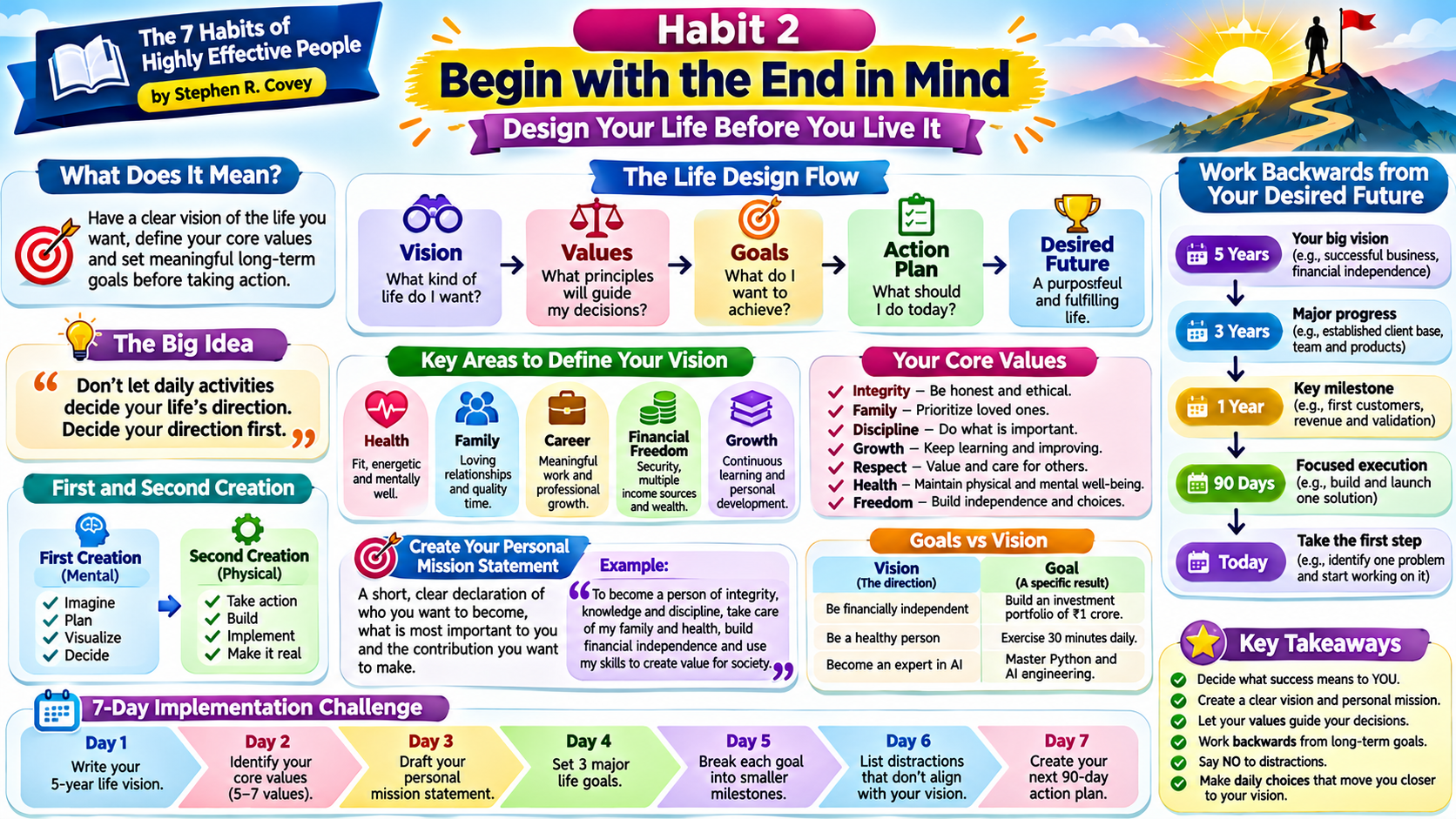
Based on Habit 2 from The 7 Habits of Highly Effective People by Stephen R. Covey.
The central message of this habit is:
Before starting any journey, know where you want to go. Before building your future, decide what you want that future to look like.
Many people work hard every day, but they never stop to ask whether they are moving in the right direction.
They are busy, but not necessarily purposeful.
Habit 2 teaches you to live with a clear vision, strong values and meaningful goals.
Imagine building a house.
Would you start purchasing bricks, cement and furniture without having an architectural plan?
Of course not!
First, you decide:
How many rooms do you need?
What should the house look like?
What is your budget?
Where should everything be placed?
Only then do you start construction.
Your life works in a similar way.
What kind of life do I want?
What principles will guide my decisions?
What do I need to achieve?
What should I do today?
A life built with purpose and direction.
The important point: Don't allow your daily activities to decide your life's direction. Decide your direction first.
One of Covey's most important ideas is that everything is created twice.
First creation: Mental creation
You imagine, visualize, plan and decide what you want.
Second creation: Physical creation
You take action and turn that vision into reality.
Consider this example:
You want to become a successful entrepreneur.
First creation | Second creation |
|---|---|
Imagine your company | Register and establish your company |
Visualize your product | Develop the product |
Plan your business model | Find customers |
Define financial targets | Generate revenue |
Imagine a successful team | Hire and develop people |
The formula
Mental creation gives direction. Physical creation produces results.
Without the first creation, you may spend years working hard on something that doesn't align with what you truly want.
Before deciding how much money you want, what position you want or which business you want to build, ask yourself a deeper question:
What kind of person do I want to become?
Think about these five areas of life.
1. Health and Fitness
Do I want to remain physically active?
What should my energy and fitness look like?
Am I taking care of my mental well-being?
2. Family and Relationships
What kind of spouse, parent and family member do I want to be?
How much quality time do I want to give my family?
What values do I want to teach my children?
3. Career and Business
What professional identity do I want?
What skills should I master?
What value do I want to create for society?
4. Financial Independence
What does financial freedom mean to me?
How much wealth do I want to build?
What income sources do I want?
5. Personal Development
What knowledge should I acquire?
How do I want to improve my confidence?
What kind of character do I want to develop?
Your values are the principles that guide your decisions.
Goals tell you where you want to go.
Values determine how you get there.
For example:
Value | What it means in practice |
|---|---|
Integrity | Never compromise honesty for money. |
Family | Give loved ones time and attention. |
Discipline | Do what needs to be done consistently. |
Growth | Never stop learning. |
Freedom | Build financial and personal independence. |
Respect | Treat people with dignity. |
Health | Protect your physical and mental well-being. |
You can earn money and achieve professional success, but if you compromise your values along the way, you may not feel successful.
Your values should guide your goals, not the other way around.
Covey recommends developing a personal mission statement.
Think of it as your personal constitution.
A constitution provides the principles by which a country is governed. Similarly, your personal mission statement provides principles by which you want to live.
It should answer:
Who do I want to become?
What is most important to me?
What contribution do I want to make?
How do I want people to remember me?
What principles will I never compromise?
I will continuously improve myself, take care of my health, provide a loving environment for my family, build financial independence through ethical work, and use my knowledge to create value for society.
My guiding principles:
Family • Integrity • Health • Learning • Financial Freedom • Contribution
This is only an example. Your own mission statement should reflect your personal beliefs and priorities.
Many people set goals but don't have a clear vision.
Let's understand the difference.
Vision | Goal |
|---|---|
Become financially independent. | Build an investment portfolio of ₹1 crore. |
Become an excellent professional. | Master Python and AI engineering. |
Have a healthy lifestyle. | Exercise 30 minutes daily. |
Build a successful business. | Acquire 10 paying clients. |
Become a great parent. | Spend one hour of quality time with your child daily. |
Vision provides direction.
Goals convert that direction into measurable outcomes.
Actions turn goals into reality.
This is one of the most practical ways to apply Habit 2.
Suppose your vision is to establish a successful AI business within five years.
Instead of asking, "What should I do today?" first define your desired destination.
Established AI business
Sustainable revenue and strong reputation
Established client base
Products, team and recurring clients
Market validation
First customers and successful projects
Build and launch
Develop one useful AI solution and find pilot customers
Take the first step
Identify one problem and build a solution
This example is illustrative, not a guaranteed business-growth timeline.
The key lesson is to connect today's activities with tomorrow's desired results.
Not every opportunity deserves your time.
Sometimes saying NO to a good opportunity is necessary to say YES to something more important.
For example:
Learning another random technology may distract you from mastering your primary skill.
Taking every business opportunity may prevent you from building one sustainable business.
Chasing higher income at the expense of family and health may conflict with your actual life vision.
Before accepting a new opportunity, ask:
Does this move me closer to the person I want to become?
If not, reconsider it.
Let's apply this habit rather than just reading about it.
Use the following exercise to create your own personal vision.
Write honestly. There are no right or wrong answers.
1. My identity
What kind of person do I want to become?
2. My family
What kind of family life do I want to create?
3. My career
What professional achievement do I want?
4. My financial future
What does financial freedom look like for me?
5. My health
What health and fitness standards do I want to maintain?
6. My contribution
How do I want to make a positive difference?
7. My personal mission statement
10. Seven-day implementation challenge
Day | Activity |
|---|---|
1 | Write your five-year life vision. |
2 | Identify your seven most important values. |
3 | Write your personal mission statement. |
4 | Define three major life goals. |
5 | Break each goal into smaller milestones. |
6 | Identify activities that distract you from your vision. |
7 | Prepare your next 90-day action plan. |
Never live your life without a direction.
Decide what success means to you.
Know your values before making important decisions.
Imagine your desired future before taking action.
Create a personal mission statement.
Work backwards from long-term goals.
Don't confuse being busy with making progress.
Learn to say NO to distractions.
Make daily decisions consistent with your long-term vision.
Build a life that you will be proud to look back on.
 Continue With Google
 Motivation

