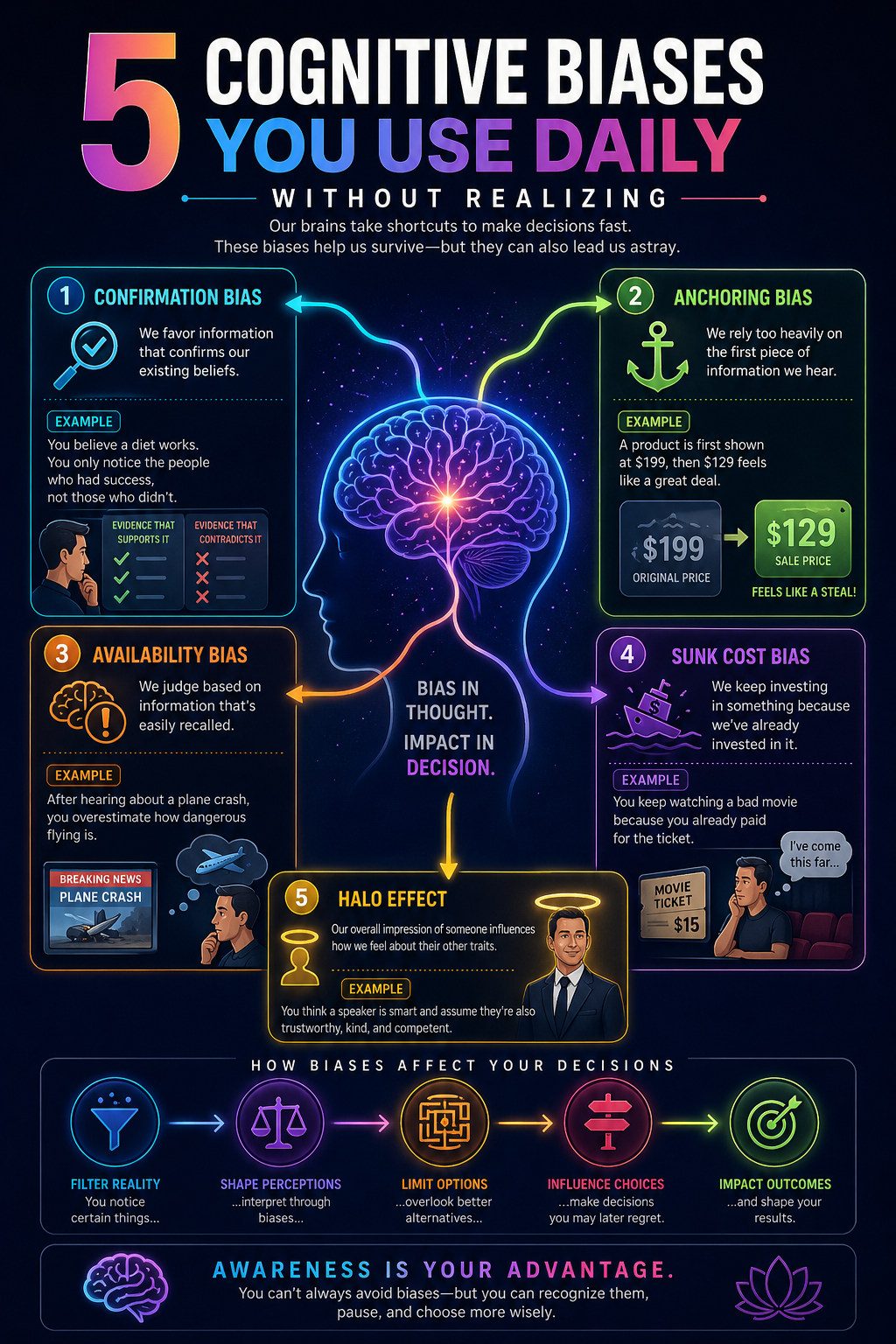
Your brain makes thousands of shortcuts every day.
Most of them help you move faster.
Some quietly distort how you think.
These distortions are called cognitive biases — mental shortcuts that can affect decisions, beliefs, relationships, and even how you judge yourself.
They are not flaws.
They are patterns.
Here are five common ones you may be using every day without noticing:
1. Confirmation Bias
You tend to notice information that supports what you already believe… and ignore what challenges it.
Example:
You think a coworker dislikes you, so you only notice moments that confirm it.
Lesson:
Sometimes what feels like proof is just selective attention.
2. Anchoring Bias
The first piece of information you hear strongly influences later judgment.
Example:
A product first shown at ₹10,000 makes ₹6,000 feel cheap, even if it isn’t.
Lesson:
First impressions often set invisible reference points.
3. Availability Bias
You judge likelihood by what comes to mind easily.
Example:
After hearing about plane crashes in the news, flying may feel more dangerous than it statistically is.
Lesson:
What feels common is not always what is common.
4. Sunk Cost Bias
You continue something only because you’ve already invested in it.
Example: Staying in a bad project or relationship because “I’ve already spent too much time.”
Lesson:
Past investment should not decide future decisions.
5. Halo Effect
One positive trait makes you assume other qualities are positive too.
Example: Someone confident may automatically seem more competent.
Lesson:
Charm can distort judgment.
🌱 Why this matters
Recognizing bias doesn’t make you irrational.
It makes you more aware.
Better decisions often begin not with more information —
but with noticing where thinking may be tilted.
 Continue With Google
  Science